| 2024 |
Critical Infrastructure Studies and Digital HumanitiesCategories Books Books
|
Category Publications
Publications| 2023 |
“Messages and Values in the Age of Machine Learning: From Postcards to Social Media”Categories Essays
|
Citation: Alan Liu, “Messages and Values ??in the Age of Machine Learning: From Postcards to Social Media,” Prace Kulturoznawcze 26, no. 4 (2023): 125–29, https://doi.org/10.19195/0860-6668.26.4.8.
- Excerpt (first paragraphs):
If Stanislaw Pietraszko were to update his essay “Messages and Values” today, would he write about social media instead of postcards?Superficially, the analogy between postcards and social media seems unavoidable. After all, Facebook, Twitter, Instagram, TikTok, and other social media transmit short messages of text, images, and/or videos characterized by the same feature that Pietraszko noticed distinguishes postcards from letters: “the public availability of the verbal text” (and other content). One can assume, then, that Pietraszko and other scholars of the “axiosemiotics” of the postcard such as Zdzislaw W?sik would today also wish to discuss social media forms whose “excessive” and “redundant” performativity (to use Pietraszko’s terms) make them objects not just of information but also, and often primarily, of culture. After all, the visual “filters” that users frequently apply to their Instagram or TikTok posts are perfect examples of such excess or redundancy. There is almost no informational and only cultural value, for instance, in making oneself look like a cat.Yet one doubts that Pietraszko would have been content with just a superficial comparison of postcards to social media. His theoretical analysis was systemic in its aims, focusing on postcards to formulate a general relation between “messages and values” based on the difference between the semiotic function of information and the axiological values of culture. One surmises that today Pietraszko would want to pursue the same kind of systemic analysis by looking deeper into the systems of information and culture behind social media—a level of analysis, however, that poses challenges to his axiosemiotic approach.
- Excerpt (last paragraph):
“Culture … is neither communication nor information,” Pietraszko wished to believe. But for those working in data science now, the challenge is that communication and information are saturated by cultural values that cannot be partitioned off. Reciprocally, for those working in cultural studies, the challenge is that cultural values increasingly are fused to the instrumental functions of communication and information (as when a “like” in social media is exploited by the system to promote an advertisement). Instrumental functions cannot be compartmentalized from values because in the final analysis the very concept of instrumentality or functionality (and its underlying logics of cause and effect) are changing. Functionalism now incorporates probabilistic operations of predictive modeling that—as technology companies like to say—“just work,” but work in semiotically non-understandable ways that perhaps most resemble how culture works.
| 2023 |
“What is Good Writing in the Age of ChatGPT?” (UC Santa Barbara)Categories Blog Essays
|
“What is Good Writing in the Age of ChatGPT?”, speech for English Department commencement ceremony, 18 June 2023.
- Full Text of Speech
What is good writing in the age of ChatGPT (which, as you know, is the most celebrated of the new generative artificial-intelligence tools based on large language models that can write prose, verse, and lies just like a human being)?That’s the question I call on you as graduating English majors to help society answer as you bring your skills in writing and speaking well — and in knowing well through language and its literatures — into the world….
| 2022 |
“Theses on Large Language Models and ‘Good’ Writing”Categories Blog Essays
|
Citation: “Theses on Large Language Models and ‘Good’ Writing” Alan Liu, 4 December 2022. doi:
The following was originally posted on Mastodon on December 3, 2022, in a series of eight posts (beginning at https://fosstodon.org/@ayliu/109451839640202878). In assembling the thread together here I have added a few links.
4 December 2022
1/8 As an English professor working in the digital humanities, my takeaway from ChatGPT (& large-language-model discourse generators in general) is that society will soon need to decide which values associated with “good” writing can and will be offloaded to LLMs so that the value added by humans can be shifted to a smaller or restructured spectrum of the functions of “good” writing for which humans can be recognized, rewarded, and held responsible.
| 2020 |
“Data Moves: Libraries and Data Science Workflows”Categories Essays
|
Citation:”Data Moves: Libraries and Data Science Workflows.” Libraries and Archives in the Digital Age. Ed. Susan Mizruchi. Cham: Palgrave Macmillan, 2020: 211-219.
- Abstract: Library-based collections and repositories are today advancing well beyond accumulating resources in digital form for the purposes of searching, reading, and other primary access. New advances toward treating collections as “always already data” facilitate next-generation computational uses of digitized materials—for example, treating collections as datasets for advanced datamining analysis.
In considering how library collections can serve as data for a variety of data ingestion, transformation, analysis, reproduction, presentation, and circulation purposes, it may be useful to compare examples of data workflows across disciplines to identify common data-analysis “moves” as well as points in the data trajectory that are especially in need of library support because they are for a variety of reasons brittle. Drawing on the precedent of so-called in silico science—which has had a ten-year start on developing methods and standards for tracking the provenance of data, annotating and visualizing data analysis workflows for reproducibility, and comparing data workflows in different fields—Liu argues that other disciplines such as the humanities and social sciences can exploit today’s library data collections in similar ways. The goal is twofold: first, open, shareable, and reproducible data scholarship, and second, higher or meta-level analysis of such scholarship. For example, might methods for comparing data workflows in the sciences (seeing, e.g., how astrophysics compares with medical science in using data) be extended across the disciplines to the digital humanities, digital arts, and digital social sciences? Beyond borrowing science data paradigms for other disciplines, Liu also thinks in the reverse direction. He draws on the twentieth-century tradition of literary and ethnographical analysis—for example, the idea of the narrative “motif” or “move” (in the Russian: mov)—to suggest that humanities and social science approaches to data workflows are just as crucial as scientific ones. After all, however one analyzes data (and in which field), one ultimately has to tell the story of that workflow and its results. That puts the problem squarely in the domain of narrative motifs and moves, which Liu argues can be matched to data workflow moves.
| 2020 |
“Toward a Diversity Stack: Digital Humanities and Diversity as Technical Problem”Categories Essays
|
Citation:“Toward a Diversity Stack: Digital Humanities and Diversity as Technical Problem.” PMLA 135.1 (2020): 130-151.
- DOI: 10.1632/pmla.2020.135.1.130.
- Open access (post-embargo published version in institutional repository, PDF) [TBD]
- Paywalled (published version, PDF)
- Abstract: How can the digital humanities help support humanities scholarship on diversity both ideologically and technically? This essay abandons the diversity paradigm prevalent in DH—the “big tent”—for a more technically functional one: the “stack.” It proposes that DH can create a “diversity stack” (conceptually like the “Internet protocol stack”) that combines technical and theoretical strategies for advancing scholarship on diversity. From low to high, crucial levels in such a stacked approach include technical methods for dealing with multilingualism, multimedia, unrepresentative corpora, geopolitical and temporal organizations of identity, and the theory of identity.
| 2018 |
Friending the Past: The Sense of History in the Digital AgeCategories Books
|
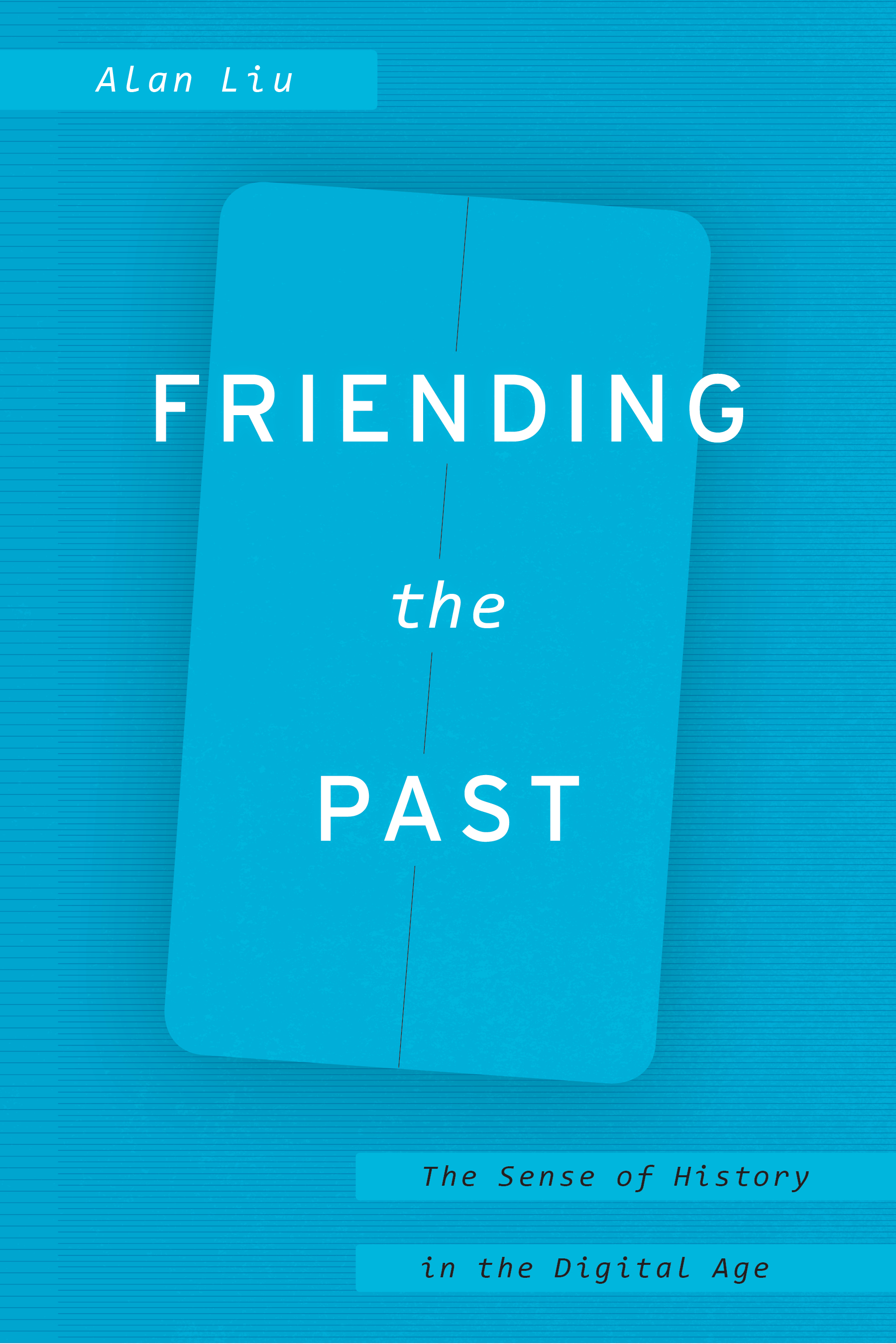
| Citation: Friending the Past: The Sense of History in the Digital Age. Chicago: University of Chicago Press, 2018.
[336 pages, 49 halftones, ISBN paperback: 9780226451954; E-book: 9780226452005]
|
|
/ excerpt » /
| 2018 |
“Digital Humanities Diversity as Technical Problem”Categories Blog Essays
|
Citation: “Digital Humanities Diversity as Technical Problem” Alan Liu, 15 January 2018. doi:10.5072/FK2222ZR81.
Update: A substantially expanded and revised version of this paper was published in 2020 as an article in PMLA titled “Toward a Diversity Stack: Digital Humanities and Diversity as Technical Problem.”
This paper was originally presented 5 January 2018 at MLA 2018, session 347 on “Varieties of Digital Humanities” (Twitter hashtags: #mla18, #s347). The original prompt to panelists (in an email from the organizers) was as follows: “The session corresponds with a planned 2019 special issue of PMLA on the same topic, and the talks at this panel may be published as an edited transcript…. Your talk would be about 10 minutes long, and we’d be interested in hearing your views on what’s next for digital humanities and/or what we can learn from what has come before.”The below version of my paper is revised to supply notes and to substitute links or references for slide images. Another change: two paragraphs elided at the live event due to lack of time–on “DH Re-imagination of Time-Space” and “Rhetorical DH”–are here included.
Clearly, there are further research directions for “digital humanities diversity as technical problem” to be explored beyond those I sketch here, but these are a beginning agenda.
15 January 2018
Our “Varieties of DH” panel addresses the methodological and social diversity of the digital humanities, in part by drawing on the digital humanities meme of the “big tent,” originally the declared theme of the international DH conference when it was held at Stanford University in 2011.[1] To quote the program description for our panel today, DH is “expansive, movable, but precarious, a tent still not big enough in terms of diversity and access.”[2]
The “big tent” metaphor, of course, comes down to us from old-timey showcases of mass experience such as nineteenth-century tent revivals and big-top circuses. Those were just two of the mass architectures, apparatuses, institutions, and (to use Foucault’s word) dispositifs whose paradoxically open and enclosed forms stage-managed the modernizing encounter (variously democratic, cultic, or fascist) between an older, affinity-based sense of the Volk and the newer awareness–at once enraptured, entertained, and appalled–of social, racial, linguistic, geopolitical, and even “special” in the sense of cross-species) variety.  Circuses, for example, were spectacles of variety. As advertised in a nineteenth-century Barnum & Bailey poster, they are “a glance at the great ethnological congress” and also menagerie of “curious . . . animals.”[3] We can add earlier and later examples to the catalogue of paradoxically open/closed, inclusive/exclusive variety–for instance, the French Revolutionary Champs de Mars, whose remaking for the 1790 Fête of Federation famously convened Parisians both low and high[4]; Albert Speer’s “cathedral of light” (Lichtdom) ringed by searchlights at the Nuremberg Nazi rallies; and today’s conceptual architecture of “open source” programming (not the “cathedral,” Eric Raymond memorably said, but the “bazaar”).[5]
What’s next for DH? I think what’s next is finally to put the “big tent” metaphor to rest. We need new paradigms and dispositifs or, in computer-speak, platforms for diversity that move the modern democratic paradox of open and closed (inclusive and exclusive) beyond nineteenth- and early-twentieth-century paradigms of mass “variety,” beyond the mid- to late-twentieth-century scientizing of such variety as statistical socioeconomics, and likely also beyond current “bags of words” cultural analytics approaches, which bring up the rear with topic models and other congregations of language standing in for the big tent (or bag) of mass human experience.
Among other things, in other words, diversity is a technical problem….
| 2017 |
“Teaching ‘Literature+’: Digital Humanities Hybrid Courses in the Era of MOOCs”Categories Essays
|
Citation:“Teaching ‘Literature+’: Digital Humanities Hybrid Courses in the Era of MOOCs.” Teaching Literature: Text and Dialogue in the English Classroom. Ed. Ben Knights. London: Palgrave Macmillan, 2017: 133-153.
| 2017 |
“Assessing Data Workflows for Common Data ‘Moves’ Across Disciplines”Categories Blog Essays
|
Citation: “Assessing Data Workflows for Common Data ‘Moves’ Across Disciplines” Alan Liu, 6 May 2017. doi: 10.21972/G21593.
This is a slightly revised version of my position paper for the “Always Already Computational: Collections as Data” Forum, UC Santa Barbara, March 1-3, 2017. (The original version is included among a collection of such position statements by participants in the conference.) A further revised version was later published as “Data Moves: Libraries and Data Science Workflows,” in Libraries and Archives in the Digital Age, ed. Susan L. Mizruchi (Cham: Palgrave Macmillan, 2020), 211–19, https://doi.org/10.1007/978-3-030-33373-7_15.
6 May 2017
In considering how library collections can serve as data for a variety of data ingest, transformation, analysis, reproduction, presentation, and circulation purposes, it may be useful to compare examples of data workflows across disciplines to identify common data “moves” as well as points in the data trajectory that are especially in need of library support because they are for a variety of reasons brittle.
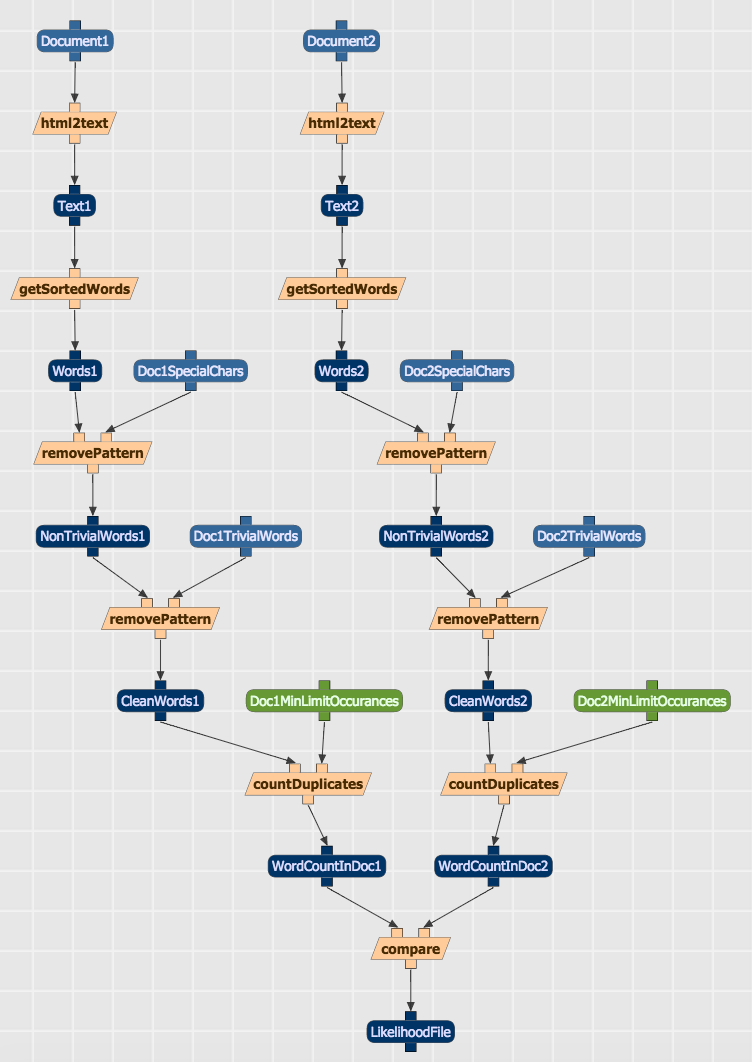
Fig. 1 – Example of data workflow visualized in the Wings workflow system (from the Wings tutorial)
We might take a page from current research on scientific workflows in conjunction with research on data provenance in such workflows. Scientific workflow management is now a whole ecosystem that includes integrated systems and tools for creating, visualizing, manipulating, and sharing workflows (e.g., Wings, Apache Taverna, Kepler, etc.). At the front end, such systems typically model workflows as directed, acyclic network graphs whose nodes represent entities (including data sets and results), activities, processes, algorithms, etc. at many levels of granularity, and whose edges represent causal or logical dependencies (e.g., source, output, derivation, generation, transformation, etc.) (see fig. 1). Data provenance (or “data lineage” as it has also been called in relation to workflows) complements that ecosystem through standards, frameworks, and tools–including the Open Provenance Model (OPM) the W3C’s PROV model, ProvONE, etc. Linked-data provenance models have also been proposed for understanding data-creation and -access histories of relations between “actors, executions, and artifacts.” In the digital humanities, the in-progress “Manifest” workflow management system combines workflow management and provenance systems. . . .
| 2016 |
“Hacking the Voice of the Shuttle: The Growth and Death of a Boundary Object”Categories Essays
|
Citation:”Hacking the Voice of the Shuttle: The Growth and Death of a Boundary Object.” Social Media Archeology and Poetics. Ed. Judy Malloy. Cambridge, MA: MIT Press, 2016: 261-271.
- Full text (open-access author’s pre-copy-edited final version in institutional repository, PDF)
| 2016 |
“Is Digital Humanities a Field? — An Answer from the Point of View of Language”Categories Essays
|
Citation:“Is Digital Humanities a Field? — An Answer from the Point of View of Language.” Journal of Siberian Federal University: Humanities and Social Sciences 7 (2016): 1546-1552.
| 2016 |
“N + 1: A Plea for Cross-Domain Data in the Digital Humanities”Categories Essays
|
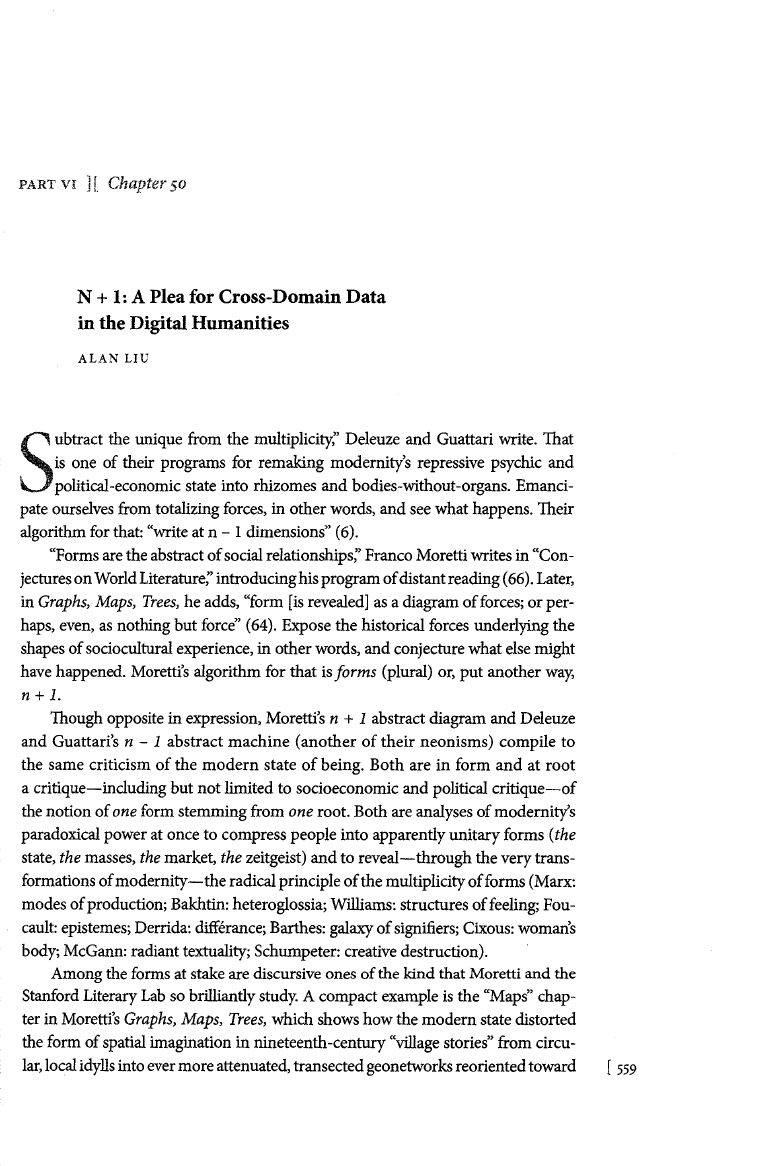
First page
Citation:”N + 1: A Plea for Cross-Domain Data in the Digital Humanities.” Debates in the Digital Humanities 2016. Ed. Matthew K. Gold and Lauren F. Klein. University of Minnesota Press, 2016: 559-568.
- Open-access full text (published version)
| 2016 |
Drafts for Against the Cultural Singularity (book in progress)Categories Blog Essays
|
Citation: “Drafts for Alan Liu, Against the Cultural Singularity (book in progress.” Alan Liu, 2 May 2016. https://liu.english.ucsb.edu/drafts-for-against-the-cultural-singularity
Excerpt
The following is draft work (notes and bibliography not included) from one of my books in progress tentatively titled Against the Cultural Singularity: Digital Humanities & Critical Infrastructure Studies. Excerpted are a few portions from the beginning of the manuscript that bear on the critical potential of the digital humanities and critique.
For a talk including this material as well as additional excerpts from my book in progress, see the video recording of my contribution to the Workshop on “Frontiers of DH: Humanities Systems Infrastructure,” University of Canterbury, 12 November 2015 (delivered as part of a series in New Zealand during my Fulbright Specialist residency at U. Canterbury, October-November, 2015.)
2 May 2016
My aim in this book is to make a strategic intervention in the development of the digital humanities. Following up on my 2012 essay, “Where is Cultural Criticism in the Digital Humanities?”, I call for digital humanities research and development informed by, and able to influence, the way scholarship, teaching, administration, support services, labor practices, and even development and investment strategies in higher education intersect with society, where a significant channel of the intersection between the academy and other social sectors, at once symbolic and instrumental, consists in shared but contested information-technology infrastructures. I first lay out in the book a methodological framework for understanding how the digital humanities can develop a mode of critical infrastructure studies. I then offer a prospectus for the kinds of infrastructure (not only research “cyberinfrastructures,” as they have been called) whose development the digital humanities might help create or guide. And I close with thoughts on how the digital humanities can contribute to ameliorating the very idea of “development”–technological, socioeconomic, and cultural–today.
Method (1)
The first step–framing for the digital humanities a suitable methodological framework for critical digital infrastructure studies–is challenging, given that the digital humanities are maturing after the late twentieth-century bloom of humanities “theory” and “cultural criticism,” which I here group together (grosso modo) under the name “critique”. . . .
| 2015 |
“Hello (again), world!”Categories Blog Essays
|
Citation: “Hello (again), world!.” Alan Liu, 4 October 2015. https://liu.english.ucsb.edu/hello-again-world/
This is the inaugural message I posted to the new “digital-humanities@lsmail.ucsb.edu” listserv at UC Santa Barbara, which I started in October 2015. The posting was made on 4 October 2015.
Excerpt
Hello (again), world!
“Hello, world!” is the customary first output for a beginner trying out a programming language. At UC Santa Barbara, many of us were saying hello, world! to the digital humanities as early as the start of the 1990s, though the name for the field had not yet been invented….
So, the underlying question that motivates me to start this digital humanities listserv now in 2015—some 20 years after we all began the great digital adventure at UCSB—is: what next? How can we exploit our advantage as early movers in the field (and in the related social science, arts, and other digital fields whose collaboration with the humanities is part of the longtime DNA of digital studies on campus) in a way that builds the next generation of digital humanities at UCSB? For example, would it be possible to exploit our unique strengths by creating a unified intellectual agenda—supported by publications, conferences, curricula, etc.—for the “digital humanities” and “new media studies”? (That unified framework doesn’t really exist yet nationally or internationally. I am amazed at how many scholars, artists, social scientists, and engineers I know working on new media or network studies with whom I have no opportunity to collaborate in conferences, co-editions, journal venues, courses, or institutional programs because such apparatus now tends to be either for “digital humanities” in a narrow sense or for “new media studies.”)
| 2015 |
“How Public Media in the U.S. and U.K. Compare in Their Terminology For the Humanities”Categories Blog Essays
|
Citation: Research Report: ”How Public Media in the U.S. and U.K. Compare in Their Terminology For the Humanities.” WhatEvery1Says Project, 4Humanities.org. (3 August 2015), DOI: 10.5072/FK2FN18G5G
Excerpt
While assembling a study corpus of public discourse in English about the humanities (since about 1990 when newspapers began fully digitizing articles), the 4Humanities “WhatEvery1Says” Project (WE1S) encountered the following questions of linguistic usage:
- How are the humanities referred to in newspapers, magazines, and other media in the U.S. compared to the U.K. (and other Commonwealth nations)? Especially, what from a comparative perspective is the overlap/difference between the terms “humanities,” “liberal arts,” “arts,” and “the arts”?
- Do the proportions of such terms change over time in each nation?
- Most practically, which terms (“humanities,” “liberal arts,” “arts,” and “the arts”) should the WE1S project use for searches in newspaper API’s and other resources as it locates texts for its corpus? (Since public discourse in newspapers, magazines, and other media is too ample to be collected in toto, WE1S aims to collect just what might be called the “neighborhood” of discussion of the humanities. The project will then apply text analysis methodology to this neighborhood to refine its understanding of the way the humanities are discussed.)
The following is a preliminary study focused on comparing linguistic usage in the U.S. and U.K. It is conducted by Alan Liu with assistance from other members of the WE1S research team and the co-leaders of 4Humanities.org. The study will be extended and revised as WE1S research continues.
| 2015 |
“Humanities in the Digital Age” (with William Thomas III)Categories Essays
|
First page
Citation: Liu, Alan, and William G. Thomas III. “Humanities in the Digital Age.” Between Humanities and the Digital. Ed. Patrik Svensson and David Theo Goldberg. Cambridge, MA: MIT Press, 2015: 45-40.
| 2014 |
“The Big Bang of Online Reading”Categories Essays
|
First page
Citation:”The Big Bang of Online Reading.” Advancing Digital Humanities: Research, Methods, Theories. Ed. Paul Longley Arthur and Katherine Bode. Palgrave Macmillan, 2014: 274-90.
- DOI of book: 10.1057/9781137337016
- Full text (open-access author’s pre-copy-edited final version in institutional repository, PDF)
| 2014 |
“Theses on the Epistemology of the Digital: Advice For the Cambridge Centre for Digital Knowledge”Categories Blog Essays
|
Citation: “Theses on the Epistemology of the Digital: Advice For the Cambridge Centre for Digital Knowledge.” Alan Liu, 14 August 2014. https://liu.english.ucsb.edu/theses-on-the-epistemology-of-the-digital-page
Excerpt
The following was written as a solicited follow-up to my participation in the second planning consultation session of the new Cambridge University Centre for Digital Knowledge. The session, held on 7 May 2014 at the Cambridge Centre for Research in the Social Sciences and Humanities (CRASSH), focused on “digital epistemology,” one of the two intended thematic strands of the Centre for Digital Knowledge. A previous planning consultation at CRASSH that I did not attend focused on the other intended strand of “digital society.”
My theses below are meant more as provocation than as prescription; and they do not take account of plans that may have been put in place for the Center for Digital Knowledge since the planning consultations.
Thesis 1: Enlightening the Digital
Establishing a Centre for Digital Knowledge oriented around the “epistemology of digital knowledge” will require a laser-sharp focus on making “knowledge” a productive framework for understanding the digital age. This framework must be robust enough to compete with such more common gestalts as “society,” “politics,” “culture,” and “economy” (represented in such phrases as “information society,” ‘”surveillance society,” “social media,” “online culture,” “information economy,” etc.). The proposed Centre for Digital Knowledge can generate its agenda by deliberately harnessing the tension between knowledge (including ideals of academic knowledge shaped by the German research university model and the Enlightenment) and social, cultural, and economic understandings of the digital age….
| 2014 |
Helen TartarCategories Other Writings
|
5 March 2014
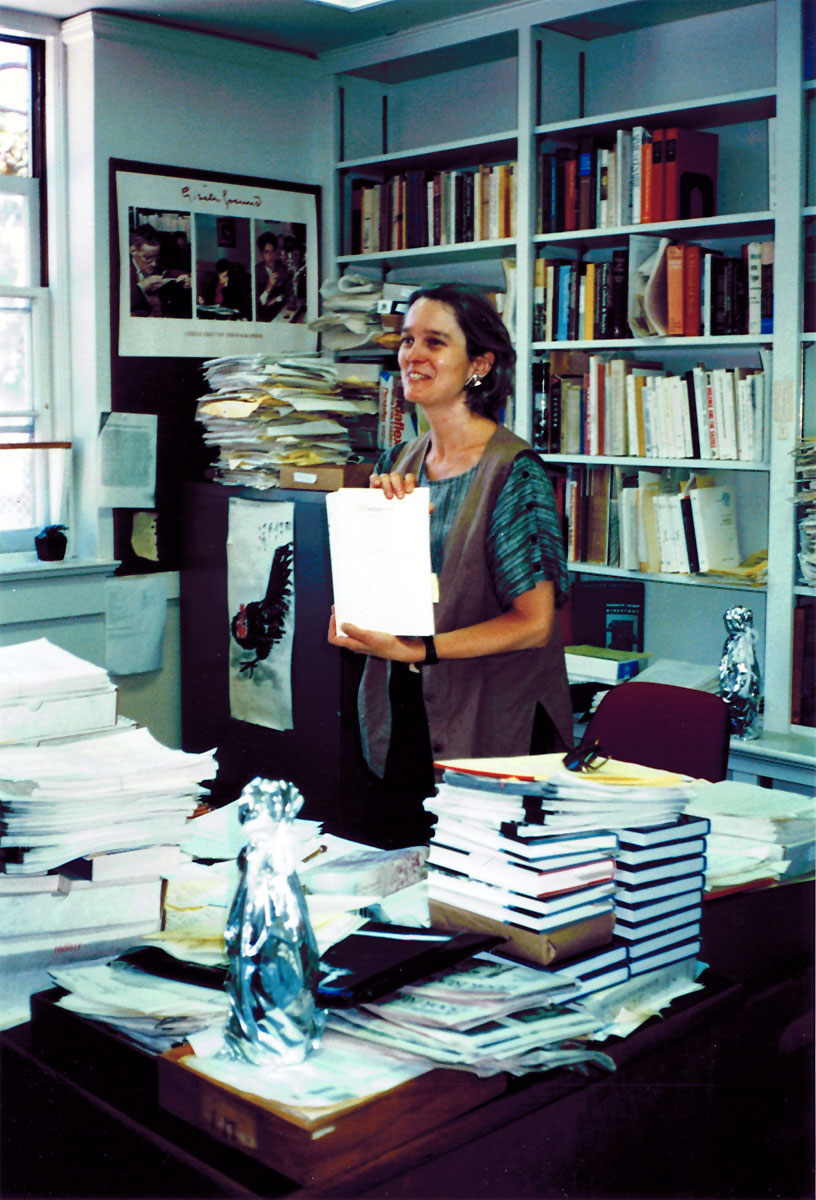
My friend and first editor, Helen Tarter — Editorial Director of Fordham University Press and formerly editor at Stanford University Press — died in a car accident on March 4th, 2014. (Fordham UP announcement) Helen was a formative influence on my writing and career who took a gamble on my sprawling first book Wordsworth: The Sense of History (Stanford UP, 1989) and nurtured it into print. I will always remember her support, the discipline she inspired rather than required, and the fluid, sparkling stream of her conversation (carried out in a voice so soft that I hear it in my mind whenever I reread Wordsworth’s “Nutting” and come to the line on “the murmur, and the murmuring sound”).
The following is excerpted from the beginning of the Acknowledgments in my second book (my first book “after Helen”):
/ excerpt » /
| 2013 |
“Reengaging the Humanities” (aModern interview)Categories Essays , Interviews
|
Citation: Scott Pound and Alan Liu, “The Amoderns: Reengaging the Humanities — A Feature Interview with Alan Liu.” aModern, 2 (2013). https://amodern.net/article/the-amoderns-reengaging-the-humanities/
| 2013 |
“‘Why I’m In It’ x 2 — Antiphonal Response to Stephan Ramsay on Digital Humanities and Cultural Criticism”Categories Blog Essays
|
Citation: “‘Why I’m In It’ x 2 — Antiphonal Response to Stephan Ramsay on Digital Humanities and Cultural Criticism.” Alan Liu, 13 September 2013. https://liu.english.ucsb.edu/why-im-in-it-x-2-antiphonal-response-to-stephan-ramsay-on-digital-humanities-and-cultural-criticism/
Excerpt
i. Prelude
On January 7, 2011, Stephen Ramsay and I both participated in the memorable panel at the Modern Language Association convention in Los Angeles entitled “The History and Future of the Digital Humanities.” We both launched on that day controversial theses about the digital humanities by asking leading questions. Steve asked, “Do you have to know how to code [build, make]?”, and I asked, “Where is cultural criticism in the digital humanities?”
Now, two and a half years on, we have (virtually) converged again at the intersection between questions about the nature of the digital humanities field and questions about its relation to cultural criticism. . . .
| 2013 |
“The Meaning of the Digital Humanities”Categories Essays
|
First page
Citation: “The Meaning of the Digital Humanities.” PMLA 128 (2013): 409-23.
- DOI: 10.1632/pmla.2013.128.2.409.
- Open access (post-embargo published version in institutional repository, PDF)
- Paywalled (published version, PDF)
 Video of lecture at New York University (May 1, 2013) based on fuller version of the paper subsequently published in PMLA. (1 hr. 47 min.)
- Translation of essay: “¿Qué significación tienen las humanidades digitales para las humanidades?”, Revistes científiques de la Universitat de Barcelona, no. 23 (2020).
/ excerpt » /
| 2013 |
“The Digital Humanities and Identity Issues”Categories Blog Essays
|
Citation: “The Digital Humanities and Identity Issues.” Alan Liu, 11 May 2013. https://liu.english.ucsb.edu/the-digital-humanities-and-identity-issues/
Excerpt
I think that the distinctive identity issue to address in considering “the intermingling of race, class, gender, sexuality and disability and the digital humanities” is the political economy of digital-human identity today. Such identity consists in a relational set of overlaps and differences between at least two [groups] of the digital human: those who stand in the position of producers or managers of the technologies and media that shape life in the information age, and those whose “power of identity” (to use Manuel Castells’s term from his trilogy about network society) is shaped by or against those technologies and media without having direct access to producing or managing them. . . .
| 2013 |
“Is Digital Humanities a Field? — An Answer From the Point of View of Language”Categories Blog Essays
|
Citation: “Is Digital Humanities a Field? — An Answer From the Point of View of Language.” Alan Liu, 6 March 2013. https://liu.english.ucsb.edu/is-digital-humanities-a-field-an-answer-from-the-point-of-view-of-language/
Excerpt
Over the past few years, I have wrestled with a low-level set of usage and style problems when publishing essays related to digital-humanities issues. These may be put in the form of the two questions: is “digital humanities” singular or plural? and should we crown the phrase with the definite article (“the digital humanities”)?
Of course, these are prosaic questions. But the issues they represent have the unsettling habit of showing up in the most prominent places, such as in the title of an essay I have forthcoming in The Changing Profession section of PMLA. Where my manuscript originally read, “The Meaning of Digital Humanities,” my copy editor has revised to,”The Meaning of the Digital Humanities.” Nor is it just in prominent places that the issues appear. Usage problems of this sort are pervasive to the point that my manuscripts on [the] digital humanities tend to be sprinkled throughout with innumerable tiny problems at the low level of articles and subject-verb agreements. . . .
| 2013 |
“Friending the Humanities Knowledge Base: Exploring Bibliography as Social Network in RoSE” (co-authored)Categories Other Writings
|
Citation: Alan Liu (lead author), Rama Hoetzlein, Rita Raley, Ivana Anjelkovic, Salman Bakht, Joshua Dickinson, Michael Hetrick, Andrew Kalaidjian, Eric Nebeker, Dana Solomon, and Lindsay Thomas. “Friending the Humanities Knowledge Base: Exploring Bibliography as Social Network in RoSE.” White Paper for the NEH Office of Digital Humanities: Rose Digital Humanities Start-up Grant (Level 2) HD-51433-11 (9/1/2011 TO 9/30/2012).
| 2013 |
“From Reading to Social Computing”Categories Essays
|
Citation: “From Reading to Social Computing.” Literary Studies in the Digital Age: An Evolving Anthology. Ed. Kenneth M. Price and Ray Siemens. MLA Commons. Modern Language Association of America. 2013. Web. <https://dlsanthology.mla.hcommons.org/from-reading-to-social-computing/>
| 2012 |
“Humanities in the Digital Age” (with William G. Thomas III)Categories Blog Essays , Other Writings
|
Citation: Alan Liu and William G. Thomas III, “Humanities in the Digital Age.” Inside Higher Ed — Views, 1 October 2012. http://www.insidehighered.com/views/2012/10/01/essay-opportunities-humanities-programs-digital-era/
Excerpt
Good strategy requires picking some point on the line to apply leverage. The leverage point in the policies now shaping the future university is the digital, and we feel that it is crucial that the humanities try for well-conceived, humanities-friendly models of digital work that are institutionally cohesive enough to influence policy.
| 2012 |
“The Humanities and Tomorrow’s Discoveries”Categories Blog Essays
|
This was written for the 4Humanities.org “Humanities, Plain & Simple” initiative.
Citation: “The Humanities and Tomorrow’s Discoveries.” 4Humanities, 25 July 2012. http://4humanities.org/2012/07/alan-liu-the-humanities-and-tomorrows-discoveries/
Excerpt
I think that the distinctive identity issue to address in Today, we use words like invention, innovation, and breakthrough to describe the most hopeful visions for the future of humanity. We pin our hopes on technological and other breakthroughs that might switch on whole new levels of economic, social, and personal well-being—or, just as important, help ward off threats to well-being. We even have a name for the greatest human challenges whose breakthrough solutions—not yet in sight—will require sustained innovation by large numbers of researchers across many fields. We call these “grand challenges.” As identified by the U.S. President’s Office, the Grand Challenges in Global Health initiative, the Bill and Melinda Gates Foundation, the U.S. National Academy of Engineering, and other public and private agencies, the grand challenges for the 21st century will be global in scale and require collaborative, interdisciplinary solutions on multiple fronts: scientific, engineering, biomedical, agricultural, social, economic, cultural, ethical, and educational. World energy, world climate, world hunger and thirst, world disease, world security. These are some of the grand challenges of the 21st century.
Yet not one of the words invention, innovation, and breakthrough are as powerful as the word that encompasses them all and gives them their full human meaning. That word is discovery, for which a society’s preparedness in the humanities is as vital as in any other field. Discovery is what happens when an invention, innovation, or breakthrough occurs in a fully human horizon of understanding that radically multiplies its value, discovering connections to whole worlds of human meaning and possibility. . . .
| 2012 |
“Where is Cultural Criticism in the Digital Humanities?”Categories Essays
|
Citation: “Where is Cultural Criticism in the Digital Humanities?” Ed. Matthew K. Gold. Debates in the Digital Humanities. Minneapolis: University of Minnesota Press, 2012: 490-509.
- Full text of essay in online open access edition of Debates in the Digital Humanities
| 2012 |
“Translitteraties: le big bang de la lecture en ligne”Categories Essays
|
Citation: “Translitteraties: le big bang de la lecture en ligne.” Trans. Françoise Bouillot. E-Dossiers de l’audiovisuel, January 2012. INA Expert (Inathèque of France). Web.
- Full text (open access published version in institutional repository, PDF)
- Full text (open access publisher’s version, HTML)
| 2012 |
“The State of the Digital Humanities: A Report and a Critique”Categories Essays
|
Citation: “The State of the Digital Humanities: A Report and a Critique.” Arts and Humanities in Higher Education, 11.1-2 (2012): 8-41. DOI: 10.1177/1474022211427364.
- Open access (author’s pre-publication final version in institutional repository, viewable online and downloadable as PDF)
- Paywalled (published version, PDF)
| 2012 |
“Friending the Past: The Sense of History and Social Computing”Categories Essays
|
Citation: “Friending the Past: The Sense of History and Social Computing.” New Literary History, 42.1 (2011): 1-30. DOI: 10.1353/nlh.2011.0004
- Open access (published article in institutional repository, viewable online and downloadable as PDF)
- Paywalled (published version, PDF)
| 2011 |
“‘So What?’: New Tools and New Humanities Paradigms”Categories Essays
|
First page
Citation: “‘So What?’: New Tools and New Humanities Paradigms.” Response to Monica Bulger, Jessica Murphy, Jeff Scheible, and Elizabeth Lagresa, “Interdisciplinary Knowledge Work: Digital Textual Analysis Tools and Their Collaboration Affordances.” Collaborative Approaches to the Digital in English Studies. Ed. Laura McGrath. Logan, UT: Computers and Composition Digital Press / Utah State University Press, 2011. 272-75. (Available online.)
- Open-access full text (published version, PDF) (“‘So What?'” response essay at end, pp. 272-275)
| 2011 |
“We Will Really Know”Categories Essays
|
First page
Citation: “We Will Really Know.” Switching Codes: Thinking Through Digital Technology in the Humanities and Arts. Ed. Thomas Bartscherer and Roderick Coover. Chicago: University of Chicago Press, 2011. 89-94.
| 2011 |
“Where is Cultural Criticism in the Digital Humanities?”Categories Blog Essays
|
Citation: “Where is Cultural Criticism in the Digital Humanities?” Alan Liu, 7 January 2011. https://liu.english.ucsb.edu/where-is-cultural-criticism-in-the-digital-humanities/
Excerpt
This is the original full text of a paper presented at the panel on “The History and Future of the Digital Humanities,” Modern Language Association convention, Los Angeles, 7 January 2011. (The paper was delivered in truncated, improvised form at the actual event due to time constraints.) An expanded version of this paper (full text) was later published under the same title in Debates in the Digital Humanities, ed. Matthew K. Gold (Minneapolis: University of Minnesota Press, 2012): 490-509.
This is the occasion to announce the new initiative titled 4Humanities: Advocating for the Humanities, which is subtitled “Powered by the International Digital Humanities Community.” The site, which I and a collective of digital humanists in the U.S., Canada, U.K., and Australia started in November 2010 in the wake of discussion on the Humanist List about whether the digital humanities had become too “industrialised” and about the budget “cuts” in the United Kingdom, is a platform for advocacy statements for the humanities and other forms of showcasing the value of the humanities. The premise of the site is that the digital humanities have a special role to play today in helping the humanities communicate in contemporary media networks. . . .
| 2009 |
“The End of the End of the Book: Dead Books, Lively Margins, and Social Computing”Categories Essays , Publications
|
Citation: “The End of the End of the Book: Dead Books, Lively Margins, and Social Computing.” Michigan Quarterly Review, 48 (2009): 499-520. Special issue on “Bookishness: The New Fate of Reading in the Digital Age”
/ excerpt » /
| 2009 |
“Thinking Destruction: Creativity, Rational Choice, Emergence, and Destruction Theory”Categories Essays , Publications
|
Citation: “Thinking Destruction: Creativity, Rational Choice, Emergence, and Destruction Theory.” Occasion: Interdisciplinary Studies in the Humanities, 1.1 (October 15, 2009). <https://web.archive.org/web/20101021080612/http://arcade.stanford.edu/journals/occasion/node/24>
/ excerpt » /
| 2009 |
“A New Metaphor for Reading”Categories Blog Essays , Other Writings , Publications
|
Citation: “A New Metaphor for Reading.” Invited contribution to “Room for Debate” forum on “Does the Brain Like E-Books?” New York Times, 14 October 2009. http://roomfordebate.blogs.nytimes.com/2009/10/14/does-the-brain-like-e-books/
Excerpt
Initially, any new information medium seems to degrade reading because it disturbs the balance between focal and peripheral attention. This was true as early as the invention of writing, which Plato complained hollowed out focal memory. Similarly, William Wordsworth’s sister complained that he wasted his mind in the newspapers of the day. It takes time and adaptation before a balance can be restored, not just in the “mentality” of the reader, as historians of the book like to say, but in the social systems that complete the reading environment.
Right now, networked digital media do a poor job of balancing focal and peripheral attention. We swing between two kinds of bad reading.
| 2009 |
“Digital Humanities and Academic Change”Categories Essays , Publications
|
Citation: “Digital Humanities and Academic Change.” English Language Notes 47 (2009): 17-35
- Open-access version (PDF) (corrected page proofs)
/ excerpt » /