“The Humanities in 2056,” panel on convening on “What Will We Want to Know about the Humanities in 30 Years?” at convening on “What We Can Know and What We Should Know about the Humanities,” American Academy of Arts & Sciences, 30 October 2026.
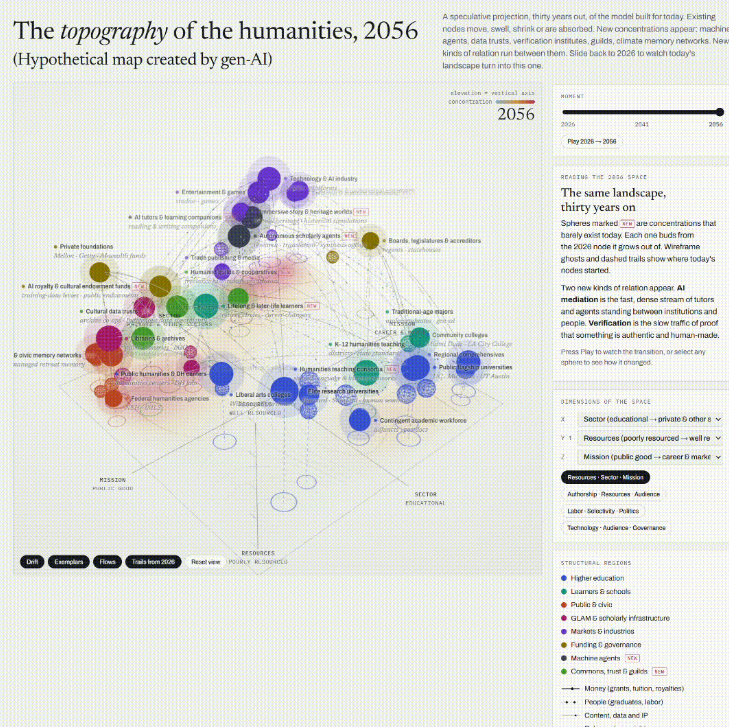
- Abstract: This presentation began by teasing the future of the humanities through interactive visualizations created by AI (Claude Opus 5.5) to predict how current humanities “nodes (structures, formations, and concentrations of work and personnel) in universities in relation to other sectors of society–will evolve from the present (2026) to thirty years in the future (2056). My talk proposed that preparing the humanities actively to plan their ongoing “restructuring” (instead of only reacting to it) will require thinking about how to plan the migration of existing and creation of new nodes, especially with allowance for how such processes are increasingly steered by media (including AI mediation). With relevance to the specific purpose of this American Academy of Arts & Science’s event–convened by its Humanities Indicators initiative to brainstorm the future of its data-collection about the humanities–good plannng will require good data about where the humanities are now, and where they are heading. And that means that humanities data-gathering initiatives such as Humanities Indicators will need to complement quantitative data gathering about established humanities programs and outcomes with qualitative data gathering about what will not easily appear in available quantatiative daa sources: information about experimental academic and emerging extra-academic areas of humanities work. The latter include, for example, “humanities-plus” programs (such as the medical, legal, environmental, or digital humanities) and new areas of humanities work outside universities focused on verifying, authenticating, and managing the intellectual property of cultural datra (e.g., for AI training data). Qualitative data-gathering can include ethnographic, documentary, and textual analysis focused on representative cases of new humanities “nodes.” It is important that such research can be analzed not just through humanities interpretive methods but also through social-sciences semi-quantitative, structured means such as grounded-theory annotative coding. That will create a bridge between qualitative and quantitative data gathering about the humanities.
- Prompt to several frontier-level AI LLMs at the time of the event (by OpenAI, Google, and Anthropic). Anthropic’s Claude Opus 5.5 was the only AI that produced not a generic result but a deeply interesting interactive visualization representing a prediction that seems to be based on substantive information and data about the humanities in its training datasets.
- Claude’s visualization of the humanities at present (2026).
- Claude’s visualizaiton of the humanities in 30 years (2056).