“Bridging from the Textual to the Digital.” Response to panel on “Literary Studies in Cyberspace.” Modern Language Association Convention. New York City. 29 December 2002.


Citation: “The Future Literary: Literature and the Culture of Information.” Time and the Literary. Ed. Karen Newman, Jay Clayton, and Marianne Hirsch. New York: Routledge, 2002. 61-100.

/ excerpt » /

Interview by Sue Thomas. Mapping the Transition from Page to Screen research project. trAce Online Writing Center. Nottingham Trent University, UK. October 2002.


URL: https://www.eliterature.org
Role: Member, ELO Board of Directors, 2002-present.

Chair, ELO PAD (Preservation/Archiving/Dissemination) Technology/Software Committee, 2002-2003.

The Electronic Literature Organization (ELO) is a 501(c)(3) nonprofit organization established in 1999 to promote and facilitate the writing, publishing, and reading of electronic literature. Since its formation, the Electronic Literature Organization has worked to assist writers and publishers in bringing their literary works to a wider, global readership and to provide them with the infrastructure necessary to reach one another. ELO’s PAD initiative arose in 2002 with the goal of creating the institutional and technical protocols needed to “preserve” works of new media literature (vulnerable to changing hardware and software platforms) by migrating them into future technological environments.

Suggested Citations:

  • Electronic Literature Organization. Home page. Retrieved [Date of access, e.g., 27 September 2006]. <https://www.eliterature.org/></li?
  • Electronic Literature Organization PAD Initiative. Home page. Electronic Literature Organization. Retrieved [Date of access, e.g., 27 September 2006]. <https://www.eliterature.org/programs/pad/>


Citation: Bruce Bimber, Kevin Almeroth, Rob Patton, Dorothy Chun, Andrew Flanagin, and Alan Liu. March 4, 2002. Center for Information Technology and Society, University of California, Santa Barbara. Retrieved [date of access]. <http://www.cits.ucsb.edu/site/techmemo/index.pdf>


/ excerpt » /

“The Humanities and the Information Revolution: Lessons for the Cool.” The Lawrence Willson Memorial Lectureship. California Lambda of Phi Beta Kappa Initiation ceremony. University of California, Santa Barbara. 1 June 2002.


“Electronic Literature in the University.” Panel on Electronic Arts in the University. “State of the Arts Symposium.” Electronic Literature Organization. UCLA. 6 May 2002.


“The Art of Extraction: Toward a Cultural History and Aesthetics of XML and Database-Driven Web Sites.” “Interfacing Knowledge” conference. University of California Digital Cultures Project and University of California Microcosms Project. University of California, Santa Barbara. 10 March 2002.

“The Laws of Cool: Information Technology and the Culture of ‘Knowledge Work.'” Center for Information Technology and Society. University of California, Santa Barbara. 2 November 2001.

Interview. Center for Information Technology (CITS). University of California, Santa Barbara. 20 August 2001.

  • VideoVideo (3 min. 30 sec., MP4)


“From Critique to Ethical Hacking: Humanities and Arts in the Age of Creative Destruction.” North American Society for the Study of Romanticism (NASSR) conference. University of Washington. Seattle. 16 August 2001.


“Toward VoS2: Database Technology in a Humanities Department.” North American Society for the Study of Romanticism (NASSR) conference. University of Washington. Seattle. 16 August 2001.


“Database Technology in a Humanities Department.” With Robert Adlington and Jeremy Douglass. University of California Digital Cultures Project Summer Institute. University of California, Santa Barbara. 22 June 2001.

“The Tribe of Cool: Information Culture and History.” Keynote address. Association for Computers and the Humanities & Association for Literary and Linguistic Computing (ACH-ALLC) conference. New York University. 16 June 2001.


Response to Jerome McGann’s Paper on “Narrative, Game, and Performative Poetics.” Conference on “Narrative at the Outer Limits.” Interdisciplinary Humanities Center. University of California, Santa Barbara. 4 May 2001.

“Historicizing Information.” eHumanities Lecture Series. National Endowment for the Humanities. Washington, D.C. 1 May 2001.


“The Tribe of Cool: Information Culture and History.” Vanderbilt University. 28 March 2001.

Profession 2000: 186-88. This reply is in response to a “Letter to the Editor” by William Pitsenberger in Profession 2000 (185-86) regarding Alan Liu’s “Knowledge in the Age of Knowledge Work,” which had appeared in Profession 1999. The following is the full text of the “Reply.”

With his combined background in business management, business law, and graduate literary studies, William Pitsenberger is uniquely placed to follow up on my call for the academy and business to engage each other critically. “Suppose instead,” he says, “that the training in critical analysis with which those with advanced degrees in literature are armed were brought into the business community in a way that offered that community new kinds of value—understanding, for example, how business texts can be read, what contradictions exist between those texts and the desired message, and how to resolve those contradictions?”

This is an imaginative vision of humanities scholarship as a new missionary activity, one that attempts to offer business not just “skills” and “tools” (to which Pitzenberger admirably refuses to reduce the issues), not even just “value” (or, as he says later, “best use of academic training”), but instead “new kinds of value.” It would be interesting for a group of experienced managers and professionals from both sides of the business/academy divide to sit down together to judge whether this idea has merit and how it could be implemented—whether in a consultancy, training workshop, internship program, or something else.

I would like to take the occasion here, however, of putting Pitsenberger’s prescription in broader perspective. If the goal is to offer business the critical understanding it needs to make wise use of the texts of contemporary management literature—whose now ample and influential body of works is by turns insightful, cruel, heedless, and shallow—then the best general term I know for such an enterprise is still education. In this light, what Pitsenberger’s suggestions makes me wonder about is the very role of education today. In the “knowledge economy,” education occurs across a whole lifetime in an unprecedented variety of social sectors, institutions, and media—not just schools, community colleges, and universities, for instance, but also businesses, broadcast media, the Internet, even the manuals or “tutorials” that accompany software applications. Education, in other words, is now a decentralized field where no one institution any longer individually corners the market and where the sheer dispersion of the kinds and scales of learning—all the way from programs leading to degrees to CNN “factoids” leading only to the next commercial—is dizzying. Given this context, I think, the relevant question becomes: where can society most responsibly and effectively place the training in critical analysis that Pitzenberger suggests? Is it in consultancies or reading groups (workshops, team exercises, and focus groups) within corporations? Is it within the academy in humanities departments, on the hoary theory that the best way to insert critical understanding in society is to teach well the students destined to enter that society? (The humanities could thus teach contemporary management theory with the same critical perspective it brings to any other past theory of civilization, which is what management theory really is in its grandest ambition.) Or, because of the importance to business of non-textual knowledges not easily amenable to learning “how business texts can be read” (a point I owe to my colleague, Christopher Newfield, who also studies business and the academy), should we instead look to the sciences to develop courses on the critical understanding of numerical analysis or to the media industry to sponsor programs on the critical use of images and music? Perhaps the best question: how can society create the most inclusive, flexible, and intelligently interrelated mix of such options to take care of all its citizens hungry to “know”?

None of these questions are rhetorical; all are open. I suspect that they will not be solved from the top down by adding more representatives from government, media, etc., to the panel of business and education managers I imagined above. Rather, the work will begin from the bottom—through efforts by those like Pitzenberger who might want to try innovating a business training workshop here or an internship program there; and also by those working within the academy to introduce works of business literature among other works we ask students to read critically. (See the following course on “The Culture of Information” for my own example:
http://transcriptions.english.ucsb.edu/archive/courses/liu/english236/)

“A Workshop on Andy Goldsworthy and ‘New Romantic Art.'” Romantic Study Group. University of California, Los Angeles. 1 June 2000.


“The Future Literary: Literature, Hacking, and the Culture of Information.” Focused Research Group on the Cultures of Literacy. University of Minnesota. 28 April 2000.


“The Classroom of the Future and The School of Athens.” Science-Humanities Forum colloquium on “Classroom of the Future.” University of California, Santa Barbara. 3 March 2000.


“Should We Historicize the Culture of Information?” University of California Transcriptions Project colloquium. University of California, Santa Barbara. 15 November 1999.


“The Laws of Cool (Information Should Not Mean But Be).” The English Institute. Cambridge, Mass. 2 October 1999.


Citation: “Knowledge in the Age of Knowledge Work.” Profession 1999: 113-24.

  • Also available online.
  • See also: Alan Liu, “Reply” to letter from William Pitsenberger regarding “Knowledge in the Age of Knowledge Work.” Profession 2000: 186-88.


/ excerpt » /

“Knowledge in the Age of Knowledge Work.” Presidential Forum Workshop. Modern Language Association Convention. San Francisco. 29 December 1998.


“Sidney’s Technology.” University of Virginia, Charlottesville. 9 November 1998.


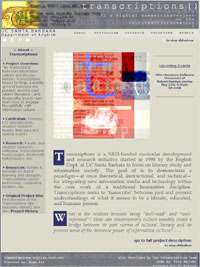
Transcriptions home pageURL: https://transcriptions.english.ucsb.edu”
Role: Director and Principal Investigator.
Transcriptions is a curricular development and research project in the UC Santa Barbara English department started with a NEH Teaching with Technology grant in 1998. Project faculty and graduate students create courses and research materials related to:

  • The social, political, economic, and cultural contexts that now make “information” so powerful;
  • The equivalent contexts that have always made literature itself an “information technology,” including the cultures of orality, manuscript, print, etc.

Transcriptions also includes an undergraduate curricular track for English majors: the Literature and Culture of Information Specialization (http://transcriptions.english.ucsb.edu/curriculum/lci/).

Suggested Citation: Transcriptions Project (Literature and the Culture of Information). Home page. University of California, Santa Barbara. Retrieved [Date of access, e.g., 27 September 2006]. <https://transcriptions.english.ucsb.edu/>


“The Downsizing of Knowledge: Knowledge Work and Literary History.” Doreen B. Townsend Center for the Humanities. University of California, Berkeley. 12 March 1998.


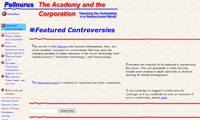
The full title of this site is Palinurus: The Academy and the Corporation – Teaching the Humanities in a Restructured World. I created the Palinurus site beginning in February 1998 to encourage critical thought about the corporatization of higher education and the relation between academic “knowledge” and postindustrial “knowledge work”; includes a rationale statement, featured controversies suggested readings, and a gallery of quotations. (Some material submitted by contributors.)

Palinurus

The site fills me with melancholy when looking back on it now from the vantage point of 2013 after continued decreases in public funding for universities; the Great Recession beginning in 2007; the “privatization” of public universities; the trend toward “accountability” and “assessment” of education; the push by technology-industry leaders, pundits, and politicians for MOOC online courses to take up the slack; and other symptoms of the colonization of higher-education institutions by neoliberal philosophies and management structures native to contemporary business.

The original rationale statement for the Palinurus site begins: “This pilot site was built by higher-education humanities scholars who have awakened to the combined practical and intellectual challenge to higher education posed by business in the era of ‘knowledge work,’ ‘learning organizations,’ and ‘information society.'”

Date: February 1998

Palinurus Gallery of Quotes
  • Palinurus Site
  • Selected Pages of Interest (select links on home page, which is a frame page):
    • Rationale statement
    • Featured Controversies, inclduing “Dearing Report (U.K.),” “Cal State ‘Technology Infrastructure Initiative’ (U.S.),” “New Zealand ‘Green Paper’ and its Critics.”
    • Suggested Readings in the following areas
      • The Idea of Business
      • The Idea of the University
      • Academe and Business
      • Information Tech and the Academy

“Managing History: The Downsizing of Knowledge.” Plenary address. Western Humanities Conference. University of California, Riverside. 17 October 1997.


“The New Knowledge.” Session on “The Impact of Electronic Culture on Human Values.” Dialogues in Human Values and Public Life. University of California, Santa Barbara. 17 May 1997.


“Managing History: The Downsizing of Knowledge.” “Temporality and History” conference. University of Virginia, Charlottesville. 29 March 1997.


“Common Standards: Academic Knowledge and Knowledge Work.” Workshop on “Computational Worlds: Metaphors and Practices.” University of California, Los Angeles. 28 February 1997.


“Common Standards: Academic Knowledge and Knowledge Work.” Workshop on “Electronic Orders: Classification, Standardization, Formalization, and Genre in Electronic Environments.” University of California, Santa Barbara. 11 January 1997.


Introduction. Session on “The Canon and the Web: Reconfiguring Romanticism in the Information Age” (co-organized with Laura Mandell, University of Miami, Ohio). Modern Language Association Convention. Washington, D. C. 29 December 1996.


“The Laws of Cool: Literature on the Line.” University of California, Santa Barbara. 10 May 1996.


“The Voice of the Shuttle.” University of Georgia. 15 April 1996.


“The Laws of Cool: Literature on the Line.” Plenary paper. National Graduate Student Conference in Romanticism. Emory University. 12 April 1996.


“The Laws of Cool: Literature on the Line.” Conference on “Reading Ethics.” State University of New York, Buffalo. 28 March 1996.


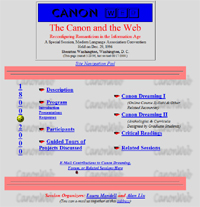
An early conference panel Web site that I built with Laura Mandell for the session on “The Canon and the Web: Reconfiguring Romanticism in the Information Age” at the MLA convention in Washington D. C., 29 December 1996. In his paper titled “Distant Mirrors and the LAMP” at the MLA convention in 2013, Matthew G. Kirschenbaum has discussed this site as an early “distant mirror” of the later web in its attempt to “situate the session amid a thick contextual network,” its “clear desire for interactivity, as expressed through the live email links and the injunction to initiate correspondence,” and its “curatorial sensibility.”

Date of site: 26 March 1996.
Date of event: 29 December 1996.

Canon and the Web Site    Go to site

« Previous PageNext Page »