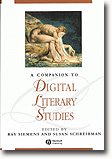
 Citation: “Imagining the New Media Encounter.” A Companion to Digital Literary Studies. Ed. Ray Siemens and Susan Schreibman. Malden, MA: Blackwell, 2007. 3-25
/ excerpt » /
| 2007 |
“Imagining the New Media Encounter” (Introduction to A Companion to Digital Literary Studies)Categories Essays , Publications Essays , Publications
|
Citation: “Imagining the New Media Encounter.” A Companion to Digital Literary Studies. Ed. Ray Siemens and Susan Schreibman. Malden, MA: Blackwell, 2007. 3-25
| 2007 |
“Knowledge 2.0: The Transliteracies Project and Social Computing” (UC Irvine)Categories Talks
|
“Knowledge 2.0: The Transliteracies Project and Social Computing.” University of California, Irvine. 19 November 2007.

| 2007 |
UC Irvine, U. Colorado, Texas A&M (Oct.-Nov. 2007)Categories Events Gallery (Archive)
|

| 2007 |
“Digital Humanities and Academic Change” (U. Colorado, Boulder)Categories Talks
|
“Digital Humanities and Academic Change.” Co-speaker with Lyn Hejinian, State of the Profession Colloquia series. Department of English. University of Colorado, Boulder. 11 October 2007.
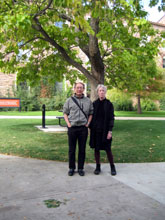 Link Library for Alan’s Presentation
| 2007 |
Link Library for “Digital Humanities and Academic Change” (U. Colorado, Boulder)Categories Uncategorized
|
Small-Team Projects
UCSB English Department’s “Center” Model
Collaborative Research or Curricular Development Projects
Selected Courses
| 2007 |
“Knowledge and Web 2.0: The Transliteracies Project and Social Computing” (Texas A&M U.)Categories Talks
|
“Knowledge and Web 2.0: The Transliteracies Project and Social Computing.” Melbern G. Glasscock Center for Humanities Research. Texas A & M University. 4 October 2007.
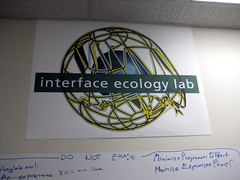 More photos of Texas A&M campus, Center for the Study of Digital Libraries, English Department, etc.
| 2007 |
“Digital Humanities and Academic Change” (U. Auckland, New Zealand)Categories Talks
|
“Digital Humanities and Academic Change.” University of Auckland. 31 August 2007.
 Link library to facilitate discussion.
| 2007 |
“Digital Humanities and Academic Change” (Victoria U., Wellington, New Zealand)Categories Talks
|
“Digital Humanities and Academic Change.” Victoria University, Wellington. 30 August 2007.
| 2007 |
“Digital Humanities Strategies” (National Library of New Zealand)Categories Talks
|
Presentation at discussion meeting to exchange ideas on the role of the humanities in information-technology development strategy with representatives of the National Library of New Zealand, The Encyclopedia of New Zealand, and Research and Education Advanced Network New Zealand( REANNZ). National Library of New Zealand, Wellington. 29 August 2007.
| 2007 |
“Digital Humanities and Academic Change” (Victoria U., Wellington, New Zealand)Categories Talks
|
“Digital Humanities and Academic Change.” Seminar on recent trends in research in the humanities and arts; with co-discussant Julie Ellison. Victoria University, Wellington. 29 August 2007.
| 2007 |
“Beyond ‘Good Enough’ Knowledge: The Humanities and Public Knowledge in the Age of Web 2.0” (Victoria U., Wellington, New Zealand)Categories Talks
|
“Beyond ‘Good Enough’ Knowledge: The Humanities and Public Knowledge in the Age of Web 2.0.” Keynote for the Te WhÄinga Aronui — The Council for the Humanities’ Transformations Congress. Victoria University, Wellington. 28 August 2007.
| 2007 |
Link Library #2 (for Meetings in New Zealand, Aug.-Sept. 2007)Categories Uncategorized
|
Materials Related to Digital Strategy, Digital Capability Development, and the Humanities in New Zealand
Selected Quotations:
1. First sentences of the Foreword to “The Digital Strategy” by the Minister of Information Technology and of Communications (David Cunliffe): “There’s a buzz about New Zealand right now. We have vibrant communities. We have innovative people and companies at the creative cutting-edge.”
2. From “The Digital Strategy”: “It is important that we keep all the dimensions of the Digital Strategy in line. Content, Connection, and Confidence are the three enablers. Connection is necessary but not sufficient — it simply provides the means. Confidence gives us the skills and a secure online environment, whilst accessing or creating Content provides a compelling reason to make it happen.”
3. In the “The Digital Strategy,” the section on “Why We Need a Digital Strategy” begins: “The information we access through digital technologies can promote innovation, increase productivity, and enrich the quality of our lives. Content creation is not only a global business — now it can be anyone’s business. Using digital technologies to create and access our distinctive cultural content enhances our identity as New Zealanders. ICT helps us unlock our stores of national content, making them accessible to all, and it is a powerful tool for directing and expressing our creativity.”
4. From Draft New Zealand Digital Content Strategy: “The appropriate mechanisms are also needed to unlock New Zealand’s stock of current and future content, in part to provide a supply of high quality content to stimulate demand and uptake of digital technology. In stimulating demand for content however, we must also protect, preserve and promote our heritage and cultural identities, in an environment open to being swamped by the widening access to international content. Maori language, knowledge and culture, a vital part of New Zealand’s identity, is particularly vulnerable to being drowned out or appropriated by international interests unless adequately protected.”
5. From an appendix of the Council of Humanities “Research Policy Paper” (the appendix is a table titled “Sketch of the Cultural Knowledge Research System”): “Research Mode: Primarily interpretive, but including creative and social scientific methodologies. Research Outcomes: Including: Peer-reviewed academic research, contract research, catalogues . . . , conferences and seminars,[etc.]”
Observations
Links and References
| 2007 |
Link Library (for Meetings in New Zealand, Aug.-Sept. 2007)Categories Uncategorized
|
Selected Web Sites
Collaborative Research or Curricular Development Projects
Selected Courses
| 2007 |
William Wordsworth (Poetry for Young People edition) (table of contents)Categories Uncategorized
|
Sterling Publishing, 2003, 48 pp., 35 illustrations, ISBN-10: 0806982772, ISBN-13: 978-0806982779
Introduction
I. Nature
II. Children & Young People
III. The Present and the Past
IV. Scenes from The Prelude
V. Growing Up
| 2007 |
“Higher Education and Online Lifelong Learning: Five Theses”Categories Essays , Publications
|
Citation: “Higher Education and Online Lifelong Learning: Five Theses.” Academy Exchange, Issue 6 (Summer 2007): 34-35.
| 2007 |
“Knowledge 2.0? — The University and Web 2.0” (English Subject Centre, London)Categories Audio/Video , Talks
|
“Knowledge 2.0? — The University and Web 2.0.” “Renewals” Conference. English Subject Centre. Royal Holloway, University of London. 6 July 2007.
| 2007 |
“Overview of University of California Transliteracies Project” (De Montfort U., Leicester, UK)Categories Talks
|
“Overview of University of California Transliteracies Project.” Distinguished Seminar at the Institute of Creative Technologies. De Montfort University. Leicester, UK. 3 July 2007.
 IOCT Publicity Announcement.
| 2007 |
England, Holland, New Zealand (Summer 2007)Categories Events Gallery (Archive)
|

| 2007 |
“Network Knowledge: Policing Web 2.0” (Amsterdam)Categories Talks
|
“Network Knowledge: Policing Web 2.0.” New Network Theory International Conference. Amsterdam, Netherlands. 28 June 2007.
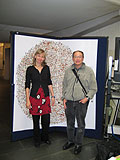 Conference site.
| 2007 |
Nicole King, “Meaningful Contexts: An Interview with Alan Liu”Categories Interviews
|
 Nicole King. “Meaningful Contexts: An Interview with Alan Liu.” English Subject Centre Newsletter, 12 (April 2007): 6-9.
| 2007 |
“Imagining the New Media Encounter” (U. Illinois, Urbana-Champaign)Categories Audio/Video , Talks
|
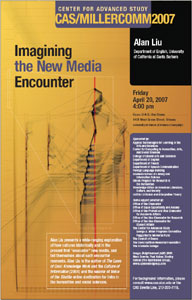 “Imagining the New Media Encounter.” Keynote lecture for “Interfaces and Visualizations: A State-of-the-Art Conference on the Humanities in Post-human Times” and Center for Advanced Study’s MillerComm Lecture Series. University of Illinois, Urbana-Champaign. 20 April 2007.
* Publicity flyer for lecture.
*  Video of talk (1 hr 22 min.; RealVideo)
*  Audio only (1 hr 22 min.; RealAudio)
| 2007 |
“The Humanities: A Technical Profession” (ACLS Occasional Papers)Categories Essays , Publications
|
Citation: “The Humanities: A Technical Profession.” Andrew Delbanco, Ronald G. Ehrenberg, Alan Liu, and Catharine R. Stimpson, The Idea and Ideals of the University. ACLS Occasional Paper No. 63, 2007.
[Note: This paper was first presented as a talk at the Annual Meeting of the ACLS, 8 May 2004, then revised slightly for publication in 2007 in the ACLS Occasional Papers online series. Though this revision stays close to the talk, it adopts some of the changes made for the first published essay version of the paper: the 2005 article (also titled “The Humanities: A Technical Profession”) in Teaching, Technology, Textuality: Approaches to New Media, ed. Michael Hanrahan and Deborah Madsen (Basingstoke [England]: Palgrave Macmillan, 2005): 11-26.]
(For an excerpt, see the entry for the above mentioned, closely similar, 2005 article.)
| 2007 |
English 25, “Introduction to the Culture of Information” (Spring 2007)Categories Undergrad Courses
|
Course site: http://transcriptions.english.ucsb.edu/curriculum/courses/overview.asp?CourseID=295
Course description:  This introductory lecture course studies contemporary information culture from the viewpoint of the humanities. What is information, and why is it so important that it not only affects our economy, politics, and society but also our culture (the culture of “cool,” it has been called) and our arts (the “new media” literatures, arts, music, and games). The course brings writings about information society together with works of new-media literature and art to study the following aspects of information: information as media, communication, and “new media”; information as work and power; and information as identity (see the Schedule page for details). Required readings are in print (e.g., Thomas Pynchon’s The Crying of Lot 49, William Gibson’s novel, Neuromancer), on the Web, and on CD-ROM (M. D. Coverley’s hypertext novel, Califia).
Assignments include some Web-authoring at the beginner’s level. No pre-existing technical skills are needed, but the ability to access the Web is necessary to do the online readings.
This course counts toward the English Dept’s specialization in Literature and the Culture of Information.
| 2007 |
UC New Media DirectoryCategories Digital Humanities & New Media Projects , Other Digital Humanities & New Media Projects
|
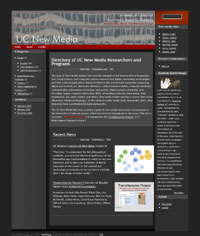 URL: http://ucnewmedia.english.ucsb.edu URL: http://ucnewmedia.english.ucsb.eduRole: Founder. The area of “new media studies” has recently emerged at the intersection of humanities, arts, social science, and computer science research into digital, networked technologies and their cultural implications. Research fields in this area include humanities computing, digital and network art, electronic literature, critical internet studies, computer-mediated communication, information technology and society, digital textual scholarship, text encoding, human computer interaction (HCI), networking protocols, data mining, data visualization, GIS, game studies, and others. New media studies also has a reverse time-arrow dimension: “media archaeology,” or the study of earlier media (oral, manuscript, print, early industrial) from a postindustrial media perspective. The UC New Media Directory provides a guide to new media researchers and programs in the University of California system, which has invested strategically in this area. (This site is currently under construction. It is managed by the Transliteracies Project, a UC Multi-campus Research Group.) |
| 2007 |
English 236, “Landcape and the Social Imaginary: Romantic Landscape and Cyberspace” (Winter 2007)Categories Graduate Courses , Selected Recent Courses
|
Course site: http://transcriptions.english.ucsb.edu/curriculum/courses/overview.asp?CourseID=290
Course Description: This course consists of two parts:
 I. Romantic Landscape (7 weeks) This part of the course attends to the specificity of Romantic landscape during the so-called British “long 18th century” or (in art history) “great century”–i.e., to the unique contribution of Romanticism to an era when in great part landscape was art and art was landscape. Rivaled perhaps only by the novel, with which it was on intimate terms, landscape was the epic of the times. It was the familiar of that other great Romantic epic form: autobiography. This part of the course concentrates on the writings of the Wordsworth circle and the paintings and watercolors of John Constable and J.M.W. Turner. These materials are developed against a backdrop that includes 18th-century writers and painters, the aesthetic theories of the picturesque and sublime, and the history and theory of “descriptive” genres (including georgic and locodescription).
II. New Forms of Landscape (3 weeks) Whether developed in conceptual, metaphorical, or virtual form, navigable space–and often specifically landscape–is important to the contemporary artistic imagination.  The course will conclude by making the transition through late-nineteenth-century landscape photography (Carlton Watkins, Eadweard Muybridge) to modern and contemporary forms of landscape imagination, including “land art” and new-media art. Materials include: the work of Robert Smithson, James Turrell, Andy Goldsworthy, Richard Long, Charlotte Davies, John Klima, and Sue Thomas as well as such forms as computer games and satellite imagery. The wager of the course is that we can learn something about the use of landscape as a major form of the social imaginary if we juxtapose Romantic poets and artists walking through nature and contemporary poets and artists browsing or navigating the networks.
The course is supported by an Online Image Gallery (login required).
| 2007 |
“The Agrippa Process: ‘Agrippa (A Book of the Dead)’ in the Age of Web 2.0” (Stanford U.)Categories Talks
|
“The Agrippa Process: ‘Agrippa (A Book of the Dead)’ in the Age of Web 2.0.” Conference on “The Extreme Contemporary.” Center for the Study of the Novel. Stanford University. 12 January 2007.
 (33)
(33)