| 2011 |
“We Will Really Know”Categories Essays
|
| 2011 |
“This is Not a Book: Long Forms of Shared Attention in the Digital Age” (Unbound Book Conference, Amsterdam / The Hague)Categories Audio/Video , Talks
|
“This is Not a Book: Long Forms of Shared Attention in the Digital Age.” Panel on “What is a Book?”, Unbound Book Conference, Central Library, Amsterdam, and Royal Library, The Hague. 20 May 2011.
Video of talk
- Conference site
- Conference Photostream
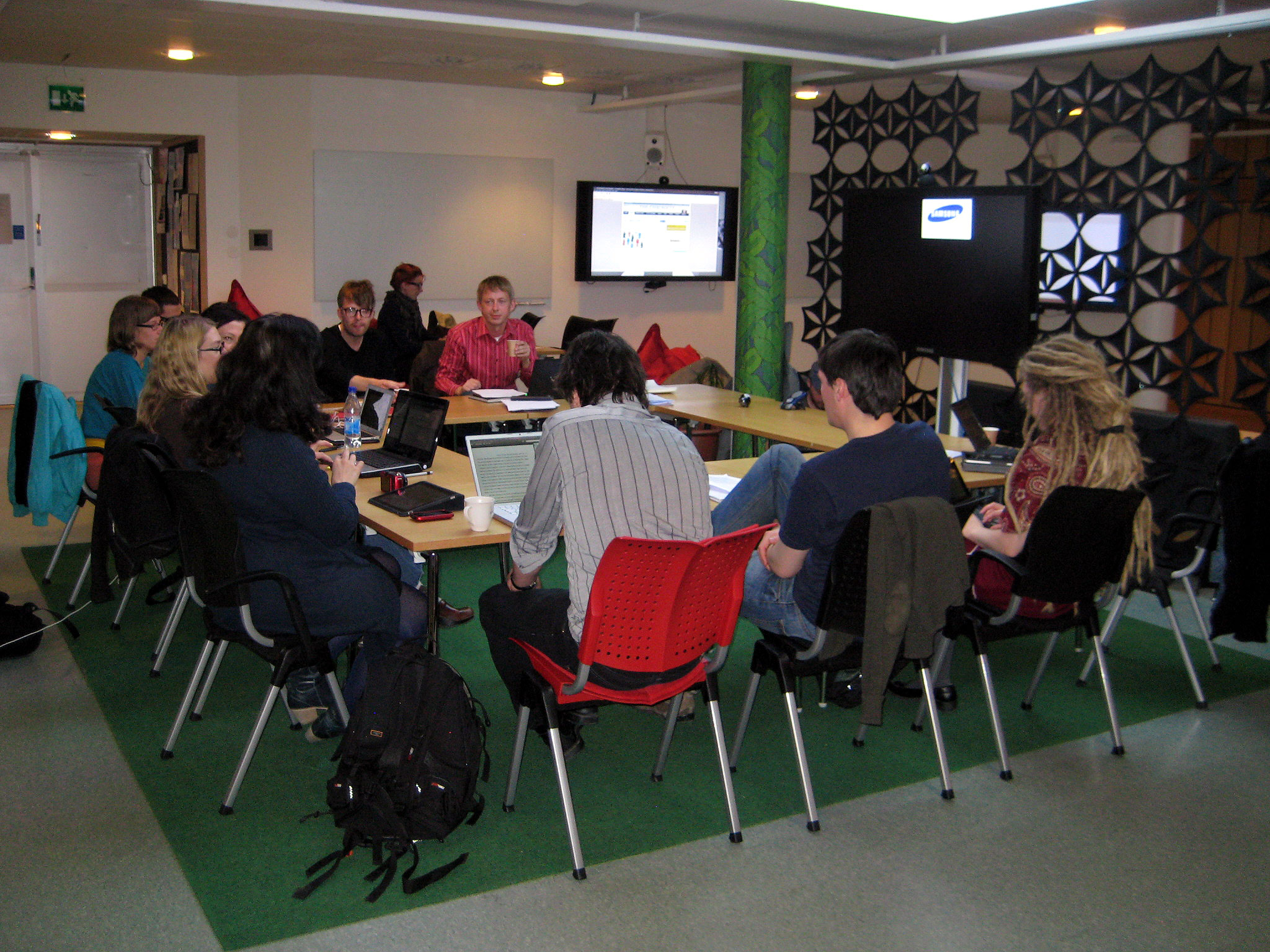
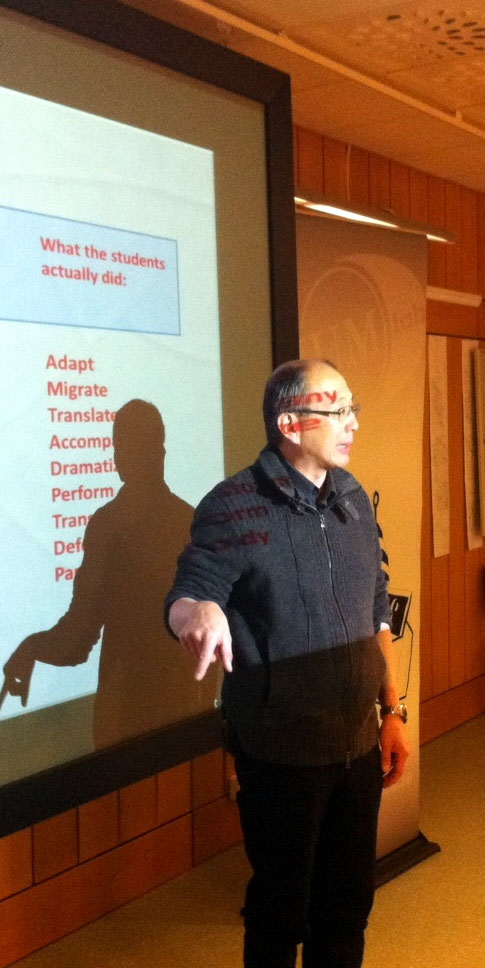
- Photos of panel on “What is a Book?”: 1 | 2 | 3 | 4 | 5
| 2011 |
“Cultural Criticism and the Digital Humanities: Alan Liu” (Culture Machine interview)Categories Audio/Video , Interviews
|
“Cultural Criticism and the Digital Humanities: Alan Liu.” Interview by Janneke Adema for Culture Machine. 19 May 2011. Amsterdam.
Audio interview (16:50 min.)
| 2011 |
Introduction to Research Slam (UCSB)Categories Talks
|
“Introduction to Research Slam.” English Department, University of California, Santa Barbara. 13 May 2011.
- HUMlab, Umeå University, Sweden
- Maryland Institute for Technology in the Humanities (MITH) (and Digital Cultures & Creativity Honors Program)
- Writers House at Rutgers University: Homepage | Photos from site visit
- University of Washington DUB (Design Use Build) Program in Human-Computer Interaction and Design
| 2011 |
Workshop with Alan Liu, Patrick Svensson, & Whitney Trettien (HUMlab, Umeå University)Categories Talks
|
Workshop with Alan Liu, Patrik Svensson, and Whitney Trettien. HUMlab, Umeå University, Sweden. 10 May 2011.
- Essays and sites for workshop:
Alan Liu, “The State of the Digital Humanities: A Report and a Critique” (manuscript of forthcoming article)- Alan Liu, “Where is Cultural Criticism in the Digital Humanities?”
- 4Humanities
- Patrik Svensonn, “The Digital Humanities as a Humanities Project” (manuscript of forthcoming article)
| 2011 |
“Close, Distant, and Unexpected Reading: New Forms of Literary Reading in the Digital Age” (HUMlab, Umeå University)Categories Audio/Video , Talks
|
“Close, Distant, and Unexpected Reading: New Forms of Literary Reading in the Digital Age.” HUMlab, Umeå University, Sweden. 10 May 2011.
| 2011 |
“Friending the Past: The Sense of History and Social Computing” (California State U., LA))Categories Talks
|
| 2011 |
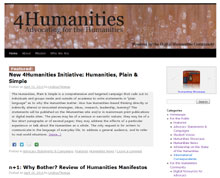
4Humanities – Advocating for the HumanitiesCategories Funded Collaborative Projects
|
URL: https://4humanities.org/
Role: Co-founder and coordinator (with Geoffrey Rockwell and Melissa Terras).
4Humanities is a site created by the international community of digital humanities scholars and educators to assist in advocacy for the humanities. As a platform, 4Humanities stages the efforts of humanities advocates to reach out to the public. It solicits well-reasoned or creative demonstrations, examples, testimonials, arguments, opinion pieces, open letters, press releases, print posters, video “advertisements,” write-in campaigns, social-media campaigns, short films, and other innovative forms of humanities advocacy, along with accessibly-written scholarly works grounding the whole in research or reflection about the state of the humanities. As a resource, 4Humanities provides humanities advocates with a stockpile of digital tools, collaboration methods, royalty-free designs and images, best practices, new-media expertise, and customizable newsfeeds of issues and events relevant to the state of the humanities in any local or national context. (Also see 4Humanities local chapters, including the 4Humanities@UCSB local chapter, co-directors Claudio Fogu and Alan Liu.)
| 2011 |
RoSE (Research Oriented Social EnvironmentCategories Funded Collaborative Projects
|
URL: http://rose.english.ucsb.edu [guest login available; active login by request]
Role: Project Lead.
White Paper for NEH: “Friending the Humanities Knowledge Base: Exploring Bibliography as Social Network in RoSE” (PDF)
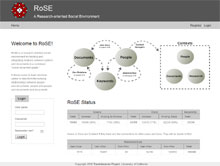
Created in its first stage as an outcome of the Transliteracies Project, RoSE completed a second stage of development under a NEH Digital Humanities Start-up Grant (Level II) [Grant number: HD-51433-11]. RoSE is a Web-based knowledge-exploration system that fuses a social-computing model to humanities bibliographical resources to allow users to explore the present and past of the human record as one “social network.” Stocked with initial information data-mined from YAGO and Project Gutenberg (with plans for data-mining the SNAC Project), RoSE provides profile pages about persons and documents, keywords and other data, and visualizations that help users see the relationships between people and documents. Uniquely, it also allows users (humanities students, scholars, and research groups) to add “thickly described” metadata on top of standard bibliographical data. This facilitates a social-network-like sense of active, dynamic interrelation with the objects of research.
- RoSE site (guest login available; active login by request)
- Press Release on RoSE, 11 January 2012, UCSB Office of Public Affairs Press (includes video interview with Alan Liu)
- White Paper for NEH
| 2011 |
“The Rebound Book: What Binds a Book Together in the Digital Age?” (Emerging Configurations Workshop, Chicago)Categories Talks
|
“The Rebound Book: What Binds a Book Together in the Digital Age?” Workshop on Emerging Configurations of the Virtual and the Real, Chicago (hosted by School of Information Sciences, University of Pittsburgh). 20 March 2011.
- Conference Web site, with slide presentations (login required)
| 2011 |
“The University in the Digital Age: The Big Questions” (U. Texas, Austin)Categories Audio/Video , Talks
|
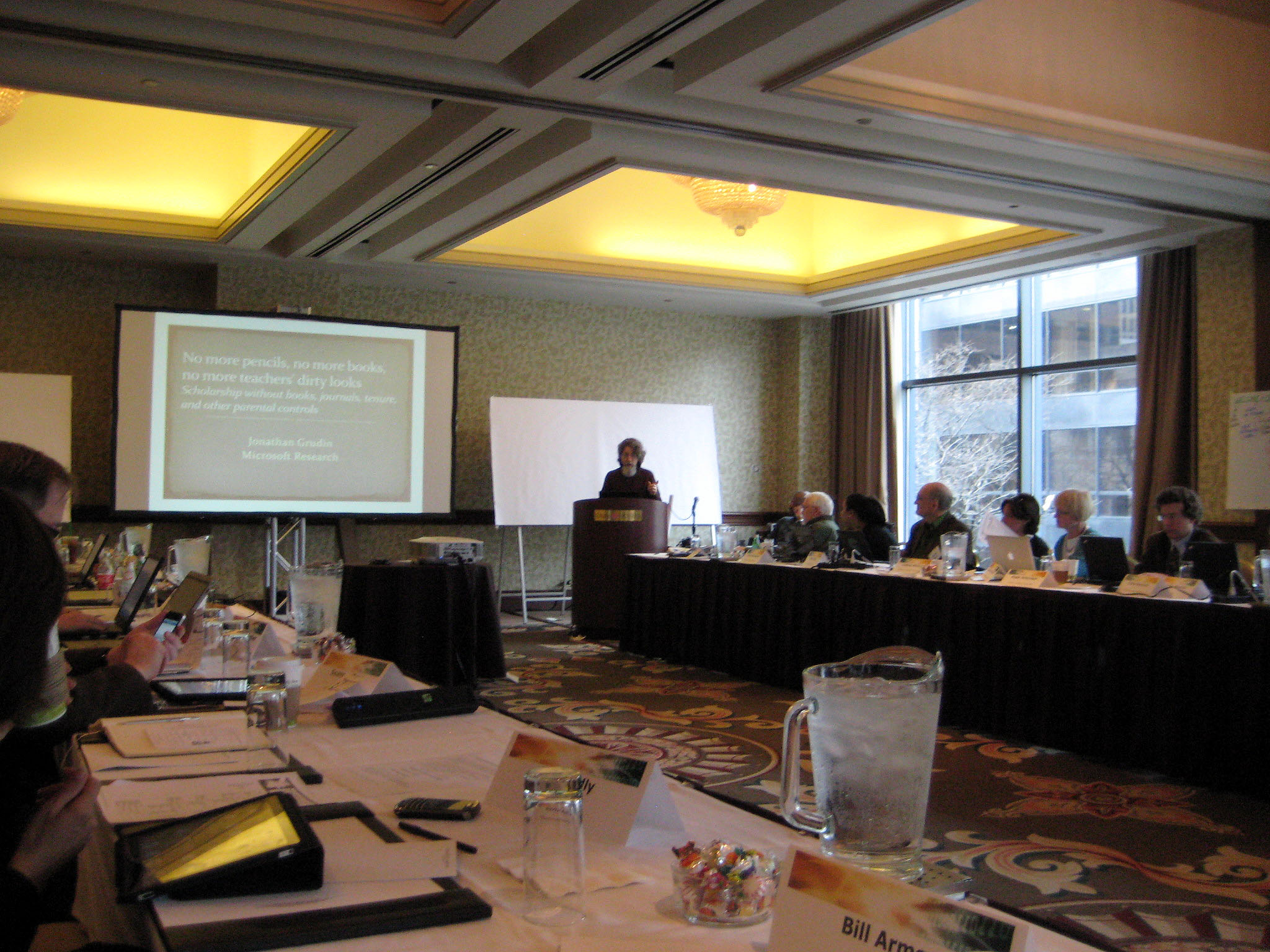
“The University in the Digital Age: The Big Questions.” Texas Institute of Literary and Textual Studies symposium on “Digital Humanities: Teaching and Learning.” University of Texas, Austin. 10 March 2011. (Talk presented via Skype.)
| 2011 |
Pedagogy Session: “A Digital Approach to Collaborating Across Disciplines: Literature+” (Susquehanna U.)Categories Talks
|
Pedagogy Session: “A Digital Approach to Collaborating Across Disciplines: Literature+”. Conference on “Literature, Creativity, and Print Culture: Sustainability in a Digital Age” (7th Annual Undergraduate Literature and Creative Writing Conference). Susquehanna University. 21 February 2011.
| 2011 |
“Close, Distant, and Unexpected Reading: New Forms of Literary Reading in the Digital Age” (Susquehanna U.)Categories Talks
|
“Close, Distant, and Unexpected Reading: New Forms of Literary Reading in the Digital Age.” Conference on “Literature, Creativity, and Print Culture: Sustainability in a Digital Age” (7th Annual Undergraduate Literature and Creative Writing Conference). Susquehanna University. 21 February 2011.
| 2011 |
“Toward a Larger Vision of Digital Instruction: Critical Reflections on the UC Online Instruction Pilot Project” (UC Santa Barbara)Categories Talks
|
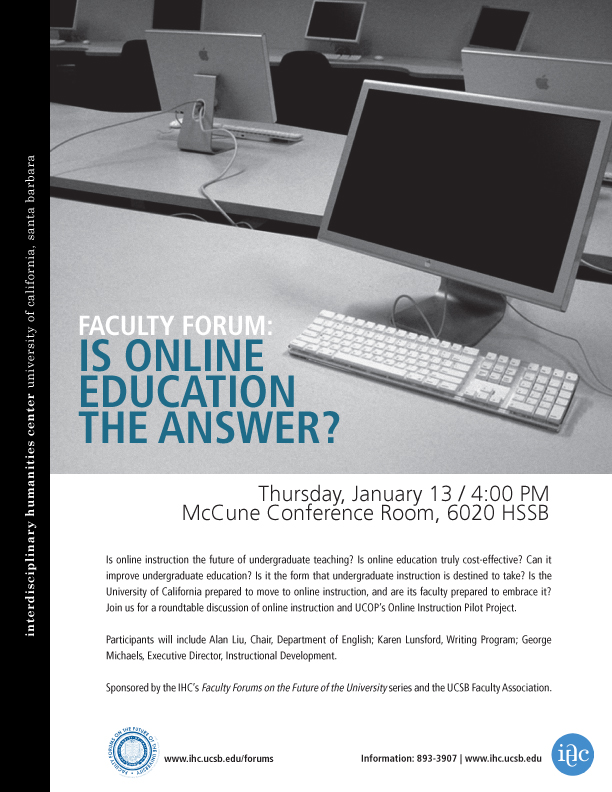
“Toward a Larger Vision of Digital Instruction: Critical Reflections on the UC Online Instruction Pilot Project.” Faculty Forum on “Is Online Education the Answer?” Interdisciplinary Humanities Center, University of California, Santa Barbara. 13 January 2011.
- Description of IHC Faculty Forum on “Is Online Education the Answer?”
- UC Online Instruction Pilot Project
| 2011 |
“Close, Distant, and Unexpected Readings” (MLA Convention, Los Angeles)Categories Talks
|
“Close, Distant, and Unexpected Readings.” Panel on “So Close and Yet So Far: Close Reading and Sociology.” Modern Language Association convention. Los Angeles. 9 January 2011.
| 2011 |
“Where is Cultural Criticism in the Digital Humanities?”Categories Blog Essays
|
Citation: “Where is Cultural Criticism in the Digital Humanities?” Alan Liu, 7 January 2011. https://liu.english.ucsb.edu/where-is-cultural-criticism-in-the-digital-humanities/
This is the original full text of a paper presented at the panel on “The History and Future of the Digital Humanities,” Modern Language Association convention, Los Angeles, 7 January 2011. (The paper was delivered in truncated, improvised form at the actual event due to time constraints.) An expanded version of this paper (full text) was later published under the same title in Debates in the Digital Humanities, ed. Matthew K. Gold (Minneapolis: University of Minnesota Press, 2012): 490-509.
This is the occasion to announce the new initiative titled 4Humanities: Advocating for the Humanities, which is subtitled “Powered by the International Digital Humanities Community.” The site, which I and a collective of digital humanists in the U.S., Canada, U.K., and Australia started in November 2010 in the wake of discussion on the Humanist List about whether the digital humanities had become too “industrialised” and about the budget “cuts” in the United Kingdom, is a platform for advocacy statements for the humanities and other forms of showcasing the value of the humanities. The premise of the site is that the digital humanities have a special role to play today in helping the humanities communicate in contemporary media networks. . . .
| 2011 |
“Where Is Cultural Criticism in the Digital Humanities?” (MLA Convention, Los Angeles)Categories Talks
|
“Where Is Cultural Criticism in the Digital Humanities?” Panel on “The History and Future of the Digital Humanities.” Modern Language Association convention. Los Angeles. 7 January 2011.
- Full text of original talk (delivered in truncated, improvised from during the panel due to time constraints)
| 2010 |
“From Reading to Social Computing” (U. Maryland, College Park)Categories Talks
|
“From Reading to Social Computing.” Department of English, University of Maryland, College Park. 5 October 2010.
| 2010 |
“Rerouting Creativity: New Media Arts after the Ideology of Creativity” (U. Maryland, College Park)Categories Talks
|
“Rerouting Creativity: New Media Arts after the Ideology of Creativity.” Arts and Humanities Dean’s Lecture Series, University of Maryland, College Park. 4 October 2010.
| 2010 |
Workshop on “When Was Linearity? What Graphics Mean in the Digital Age” (Carnegie Mellon U.)Categories Talks
|
Workshop on “When Was Linearity? What Graphics Mean in the Digital Age.” Center for the Arts in Society, Carnegie Mellon University. 17 September 2010.
| 2010 |
“Remembering Networks: Agrippa, RoSE, and Network Archaeology” (Carnegie Mellon U.)Categories Talks
|
“Remembering Networks: Agrippa, RoSE, and Network Archaeology.” Center for the Arts in Society, Carnegie Mellon University. 16 September 2010.
- Abstract: In 1992, at the onset of the digitally networked aged, publisher Kevin Begos, Jr., artist Dennis Ashbaugh, and novelist William Gibson issued their collaborative artist book Agrippa (a book of the dead), whose last pages contained a self-encrypting, “vanishing” poem on a diskette. The poem immediately went viral on the networks and clinched Agrippa’s status as a prototypical networked book or “book that became a network.”
Basing his talk on Agrippa as well as on The Agrippa Files site that he and graduate students built to document the book’s media and contexts, Alan Liu speculates on how a “network archaeology” might be possible that extends the scholarly approaches of “media archaeology” and “the history of the book” to past works that are networked. Liu will conclude with a presentation of the RoSE (Research-oriented Social Environment) online system that the Transliteracies Project he directs created to capture networks of past writers, readers, and works through present social-network technologies.
| 2010 |
Interview with Alan Liu (U. South Carolina)Categories Audio/Video , Interviews
|
Interview by David Miller, Director, Center for Digital Humanities, University of South Carolina. 10 September 2010.
Video interview (56 min.)
| 2010 |
“From Reading to Social Computing” (U. South Carolina)Categories Audio/Video , Talks
|
“From Reading to Social Computing.” Center for Digital Humanities, University of South Carolina. 9 September 2010.
Video of talk
Video interview of Alan Liu by David Miller, Director of Center for Digital Humanities
| 2010 |
“Literature and Social Mapping: From Reading to Social Computing” (U. Tennessee, Knoxville)Categories Talks
|
“Literature and Social Mapping: From Reading to Social Computing.” University of Tennessee, Knoxville. 26 August 2010.
| 2010 |
Workshop on “Escaping History: The New Historicism, Databases, and Contingency” (U. Tennessee, Knoxville)Categories Talks
|
Workshop on “Escaping History: The New Historicism, Databases, and Contingency” (chap. 9 of Local Transcendence: Essays on Postmodern Historicism and the Database). University of Tennessee, Knoxville. 26 August 2010.
| 2010 |
“Against the Monotony of Singularity: Humanities Institutions and Collective Intelligence” (Society for Digital Humanities, Montreal)Categories Talks
|
“Against the Monotony of Singularity: Humanities Institutions and Collective Intelligence.” Roundtable on “Collective Intelligence or Silicon Cage?: Digital Culture in the Twenty-First Century – A Bilingual Dialogue between Alan Liu and Pierre Lévy.” Society for Digital Humanities 2010 Conference. Montreal. 2 June 2010.
- Pierre Lévy’s untitled opening statement
(full text in English with slides; delivered informally in French at the event) - Alan Liu’s opening statement, “Against the Monotony of Singularity: Humanities Institutions and Collective Intelligence”
(full text as .doc; slides below) (larger slides in separate window)
| 2010 |
“From Reading to Social Computing” (Stanford U.)Categories Talks
|
“From Reading to Social Computing.” Workshop in the Stanford U., Mills C., UC Berkeley, and UC Santa Cruz “What is a Reader?” project. Stanford University. 21 May 2010.
| 2010 |
RoSE (Research-oriented Social Environment) (UC Santa Barbara)Categories Talks
|
“RoSE (Research-oriented Social Environment).” Media Arts & Technology 595M Seminar Series. University of California, Santa Barbara. 17 May 2010.
| 2010 |
“From Reading to Social Computing” (NeMLA, Montreal)Categories Talks
|
“From Reading to Social Computing.” Keynote address. Northeast Modern Language Association convention. Montreal. 9 April 2010.
| 2010 |
“Friending the Past: The Sense of History and Social Computing” (McGill U.)Categories Talks
|
“Friending the Past: The Sense of History and Social Computing.” Maxwell Cummings Distinguished Lecture. McGill University. 8 April 2010.
| 2010 |
“From Reading to Social Computing” (U. Kansas)Categories Talks
|
“From Reading to Social Computing.” University of Kansas, Lawrence. 8 March 2010.
| 2010 |
“RoSE (Research-oriented Social Environment)” (UC Santa Barbara)Categories Talks
|
“RoSE (Research-oriented Social Environment).” Transliteracies Project Design Charrette. University of California, Santa Barbara. 16 February 2010.
| 2009 |
“The End of the End of the Book: Dead Books, Lively Margins, and Social Computing”Categories Essays , Publications
|
Citation: “The End of the End of the Book: Dead Books, Lively Margins, and Social Computing.” Michigan Quarterly Review, 48 (2009): 499-520. Special issue on “Bookishness: The New Fate of Reading in the Digital Age”
| 2009 |
“The Future of Graduate Education” (UC Santa Barbara)Categories Talks
|
| 2009 |
“Thinking Destruction: Creativity, Rational Choice, Emergence, and Destruction Theory”Categories Essays , Publications
|
Citation: “Thinking Destruction: Creativity, Rational Choice, Emergence, and Destruction Theory.” Occasion: Interdisciplinary Studies in the Humanities, 1.1 (October 15, 2009). https://shc.stanford.edu/arcade/publications/occasion/rational-choice-theory-and-humanities/thinking-destruction-creativity
| 2009 |
“A New Metaphor for Reading”Categories Blog Essays , Other Writings , Publications
|
Citation: “A New Metaphor for Reading.” Invited contribution to “Room for Debate” forum on “Does the Brain Like E-Books?” New York Times, 14 October 2009. http://roomfordebate.blogs.nytimes.com/2009/10/14/does-the-brain-like-e-books/
Initially, any new information medium seems to degrade reading because it disturbs the balance between focal and peripheral attention. This was true as early as the invention of writing, which Plato complained hollowed out focal memory. Similarly, William Wordsworth’s sister complained that he wasted his mind in the newspapers of the day. It takes time and adaptation before a balance can be restored, not just in the “mentality” of the reader, as historians of the book like to say, but in the social systems that complete the reading environment.
Right now, networked digital media do a poor job of balancing focal and peripheral attention. We swing between two kinds of bad reading.
| 2009 |
“Literature and Data” (Yale U.)Categories Talks
|
“Literature and Data.” Theory and New Media Studies Colloquium. Yale University. 7 October 2009.
- Alan Liu, Local Transcendence: Essays on Postmodern Historicism and the Database (Chicago: University of Chicago Press, 2008), pp. 239-40
- Franco Moretti, Graphs, Maps, Trees: Abstract Models for a Literary History (London; New York: Verso, 2005), pp. 1-33, 91-92
- Alan Liu, “Digital Humanities and Academic Change,” English Language Notes 47.1 (Spring/Summer 2009): 17-35
| 2009 |
“Friending the Past: The Sense of History and Social Computing” (Yale U.)Categories Talks
|
“Friending the Past: The Sense of History and Social Computing.” Yale University. 6 October 2009.
| 2009 |
Notes & Links for “Literature and Data” (Theory and Media Studies Colloquium, Yale U.)Categories Uncategorized
|
Literature and Data
(Theory & Media Studies Colloquium, Yale Univ., Oct. 7, 2009)
- ProSE (alpha version)
- ProSE Developer Collaboration
- The Two Cultures
- The Sense of History and Information Culture
Department Projects
- Web Pages & Database-to-Web Sites (“Web 1.0” and “Web 1.5”)
- Voice of the Shuttle (1994-2001) (2001-present)
- The Romantic Chronology (co-editor Laura Mandell; original version 1995-96; database version 1999)
- English Dept. Site
- Coursebuilder
- Blogs and Wikis (Web 2.0)
- English 194 (Spring 2006)
- EDKB-Wiki
- The Agrippa Files (co-built with graduate students)
- Immersive Virtual Environments
- Second Life Instructional Project (co-developed with Rita Raley and Media Arts & Technology, English, and Sociology graduate students)
Department “Center” Model
Collaborative Research or Curricular Development rojects
- Digital Cultures Project (director: William Warner; 2000-2005)
- English Broadside Ballad Archive (director: Patricia Fumerton, 2006-)
- Transliteracies Project: Research in the Technological, Social, and Cultural Practices of Online Reading (2005-2010)
- UCSB Center for Information Technology & Society (CITS)
- UCSB Media Arts & Technology Program (MAT)
- UCSB Social Computing Group
Experimental Courses
- English 194: Creativity and Collaboration
- English 194: Literature+ (Spring 2007)
- English 149: Literature+ (Winter 2008)
- English 149: Literature+ (Winter 2009; co-taught with James Donelan)
- English 236: Literature+ (Winter 2008)
- Toy Chest (Online or Downloadable Tools for Building Projects)
- See A. Liu, “Literature+”.
Currents in Electronic Literacy (Spring 2008). <http://currents.cwrl.utexas.edu/Spring08/Liu>- Ideal Conclusion
There has never been a time when world issues on the scale of globalism, terrorism, and the environment have created such a need for radical interdisciplinarity in the academy. There has never been a time when the digital tools facilitating such interdisciplinarity have been more accessible, shareable, and useable. And, from the point of view of our students (who are idealistic about the future but also worried about their careers after graduation), there has also never been a time when the workplace seems more to reward “knowledge workers” able to collaborate via digital technologies across expertises, departments, firms, and nations. My Literature+ courses are packed, drawing students from many disciplines who sense that they are in the pipeline, for better or worse, to such a future. Can the humanities prepare its students not just to survive but to shape the future into what might be called, in complementarity to Literature+ , Dataset+? I mean by this a view of the world that exceeds the usual spreadsheets, databases, reports, and other bleak expressive forms that today sum up the knowledge of business, government, etc., to afford some measure of ethical intelligence, social awareness, communicational fluency, aesthetic/design sensibility, and other cultural quotients of a robust human knowledge?
Of course, a skeptic responding to such idealism might be suspicious that asking students to take a literary work and do anything with it other than literary interpretation in preparation for a more robust knowledge work can only be a recipe for dilution, popularization, and philistinism. But I have rarely, if ever, seen students more truly engaged with literature than in these courses, where they decide what is essential about a work that must be modeled in new paradigms and technologies so as to make literary experience tractable and manipulable in other disciplinary world views. During the studio/lab classes, I rotate among student teams to ask such questions as, “So what is this work really about? What does your project have to carry over no matter what?” Given that responsibility, students act as if they were at the sensitive stick of a jet fighter called literature.
- Ideal Conclusion
What is the Relation of Literary Study to Data?
- Exempla:
- Shaun Sanders, Textones I, Textones II
- Jeremy Douglass (and Lev Manovich), Cultural Analytics Project (Software Studies Program, UC San Diego)
- Hans Rosling, demo of GapMinder software at TED (2006)
(TED = Technology, Entertainment, Design annual conference, Monterey, CA)- Bio: "Rosling began his wide-ranging career as a physician, spending many years in rural Africa tracking a rare paralytic disease (which he named konzo) and discovering its cause: hunger and badly processed cassava. He co-founded Médecins sans Frontièrs (Doctors without Borders) Sweden, wrote a textbook on global health, and as a professor at the Karolinska Institut in Stockholm initiated key international research collaborations. He’s also personally argued with many heads of state, including Fidel Castro."
- Franco Moretti, Graphs, Maps, Trees: Abstract Models for a Literary History (2005)
- Some Questions:
- What is the relation of literary study to data?
- What do we gain, and what do we lose with "distant reading"?
- Whither "interpretation"?
- What is the relation between data and aesthetics?
- What do we gain, and what do we lose with "distant reading"?
- What is the relation of literary study to data?
- Franco Moretti, Graphs, Maps, Trees: Abstract Models for a Literary History (2005):
“But within that old territory [of literature], a new object of study: instead of concrete, individual works, a trio of artificial constructs–graphs, maps, and trees–in which the reality of the text undergoes a process of deliberate reduction and abstraction. ‘Distant reading,’ I have once call this type of approach; where distance is however not an obstacle, but a specific form of knowledge: fewer elements, hence a sharper sense of their overall interconnection. Shapes, relations, structures. Forms. Models” (p. 1). - Willard McCarty, Humanities Computing (2005):
“By ‘modelling’ I mean the heuristic process of constructing and manipulating models: a ‘model’ I take to be either a representation of something for purposes of study, or a design for realizing something new…. Two effects of computing sharpen the distinction between ‘concept’ on the one hand and the ‘model’ on the other: first, the computational demand for tractability, i.e. for complete explicitness and absolute consistency; second, the manipulability that a digital representation provides…. Take, for example, knowledge one might have of a particular concentration in a deeply familiar work of literature. In modelling one begins by privileging this knowledge, however wrong it might later turn out to be, then building a computational representation of it, e.g. by specifying a structured vocabulary of word-forms in a text-analysis tool. In the initial stages of use, this model would be almost certain to reveal trivial errors of omission and commission. Gradually, however, through perfective iteration trivial error is replaced by meaningful surprise . . . either by a success we cannot explain . . . or by a likewise inexplicable failure” (pp. 24, 25, 25-26)
- Lisa Samuels and Jerome J. McGann, “Deformance and Interpretation,” New Literary History 30, No. 1 (Winter, 1999):
“The usual object of interpretation is “meaning,” or some set of ideas that can be cast in thematic form. These meanings are sought in different ways: as though resident ‘in’ the work, or evoked through ‘reader-response,’ or deconstructable through a process that would reinstall a structure of intelligibility at a higher, more critical level…. In this paper we want to propose–or recall–another way of engaging imaginative work…. The alternative moves to break beyond conceptual analysis into the kinds of knowledge involved in performative operations–a practice of everyday imaginative life. We will argue that concept-based interpretation, reading along thematic lines, is itself best understood as a particular type of performative and rhetorical operation…. In an undated fragment on a leaf of stationery, Emily Dickinson wrote what appears to be one of her ‘letters to the world’: ‘Did you ever read one of her Poems backward, because the plunge from the front overturned you? I sometimes (often have, many times) have–a Something overtakes the Mind’ (Prose Fragment 30)…. Our deformations do not flee from the question, or the generation, of ‘meaning.’ Rather, they try to demonstrate–the way one demonstrates how to make something, or do something … that ‘meaning’ in imaginative work is a secondary phenomenon, a kind of meta-data, what Blake called a form of worship ‘Dependent’ upon some primary poetical tale. This point of view explains why, in our deformative maneuvers, interpretive lines of thought spin out of some initial nondiscursive ‘experiment’ with the primary materials. ‘Meaning’ is important not as explanation but as residue. It is what is left behind after the experiment has been run” (pp. 26, 48).
- The unstable continuum between modeling and interpreting:
- Model
- Adaptation
- Translation
- Performance
- Rendering
- Simulation
- Deformance
- Edition
- Interpretation