Citation:“Toward a Diversity Stack: Digital Humanities and Diversity as Technical Problem.” PMLA 135.1 (2020): 130-151.

  • DOI: 10.1632/pmla.2020.135.1.130.
  • Open access (post-embargo published version in institutional repository, PDF) [TBD]
  • Paywalled (published version, PDF)
  • Abstract: How can the digital humanities help support humanities scholarship on diversity both ideologically and technically? This essay abandons the diversity paradigm prevalent in DH—the “big tent”—for a more technically functional one: the “stack.” It proposes that DH can create a “diversity stack” (conceptually like the “Internet protocol stack”) that combines technical and theoretical strategies for advancing scholarship on diversity. From low to high, crucial levels in such a stacked approach include technical methods for dealing with multilingualism, multimedia, unrepresentative corpora, geopolitical and temporal organizations of identity, and the theory of identity.


“Dialogue between Alan Liu (UC Santa Barbara), Tim Hitchcock (U. Sussex), and Jessica Otis (George Mason U.).” Fourth Annual Conference on Digital Humanities and Digital History at the German Historical Institute. Washington, D.C., 12 October 2019.

“Critical Infrastructure Studies — A Primer.” University of Texas at Austin, 4 September 2019.

  • Abstract: What have been the main approaches to the study of infrastructure that now combine to make the topic of such compelling socio-political, technological, media-informatic, cultural, historical, and artistic interest across the disciplines? In this talk, Alan Liu provides an introduction to “critical infrastructure studies,” focusing on why multi-disciplinary perspectives–sometimes tensely divergent in their premises even when converging to make, for example, a “bridge” or a “barrier”–are needed to imagine good infrastructure as the foundation for “good systems.” In the case of the University of Texas “Bridging Barriers” Grand Challenges initiative, for example, how many different ways are there to understand what a bridge or a barrier is good for (and for whom)?
  • Citations for the works in the “primer” included in the talk: bit.ly/cistudies-primer

“What Infrastructure Assumes: Digital Humanities and Critical Infrastructure Studies.” U. Guelph, 7 March 2019.

“Digital Humanities Learning Goals for Undergraduates.” U. Colorado, Boulder, 22 February 2019.

“What Infrastructure Assumes: Digital Humanities and Critical Infrastructure Studies.” The Graduate Center, City University of New York (CUNY), 15 February 2019.

“Critical Infrastructure Studies — A Primer.” Initial talk of a pair of presentations by Alan Liu and James Smithies. Humanities Research Center, Rice University, 24 January 2019.

“The WhatEvery1Says Project — An Overview.” Panel on the WhatEvery1Says Project, U. Miami, 17 January, 2019.

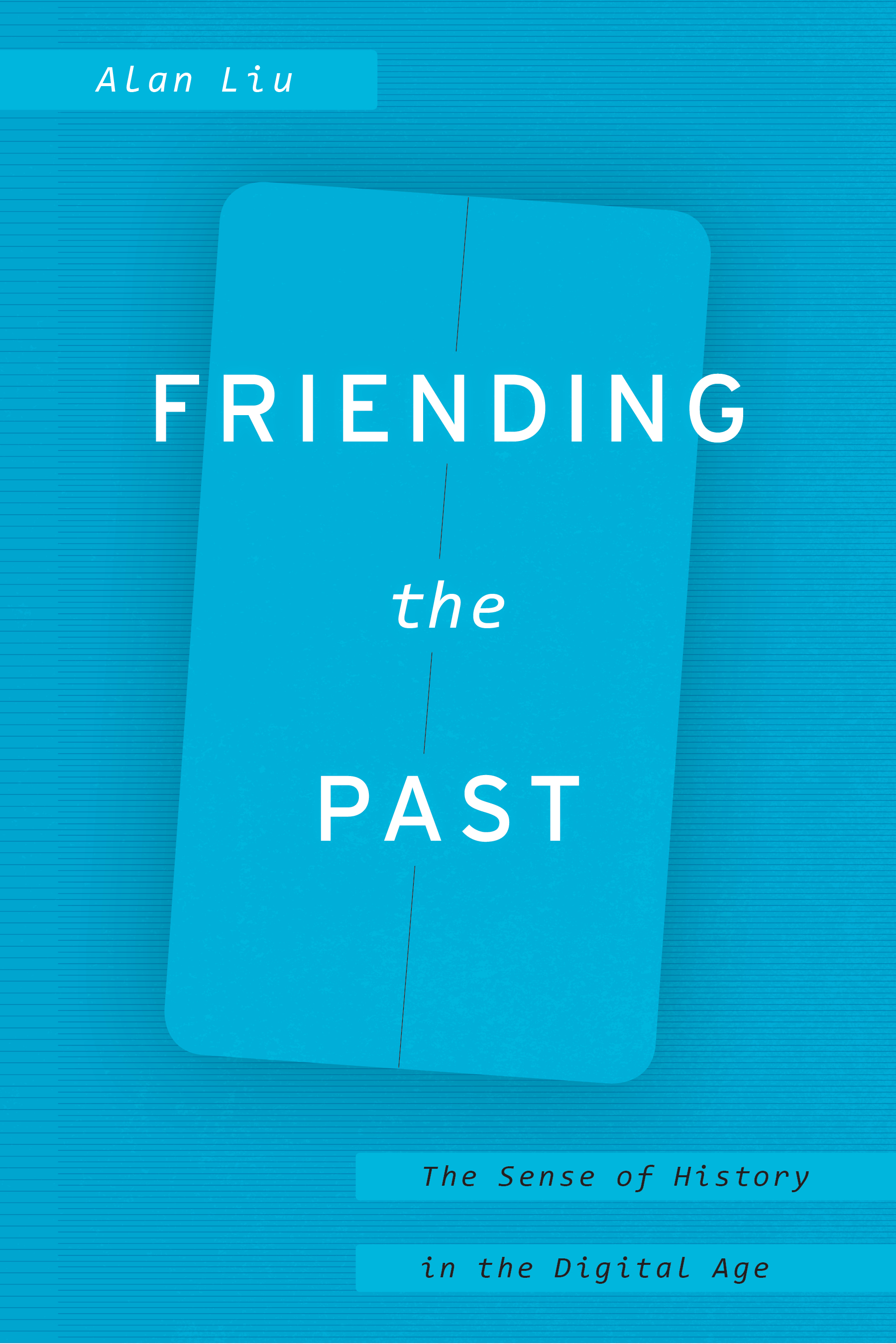
Citation: Friending the Past: The Sense of History in the Digital Age. Chicago: University of Chicago Press, 2018.

[336 pages, 49 halftones, ISBN paperback: 9780226451954; E-book: 9780226452005]

Video Companion video (talk by Alan Liu on the book) (recorded 4 May 2020; 47 min.)

Cover of Alan Liu, Friending the Past

book spine back cover back cover front cover

/ excerpt » /

“Open and Reproducible Workflows for the Digital Humanities–A 35,000-foot Elevation View.” Keynote at the Digital Bridges Symposium (Digital Bridges for Humanistic Inquiry project), University of Iowa and Grinnell College, 10 August 2018.

“Romanticism and Critical Infrastructure Studies.” Introduction to seminar co-led with Jacques Khalip on “Romanticism and Critical Infrastructural Studies.” NASSR 2018, Brown University, 22 June 2018.

Friending the Past: The Sense of History in the Digital Age. Chicago: University of Chicago Press, 2018 (forthcoming  November 2018).

Cover of Alan Liu, Friending the Past
Catalogue Copy

Can today’s society, increasingly captivated by a constant flow of information, share a sense of history? How did our media-making forebears balance the tension between the present and the absent, the individual and the collective, the static and the dynamic—and how do our current digital networks disrupt these same balances? Can our social media, with its fleeting nature, even be considered social at all?

In Friending the Past, Alan Liu proposes fresh answers to these innovative questions of connection. He explores how we can learn from the relationship between past societies whose media forms fostered a communal and self-aware sense of history—such as prehistorical oral societies with robust storytelling cultures, or the great print works of nineteenth-century historicism—and our own instantaneous present. He concludes with a surprising look at how the sense of history exemplified in today’s JavaScript timelines compares to the temporality found in Romantic poetry.

Interlaced among these inquiries, Liu shows how extensive “network archaeologies” can be constructed as novel ways of thinking about our affiliations with time and with each other. These conceptual architectures of period and age are also always media structures, scaffolded with the outlines of what we mean by history. Thinking about our own time, Liu wonders if the digital, networked future can sustain a similar sense of history.

[See abstracts for book and chapters]


Table of Contents

Acknowledgments

Introduction (abstract)

1          Friending the Past (abstract)

2          Imagining the New Media Encounter (abstract)

3          When Was Linearity? (abstract)

4          Remembering Networks (abstract)

5          Like a Sense of History (abstract)

Appendix: Hypothetical Machine-Learning Workflow for Studying the Sense of History


Book Abstract

Friending the Past asks if today’s society, increasingly captivated by up-to-the-minute information media, can have a sense of history. What is the relation between past societies whose media forms fostered a communal or self-aware sense of history—for example, storytelling in prehistorical oral societies, or the great print works of historicism in the nineteenth century—and today’s “instant” networked information society? How did the sense of history once balance between the feeling for the present and for the absent, the temporal and the social, the individual and the collective, and the static and the dynamic? And how do digital networks now change the balance? Blending the approaches of intellectual history, media studies, and digital humanities, the book proposes novel ways of thinking about the evolving sense of history. Topics include the relation between high-print historicism and social networking; narratives of “new media encounters” between societies; graphically visualized and conceptualized understandings of history; and “network archaeology” as the variant of media archaeology needed to grasp the networked texture of our contemporary feeling for history. At its close, the book calls the question: is there a sense of history in the digital, networked age? The book concludes with an example of what a digitally networked sense of history can be by examining (in a manner poised between “close reading” and “distant reading”) the code of one of today’s JavaScript “timelines” and comparing it to the experience of temporality encoded in William Wordsworth’s poetry during the era of romanticism.

Book Keywords:
digital humanities, historicism, history, information society, media, media archaeology, networks, romanticism, temporality, timelines


Chapter Abstracts

Introduction

Written fictionally in the voice of today’s “sense of history,” the introduction frames the central question of the book: in the age of digital media, digital networks, social networking, and data, can society have a sense of history comparable to that which characterized earlier eras of history and media? Speaking like a chorus in a Greek tragedy, the Sense of History speaks in character to reframe the problem as the transition from an older, interconnected circuit of meaning-making acts—”rhetoric representation interpretation”—to a later one: “communication information media.”

Chapter Keywords: communication, data, digital, information, interpretation, media, networks, representation, rhetoric, sense of history


Chapter 1: Friending the Past

Chapter 1 studies the change from prior senses of history to today’s “real time” sense of history—or instant sense of community—of social networks. How was the equivalent of a sense of history experienced, and mediated, in prehistorical oral cultures? How did print culture at the height of the history of the book, which coincided with narrative historicism in the mode of Leopold von Ranke (Historismus), alter the sense of history? And how do “Web 2.0” and social networking today yet again change the sense of history? Can today’s society “friend” past ones to imagine, and absorb, prior senses of history as a layered, enrichening texture of the present? What continuities—for example, of Internet transmissions following the routes once forced by imperial roads across conquered lands—lock the digital present to its historical past? But, also, what discontinuities allow past historicism and today’s information empire to challenge each other’s assumptions, thus enabling a more humane texture of the present mindful of the past?

Chapter Keywords: historicism, Historismus, history of the book, Leopold von Ranke, media determinism, narrative, oral culture, print culture, social networking, web 2.0


Chapter 2: Imagining the New Media Encounter

This chapter studies “narratives of new media encounter” (accounts of how individuals and societies react to the introduction of writing, radio, television, the Internet, Web 2.0, and so on) to suggest that major historical changes in the sociocultural order are mirrored in narratives of media history. Often, as in the case of Marshall McLuhan’s writings, such narratives follow a plot of progressivist media determinism—of necessary change from old media to new media—even as they also reveal the more ambivalent experience of a “contact zone” between civilizations. At once descriptive and interpretive, tales of new media encounter are a foundational form of media theory—a kind of media archaeology of media theory. They show how societies experience history as communication and information media, and communication and information media as history. They register the experience of history as media history. Finishing on the promising example of a recent collection of essays on the digital humanities, the chapter concludes by asking the critical question: what is an imaginatively enrichening rather than determinist and constraining narrative of new media encounter?

Chapter Keywords: contact zone, digital humanities, Marshall McLuhan, media archaeology, media determinism, media history, media theory, narrative, new media, old media,


Chapter 3: When Was Linearity?

Linearists, as they might be called, have staked deep claims of cultural and other value on the linear exposition of history, narrative, argument, and other forms of thought. Theorists of networks, hypertext, and other domains of today’s digital era stake equally significant claims on the nonlinear, often represented emblematically in network-style or other postlinear graphical visualizations. Indeed, they often elevate the importance of graphical knowledge in general. Informed by media history extending from oral culture and the history of the book to digital new media, this chapter asks the simplifying question: what if there never was any linearity to defend or to contest? What if the idea of linearity has always been an ideology deployed through graphical knowledge systems that are realized in graphics as the visualization of any era’s idea of authoritative linearity—for example, who gets to go to the front of a line and why—and ultimately of its sense of history? The chapter makes Wallace Stevens’s poem “The Idea of Order at Key West” (with its invocation of “meaningless plungings” yet also visualization of seas “portioned” into fixed “emblazoned zones”) a recurrent poetic touchstone of its argument–in part by using digital humanities text analysis methods to render the poem as visualizations.

Chapter Keywords: digital humanities, graphics, history of the book, ideology, linearity, media history, networks, oral culture, Wallace Stevens, visualization


Chapter 4: Remembering Networks

Chapter 4 begins on the paradigmatic instance of a hybrid print/digital work at the onset of the digital networked era—Agrippa (A Book of the Dead) by Dennis Ashbaugh, Kevin Begos, Jr., and William Gibson (1992)—to call for a method of “network archaeology” extending media archaeology. Network archaeology facilitates understanding the sense of history in our postlinear age of digital networks filled with buzzing, flitting ephemeral and dynamic artifacts making a mockery of archiving yet urgently requiring methods not just of archiving but of open, transparent archiving. Past eras created networked artifacts and systems in their own way. The chapter braids together research on web archiving, scientific workflows (data-analysis workflows facilitating reproducible research), data provenance, and digital humanities prosopography to make the case for remembering networks through new digital archiving methods. Remembering networks, it argues, is foundational for providing our networked age with its appropriate, distinctive sense of history.

Chapter Keywords: Agrippa (A Book of the Dead), media archaeology, network archaeology, networks, prosopography, provenance, reproducible research, scientific workflows, web archiving, William Gibson


Chapter 5: Like a Sense of History

This concluding chapter defines the sense of history of any era or culture as a set of parameters—ontological, epistemological, socio-historical, and others—that can be studied through a combination of close reading and digital humanities distant reading. Splitting the difference between close and distant reading, the chapter studies visualized “timelines” as a traditional mode of distant reading history (analyzing and visualizing long vistas of historical event). Then, to define the sense of history specific to the internet age, it “close reads” at the code level an influential contemporary form of history: digital timelines. Focusing on the genre of JavaScript digital timelines, which dynamically draw data from backend sources to populate the “document object model” (DOM) of web-based timelines in frontend interfaces, the chapter postulates that the digital era is characterized by its own sense of history—one attuned to the contingency of networks. Setting this contingent sense of history in relief against that of an earlier era, the chapter ends by comparing the TimelineJS Javascript timeline in particular to the time sense, and implicit timelines, in William Wordsworth’s poetry and romanticism. Code meets poetry at a junction between the internet era and the humanities.

Chapter Keywords: close reading, contingency, digital humanities, distant reading, JavaScript, networks, romanticism, sense of history, timelines, William Wordsworth

“‘Humanities digital cultural tools . . . technology computing culture society’ — James Smithies’s The Digital Humanities and the Digital Modern.” Book Launch for James Smithies’s The Digital Humanities and the Digital Modern, King’s College, London, 29 March 2018.

“Scoping Critical Infrastructure Studies.” Critical Infrastructures Studies Seminar, King’s College, London, 29 March 2018.

“Open and Reproducible Workflows for the Digital Humanities–A 10,000 Meter Elevation View.” Digital Humanities in the Nordic Countries Convention 2018. University of Helsinki, 7 March 2018.

  • Abstract: Can digital humanities projects that collect, analyze, and interpret texts and other materials make their provenance and data workflows transparent to others for reproduction or adaptation? How can the digital humanities learn from the workflow management systems of the “in silico” sciences? And how should they be different from the sciences? Ultimately, what is the combined humanistic and scientific meaning of open research–epistemological, infrastructural, institutional, and sociocultural–to which DH contributes? Extrapolating from the example of the “WhatEvery1Says” (WE1S) project, which he directs, Alan Liu offers a general humanistic vision of open, reproducible workflows for the digital humanities.
  • Video Video of this keynote talk (35 min.) taken from the audience by Timo Honkela (@THonkela).

Citation: “Digital Humanities Diversity as Technical Problem” Alan Liu, 15 January 2018. doi:10.5072/FK2222ZR81.

Update: A substantially expanded and revised version of this paper was published in 2020 as an article in PMLA titled “Toward a Diversity Stack: Digital Humanities and Diversity as Technical Problem.”

This paper was originally presented 5 January 2018 at MLA 2018, session 347 on “Varieties of Digital Humanities” (Twitter hashtags: #mla18, #s347). The original prompt to panelists (in an email from the organizers) was as follows: “The session corresponds with a planned 2019 special issue of PMLA on the same topic, and the talks at this panel may be published as an edited transcript…. Your talk would be about 10 minutes long, and we’d be interested in hearing your views on what’s next for digital humanities and/or what we can learn from what has come before.”The below version of my paper is revised to supply notes and to substitute links or references for slide images. Another change: two paragraphs elided at the live event due to lack of time–on “DH Re-imagination of Time-Space” and “Rhetorical DH”–are here included.

Clearly, there are further research directions for “digital humanities diversity as technical problem” to be explored beyond those I sketch here, but these are a beginning agenda.

15 January 2018

Our “Varieties of DH” panel addresses the methodological and social diversity of the digital humanities, in part by drawing on the digital humanities meme of the “big tent,” originally the declared theme of the international DH conference when it was held at Stanford University in 2011.[1]  To quote the program description for our panel today, DH is “expansive, movable, but precarious, a tent still not big enough in terms of diversity and access.”[2]

The “big tent” metaphor, of course, comes down to us from old-timey showcases of mass experience such as nineteenth-century tent revivals and big-top circuses. Those were just two of the mass architectures, apparatuses, institutions, and (to use Foucault’s word) dispositifs whose paradoxically open and enclosed forms stage-managed the modernizing encounter (variously democratic, cultic, or fascist) between an older, affinity-based sense of the Volk and the newer awareness–at once enraptured, entertained, and appalled–of social, racial, linguistic, geopolitical, and even “special” in the sense of cross-species) variety. Barnum & Bailey Circus poster, c. 1895, Library of CongressCircuses, for example, were spectacles of variety. As advertised in a nineteenth-century Barnum & Bailey poster, they are “a glance at the great ethnological congress” and also menagerie of “curious . . . animals.”[3] We can add earlier and later examples to the catalogue of paradoxically open/closed, inclusive/exclusive variety–for instance, the French Revolutionary Champs de Mars, whose remaking for the 1790 Fête of Federation famously convened Parisians both low and high[4]; Albert Speer’s “cathedral of light” (Lichtdom) ringed by searchlights at the Nuremberg Nazi rallies; and today’s conceptual architecture of  “open source” programming (not the “cathedral,” Eric Raymond memorably said, but the “bazaar”).[5]

What’s next for DH? I think what’s next is finally to put the “big tent” metaphor to rest. We need new paradigms and dispositifs or, in computer-speak, platforms for diversity that move the modern democratic paradox of open and closed (inclusive and exclusive) beyond nineteenth- and early-twentieth-century paradigms of mass “variety,” beyond the mid- to late-twentieth-century scientizing of such variety as statistical socioeconomics, and likely also beyond current “bags of words” cultural analytics approaches, which bring up the rear with topic models and other congregations of language standing in for the big tent (or bag) of mass human experience.

Among other things, in other words, diversity is a technical problem….


“Introduction to Critical Infrastructure Studies.” Panel on Critical Infrastructure Studies, Modern Language Association convention, New York, 6 January 2018.

“Digital Humanities Diversity as Technical Problem.” Modern Language Association convention, New York, 5 January 2018.

  • Excerpt: “Among other things, in other words, diversity is a technical problem. What’s next is for DH to help make advances in the technical platforms and methods for understanding–and also changing our understanding–of diversity née variety (two words with a common root but increasingly different meanings). That will require collaborating with the social sciences, information science, computer science, in silico STEM sciences, non-profits such as DataKind and ProPublica, and also Silicon Valley industry to foster a virtuous circle in which technical innovation drives the understanding of diversity, and the understanding of diversity drives technical innovation. Inasmuch as DH has a unique, as opposed to follow-on, contribution to make to cultural criticism (about which I asked some years ago), I think the techne of diversity may be it.”

“What Infrastructure Assumes.” The Futures of Literature, Science, and Media: A Symposium Honoring Professor N. Katherine Hayles. Duke University. 17 November 2017.

  • Abstract: In this talk, Alan Liu sketches the context and current methods of “critical infrastructure studies,” then proposes a “verb first” way of discussing infrastructure that rethinks the nature of infrastructural agency and its mode of “being” in the world. Infrastructure is assumed, but it also assumes.

“WhatEvery1Says About the Humanities.” Panel on “What Crisis?: Mobilizing the Humanities Through Data.” National Humanities Conference, 3 November 2017, Boston.


“Overview: Open, Shareable, Reproducible Workflows for the Digital Humanities.” Panel on “Open, Shareable, Reproducible Workflows for the Digital Humanities: The Case of the 4Humanities.org ‘WhatEvery1Says’ Project.” Digital Humanities 2017 conference, 11 August 2017, Montreal.

Citation:“Teaching ‘Literature+’: Digital Humanities Hybrid Courses in the Era of MOOCs.” Teaching Literature: Text and Dialogue in the English Classroom. Ed. Ben Knights. London: Palgrave Macmillan, 2017: 133-153.


“Critical Infrastructure Studies.” University of Wroclaw. 28 June 2017.

  • Abstract: In an era when complexly “smart” and hybrid material-virtual infrastructures ranging from the micro to the macro scale seem to obviate older distinctions between material base and cultural superstructure, how can the digital humanities and new media studies join in an emergent “critical infrastructure studies”? What are the traditions of such studies? What is the topic’s scope? What are some especially high-value areas for intervention by digital humanists and new media scholars/artists? And how can digital scholars in the humanities and arts collaborate with digital social scientists taking up similar matters? In this seminar, Alan Liu will lead a seminar among participants that considers the question: is critical infrastructure studies today’s distinctive mode of “cultural criticism”? (Participants are asked to read a pre-circulated paper by Liu titled “Toward Critical infrastructure Studies: Digital Humanities, New Media Studies, and the Culture of Infrastructure.”)

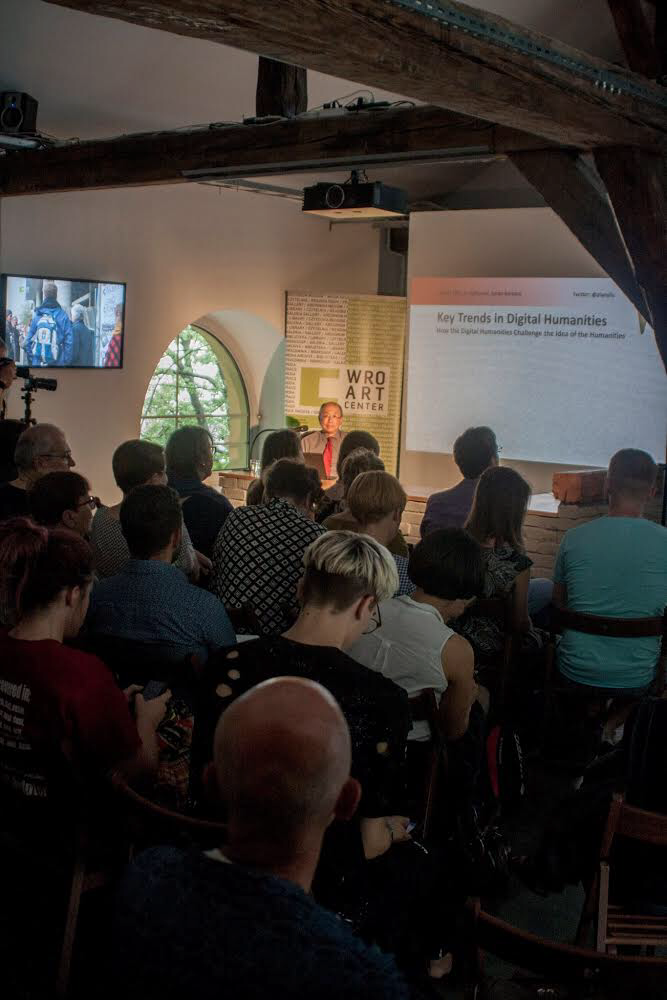
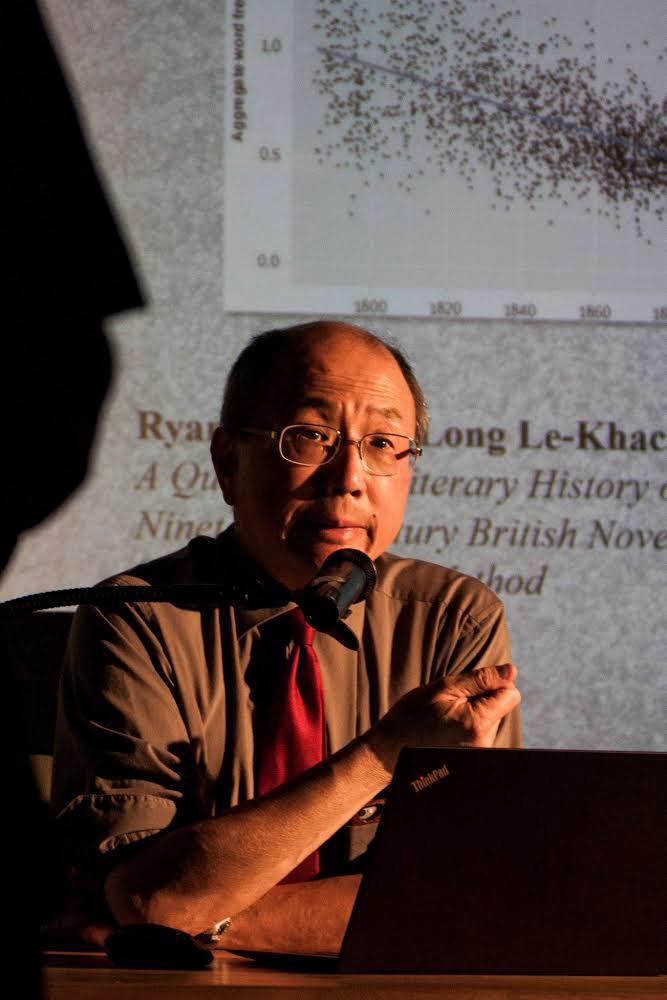
“Key Trends in the Digital Humanities — How the Digital Humanities Challenge the Idea of the Humanities.” WRO Art Center, Wroclaw, Poland. 27 June 2017.

  • Abstract: How do key methods in the digital humanities such as data mining, mapping, visualization, social network analysis, and topic modeling make an essential difference in the idea of the humanities, and vice versa? Using examples of digital humanities research, Alan Liu speculates on the large questions that confront the humanities in the face of computational media–most importantly, questions about the nature and function of interpretive “meaning.”
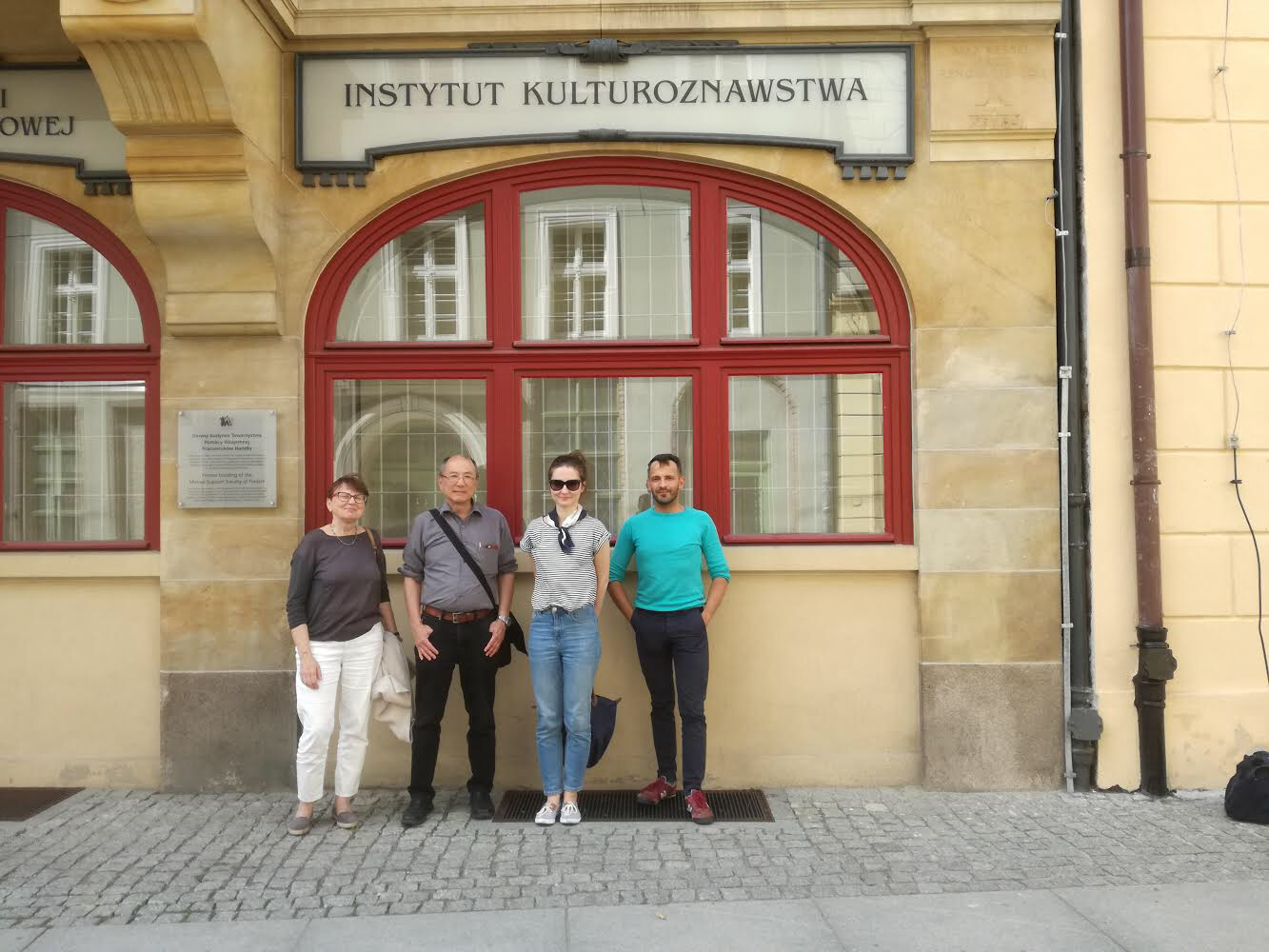
Talk at WRO Art Center, Wroclaw   Talk at WRO Art Center, Wroclaw   With (left to right) Dorota Wolska, Alexandra Kil, and Jacek Ma?czy?ski of the University of Wroclaw's Laboratory of Contemporary Humanities (in the Department of Cultural Studies


Citation: “Assessing Data Workflows for Common Data ‘Moves’ Across Disciplines” Alan Liu, 6 May 2017. doi: 10.21972/G21593.

This is a slightly revised version of my position paper for the “Always Already Computational: Collections as Data” Forum, UC Santa Barbara, March 1-3, 2017. (The original version is included among a collection of such position statements by participants in the conference.) A further revised version was later published as “Data Moves: Libraries and Data Science Workflows,” in Libraries and Archives in the Digital Age, ed. Susan L. Mizruchi (Cham: Palgrave Macmillan, 2020), 211–19, https://doi.org/10.1007/978-3-030-33373-7_15.

6 May 2017

In considering how library collections can serve as data for a variety of data ingest, transformation, analysis, reproduction, presentation, and circulation purposes, it may be useful to compare examples of data workflows across disciplines to identify common data “moves” as well as points in the data trajectory that are especially in need of library support because they are for a variety of reasons brittle.

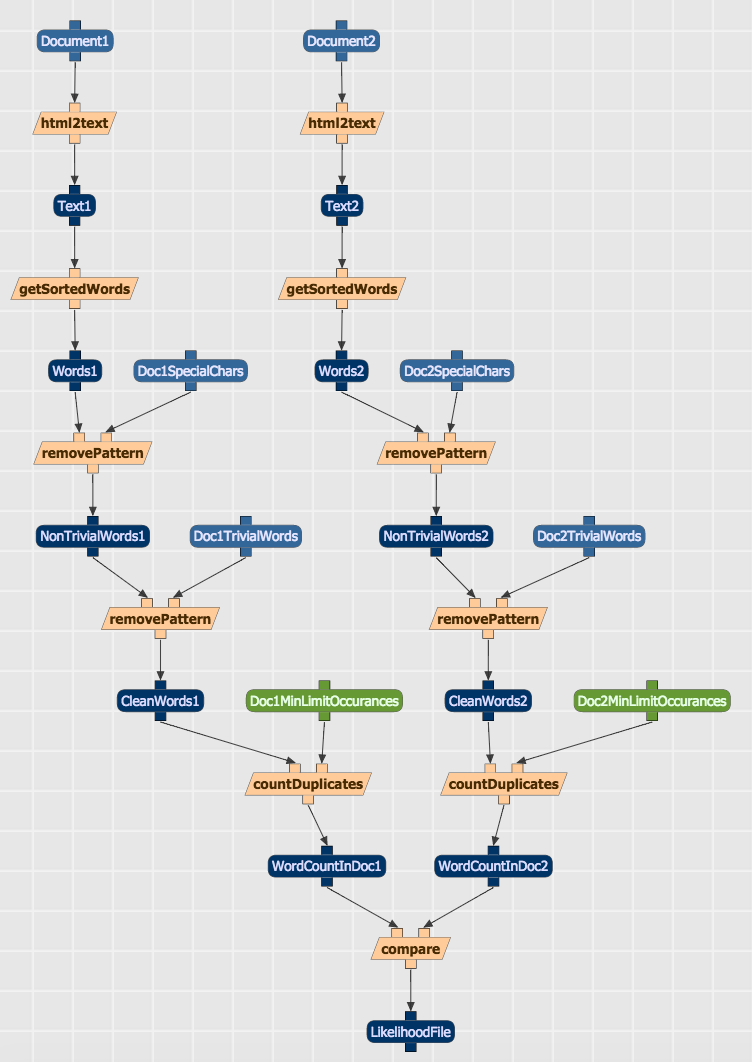
Wings system workflow diagram.

Fig. 1 – Example of data workflow visualized in the Wings workflow system (from the Wings tutorial)

We might take a page from current research on scientific workflows in conjunction with research on data provenance in such workflows. Scientific workflow management is now a whole ecosystem that includes integrated systems and tools for creating, visualizing, manipulating, and sharing workflows (e.g., Wings, Apache Taverna, Kepler, etc.). At the front end, such systems typically model workflows as directed, acyclic network graphs whose nodes represent entities (including data sets and results), activities, processes, algorithms, etc. at many levels of granularity, and whose edges represent causal or logical dependencies (e.g., source, output, derivation, generation, transformation, etc.) (see fig. 1). Data provenance (or “data lineage” as it has also been called in relation to workflows) complements that ecosystem through standards, frameworks, and tools–including the Open Provenance Model (OPM) the W3C’s PROV model, ProvONE, etc. Linked-data provenance models have also been proposed for understanding data-creation and -access histories of relations between “actors, executions, and artifacts.” In the digital humanities, the in-progress “Manifest” workflow management system combines workflow management and provenance systems. . . .


“Open, Shareable, Reproducible Workflows for the Digital Humanities: The Case of the 4Humanities.org ‘WhatEvery1Says’ Project.” University of Sussex. 29 March 2017.

  • Abstract: Can digital humanities projects that collect, analyze, and interpret texts and other materials make their provenance and workflow transparent to others? Can such workflows be shared for reproduction or adaptation? How can the digital humanities learn from the workflow management systems of the “in silico” sciences? And how in this regard should they be different from the sciences? Using as example the in-progress “WhatEvery1Says” (WE1S) project he leads (which is topic modeling articles mentioning the humanities in newspapers), Alan Liu offers a general vision of open, shareable, and reproducible workflows for the digital humanities. He also speculates on what is at stake from the viewpoint of humanists more broadly.
 

“Toward Critical infrastructure Studies: Digital Humanities, New Media Studies, and the Culture of Infrastructure.” University of Connecticut, Storrs. 23 February 2017.

  • Abstract: In an era when complexly “smart” and hybrid material-virtual infrastructures ranging from the micro to the macro scale seem to obviate older distinctions between material base and cultural superstructure, how can the digital humanities and new media studies join in an emergent “critical infrastructure studies”? What are the traditions of such studies? What is the topic’s scope? What are some especially high-value areas for intervention by digital humanists and new media scholars/artists? And how can digital scholars in the humanities and arts collaborate with digital social scientists taking up similar matters? In this keynote talk, Alan Liu considers the hypothesis that today’s “cultural studies” is a mode of critical infrastructure studies.
  • Video Video of lecture with introductions and Q & A (slides not shown) (1hr, 32 min.)

“Digital Humanities and Critical Infrastructure Studies.” DHU2 (2017 Digital Humanities Symposium Utah. University of Utah. 10 February 2017.

“‘Wild Surmise’: How Humanists and Artists Discovered the Internet at UCSB, c. 1994 — An Origins Story.” University Library, UC Santa Barbara. 13 June 2017.

  • Abstract: How did humanities and arts computing start at UCSB in the era of the beginning of the Web? How did our campus become one of the early leaders in scholarly use and study of the Internet by humanists? In this talk, Alan Liu provides a glimpse of the origin of his Voice of the Shuttle Web site for humanities research, the UCSB Many Wolves Authoring Collective, the Ultrabasic Guide to the Internet for Humanities Users at UCSB, the original Humanitas.ucsb.edu server, the first department-based server in the humanities, and other greatest hits of the very, very early online era at UCSB. What did the world look like in 1994 from the perspective of humanists browsing on a 2400-baud modem with Lynx and Mosaic?

“The Digital Humanities: A Window on Tomorrow’s Structures of Humanities Knowledge.” Mellon Foundation, New York City. 2 November 2016.

“Infrastructure.” Penn State Center for Humanities and Information, Pennsylvania State University. 28 October 2016.


“WhatEvery1Says About the Humanities — Digital Humanities Methods for Understanding and Making a Difference in Public Perception of the Humanities.” Dartmouth College. 20 September 2016.

  • Abstract: Drawing on research and advocacy conducted by the 4humanities.org initiative that he founded, Alan Liu discusses the contemporary public perception of the humanities, methods of using digital research and communications to develop effective humanities advocacy, and the broader question of the future of humanities disciplines. Part of the talk focuses on the in-progress 4Humanities “WhatEvery1Says” project, which uses topic-modeling and other digital methods to study a large corpus of articles about the humanities in the media with the aim of assisting the humanities in reframing the debate. How does data mining newspapers, magazines, etc. help put in perspective the themes–some might call them “memes”–declared in headlines about the decline of the humanities, the crisis of the humanities, etc.?

“From Cultural Studies to Infrastructure Studies? (Digital Humanities and Critical Infrastructure Studies).” Dartmouth College. 20 September 2016.


“Digital Humanities: Overview and the Example of the 4Humanities.org WhatEvery1Says Project.” University of Mannheim. 31 August 2016.


Citation:”Hacking the Voice of the Shuttle: The Growth and Death of a Boundary Object.” Social Media Archeology and Poetics. Ed. Judy Malloy. Cambridge, MA: MIT Press, 2016: 261-271.

  • Full text (open-access author’s pre-copy-edited final version in institutional repository, PDF)


KCSB-FM Interview with Alan Liu on “The Importance of the Humanities.” Interview by KCSB-FM Associate News Director Kendra Lee. 11 August 2016. Santa Barbara/Mannheim.


Citation:“Is Digital Humanities a Field? — An Answer from the Point of View of Language.” Journal of Siberian Federal University: Humanities and Social Sciences 7 (2016): 1546-1552.


“What Infrastructure Means to Me.” Interrogating Infrastructure Symposium, King’s College. 8 July 2016.


The following writings by Alan Liu are available online in open-access full text form.

“The 4Humanities WhatEvery1Says Project: Initial Work and Future Plans.” SyncDH, University of California, Santa Barbara. 27 May 2016.

« Previous PageNext Page »