Citation:“Is Digital Humanities a Field? — An Answer from the Point of View of Language.” Journal of Siberian Federal University: Humanities and Social Sciences 7 (2016): 1546-1552.


“What Infrastructure Means to Me.” Interrogating Infrastructure Symposium, King’s College. 8 July 2016.


The following writings by Alan Liu are available online in open-access full text form.

“The 4Humanities WhatEvery1Says Project: Initial Work and Future Plans.” SyncDH, University of California, Santa Barbara. 27 May 2016.

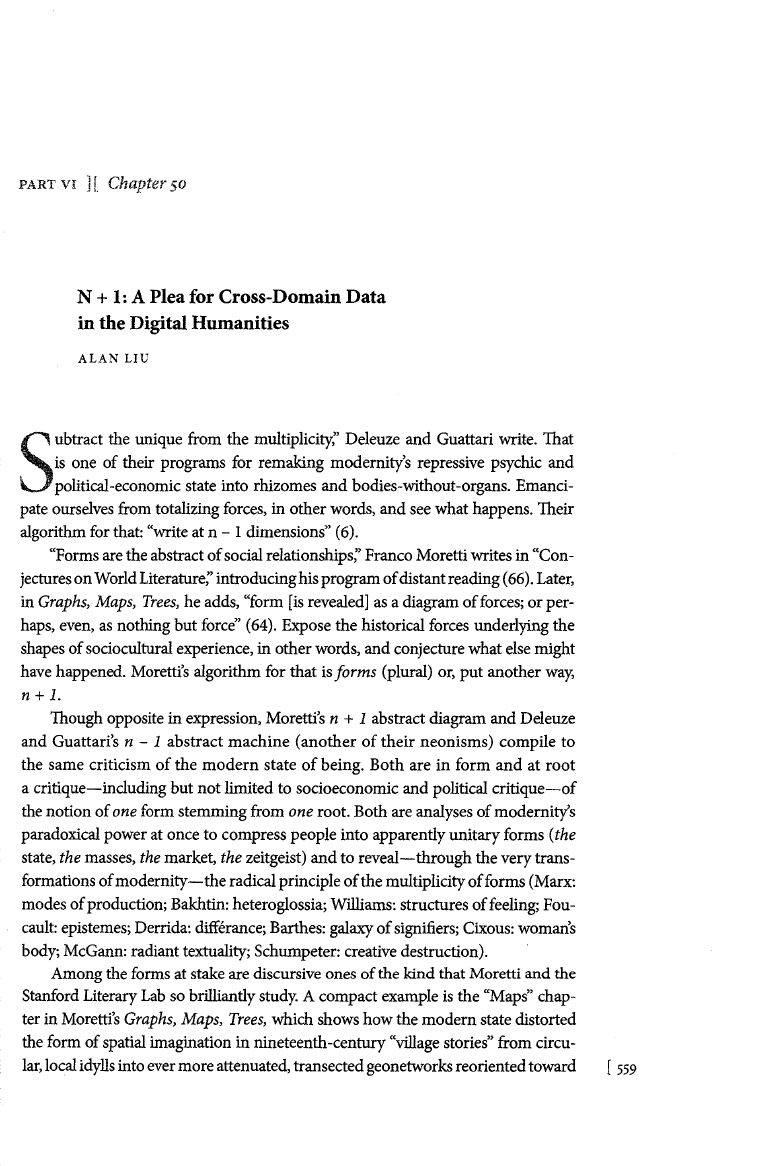
"N + 1: A Plea for Cross-Domain Data in the Digital Humanities"

First page

Citation:”N + 1: A Plea for Cross-Domain Data in the Digital Humanities.” Debates in the Digital Humanities 2016. Ed. Matthew K. Gold and Lauren F. Klein. University of Minnesota Press, 2016: 559-568.


Citation: “Drafts for Alan Liu, Against the Cultural Singularity (book in progress.” Alan Liu, 2 May 2016. https://liu.english.ucsb.edu/drafts-for-against-the-cultural-singularity

Excerpt

The following is draft work (notes and bibliography not included) from one of my books in progress tentatively titled Against the Cultural Singularity: Digital Humanities & Critical Infrastructure Studies. Excerpted  are a few portions from the beginning of the manuscript that bear on the critical potential of the digital humanities and critique.

For a talk including this material as well as additional excerpts from my book in progress, see the video recording of my contribution to the Workshop on “Frontiers of DH: Humanities Systems Infrastructure,” University of Canterbury, 12 November 2015 (delivered as part of a series in New Zealand during my Fulbright Specialist residency at U. Canterbury, October-November, 2015.)

2 May 2016

My aim in this book is to make a strategic intervention in the development of the digital humanities.  Following up on my 2012 essay, “Where is Cultural Criticism in the Digital Humanities?”, I call for digital humanities research and development informed by, and able to influence, the way scholarship, teaching, administration, support services, labor practices, and even development and investment strategies in higher education intersect with society, where a significant channel of the intersection between the academy and other social sectors, at once symbolic and instrumental, consists in shared but contested information-technology infrastructures.  I first lay out in the book a methodological framework for understanding how the digital humanities can develop a mode of critical infrastructure studies.  I then offer a prospectus for the kinds of infrastructure (not only research “cyberinfrastructures,” as they have been called) whose development the digital humanities might help create or guide.  And I close with thoughts on how the digital humanities can contribute to ameliorating the very idea of “development”–technological, socioeconomic, and cultural–today.

Method (1)

The first step–framing for the digital humanities a suitable methodological framework for critical digital infrastructure studies–is challenging, given that the digital humanities are maturing after the late twentieth-century bloom of humanities “theory” and “cultural criticism,” which I here group together (grosso modo) under the name “critique”. . . .


Citation: “Drafts for Against the Cultural Singularity (book in progress).” Alan Liu, 2 May 2016. doi:10.21972/G2B663. https://liu.english.ucsb.edu/drafts-for-against-the-cultural-singularity

The following is draft work (notes and bibliography not included) from one of my books in progress tentatively titled Against the Cultural Singularity: Digital Humanities & Critical Infrastructure Studies. Excerpted  are a few portions from the beginning of the manuscript that bear on the critical potential of the digital humanities and critique.

For a talk including this material as well as additional excerpts from my book in progress, see the video recording of my contribution to the Workshop on “Frontiers of DH: Humanities Systems Infrastructure,” University of Canterbury, 12 November 2015 (delivered as part of a series in New Zealand during my Fulbright Specialist residency at U. Canterbury, October-November, 2015.)

2 May 2016

My aim in this book is to make a strategic intervention in the development of the digital humanities.  Following up on my 2012 essay, “Where is Cultural Criticism in the Digital Humanities?”, I call for digital humanities research and development informed by, and able to influence, the way scholarship, teaching, administration, support services, labor practices, and even development and investment strategies in higher education intersect with society, where a significant channel of the intersection between the academy and other social sectors, at once symbolic and instrumental, consists in shared but contested information-technology infrastructures.  I first lay out in the book a methodological framework for understanding how the digital humanities can develop a mode of critical infrastructure studies.  I then offer a prospectus for the kinds of infrastructure (not only research “cyberinfrastructures,” as they have been called) whose development the digital humanities might help create or guide.  And I close with thoughts on how the digital humanities can contribute to ameliorating the very idea of “development”–technological, socioeconomic, and cultural–today.

Method (1)

The first step–framing for the digital humanities a suitable methodological framework for critical digital infrastructure studies–is challenging, given that the digital humanities are maturing after the late twentieth-century bloom of humanities “theory” and “cultural criticism,” which I here group together (grosso modo) under the name “critique.”  The late-comer status of the digital humanities in this regard is epitomized in the field’s debate a few years ago about “hack versus yack.”  Should digital humanists primarily program, build, or make (hack)?  Or should they instead critically interpret and theorize information media, past and present, in a manner much like normative humanities research (yack)?  At core, the debate is not really about theorized critique versus something other than such critique.  Instead, the debate situates the digital humanities at a fork between two branches of late humanities critique.  One, a hack branch (sometimes referred to as “critical making”), affiliates with, but is often more concretely pragmatic, than “thing theory,” the new materialism, actor-network theory, assemblage theory, and similar late poststructuralist theories.  The other, a yack branch, descends from the not unrelated critical traditions of Frankfurt School “critical theory,” deconstruction, Foucauldian “archaeology,” cultural materialism, postcolonial theory, and gender and race theory–especially as all these have now been inflected by media studies.

In short, the question is not whether the digital humanities should include theorized critique.  At some level, and especially in some branches, the field already does by virtue simply of belonging to the family of the contemporary humanities.  Instead, the question is what sort of critique is uniquely appropriate and purposive for the digital humanities.  What critique, in other words, not only allows the field to assist mainstream humanities critique but could not be conducted except through digital humanities methods that use technology self-reflexively as part of the very condition, and not just facility, of critically knowing and acting on culture today?

The answer to this question, I suggest, is critique at the level of, and articulated through, infrastructure–where “infrastructure,” the social-cum-technological milieu that at once enables the fulfillment of human experience and enforces constraints on that experience, today has much of the same scale, complexity, and general cultural impact as the idea of “culture” itself.  Indeed, it may be that in late modernity when the bulk of life and work occurs in organizational institutions of one kind or another, the experience of infrastructure at institutional scales (undergirded by national or regional infrastructures such as electricity grids and global-scale infrastructures such as the Internet) is operationally the experience of “culture.”  Put another way, the word “infrastructure” can now give us the same kind of general purchase on social complexity that Stuart Hall, Raymond Williams, and others sought when they reached for their all-purpose word, “culture.”  Consider the way dystopian films produced at the onset of the digital information age such as Blade Runner (1982) and the Mad Max films (beginning in 1979) characterized whole cultures by foregrounding infrastructure–in the former: glistening, noir cityscapes defined by transportation and media technology; in the latter: desert landscapes defined by fuel and water supply systems. Those films gave a foretaste of the way late-modern infrastructure is increasingly the mise-en-scène of culture.  Daily life steeps us in pervasive encounters with transportation, media, and other infrastructures that do not just neutrally convey the experience of culture but are visibly parts of our cultural experience. Late modernity is thus car culture, cable TV culture, Internet culture, smartphone culture, and any other kind of “cool” culture where, as I studied in my Laws of Cool, “cool” is a cultural affect of both “smart” technologies and the knowledge workers who use them to be, or at least look, smart.

The consequence of such convergence between infrastructure and culture for critique may be predicted as follows: especially in the digital humanities, critique must now begin to focus on infrastructure in order to have any hope of creating tomorrow’s equivalents of the great cultural-critical statements of the past. Tomorrow’s E. P. Thompson writing about the making of the working class, C. Wright Mills about white collars, Raymond Williams about culture and society, Michel Foucault about discipline, Judith Butler about gender and performativity, Donna Haraway about cyborgs, or Homi Bhaba about hybridity–among many more who could be cited–will need to include in their critiques attention to infrastructure as that cyborg being whose making, working, disciplining, performance, gender formation, and hybridity are increasingly part of the core identity of late modern culture.

What would the method for such a digital humanities cultural criticism focused on infrastructure actually look like? [material elided here]  . . . [P]rosaically, the style of digital humanities infrastructural critique I imagine–one that takes advantage of modes of thinking already prevalent in the field–may be called lightly-antifoundationalist.  The question that I concoct this phrase to answer is how much antifoundationalism–or, perhaps “anti-groundwork” (to allude to Marx’s Grundrisse der Kritik der Politischen Ökonomie)–is actually useful for critical infrastructure studies.  Mainstream humanistic critique (the “hermeneutics of suspicion” that Rita Felski has recently taken to task in her critique of critique) has often been antifoundationalist all the way down according to a three-stage logic that might be outlined as follows.

In its first logical moment, critique recognizes that the “real,” “true,” or “lawful” groundwork (i.e., infrastructure) for anything, especially the things that matter most to people, such as the allocation of goods or the assignation of identity, is ungrounded.  For example, while there are material reasons for resource allocation and the social relations of force needed to do that dirty deed–i.e., for political economy and society–any particular political economy and society are arbitrary and, in the last analysis, unjust.  Political economy and society are thus not grounds but, to play on the word, precisely groundworks: particular ways of working the ground (i.e., a mode of production) supported by discursive, epistemic, psychic, and cultural institutions for ensuring that the work continues in the absence of rational or moral foundation.

In its second logical moment, critique then goes antifoundationalist to the second degree by criticizing its own standing in the political-economic system–a recursion effect attested in now familiar, post-May-1968 worries that critics themselves are complicit in elitism, “embourgeoisment,” “recuperation,” “containment,” and majoritarian identity, not to mention tenure.

Finally, in its third logical moment, critique seeks to turn its complicity to advantage–for example, by positioning critics as what Foucault called embedded or “specific intellectuals” acting on a particular institutional scene to steer social forces.  A related idea is to go “tactical” in the manner theorized by Michel de Certeau, who argued that people immured in any system can appropriate that system’s infrastructure through bottom-up agency for deviant purposes (as in his paradigm of jaywalking in the city).  Media critics, including new media critics, have generalized de Certeau’s notion in the name of “tactical media,” meaning media whose platforms, channels, interfaces, and representations can be appropriated by users for alternative ends.

In general, the digital humanities tend to do things according to methods that slice out from the above total arc of critique just the latter tactical moment.  Such slicing–hacking critique to severe its roots from purist antifoundationalism–brings digital humanities critique into the orbit of several late- or post-critical approaches with a similar style (style rather than full-blown theory precisely because they eschew foundational purity).  One approach that James Smithies has associated with the digital humanities is “postfoundationalism” in his “Digital Humanities, Postfoundationalism, Postindustrial Culture.”  Borrowing from the philosopher of science Dimitri Ginev, Smithies argues that postfoundationalism is “an intellectual position that balances a distrust of grand narrative with an acceptance that methods honed over centuries and supported by independently verified evidence can lead, if not to Truth itself, then closer to it than we were before” (¶ 26).  Postfoundationalism is thus well matched to the digital humanities, Smithies suggests, if we think of the digital humanities as “a process of continuous methodological and . . . theoretical refinement that produces research outputs as snapshots of an ongoing activity rather than the culmination of ‘completed’ research” (¶ 29).  A related idea is “critical technical practice,” which Michael Dieter (“The Virtues of Critical Digital Practice”)–building on Philip Agre’s writings on artificial intelligence research–makes a goal of the digital humanities.  Dieter quotes from Agre: “The word ‘critical’ here does not call for pessimism and destruction but rather for an expanded understanding of the conditions and goals of technical work. . . .  Instead of seeking foundations it would embrace the impossibility of foundations, guiding itself by a continually unfolding awareness of its own workings as a historically specific practice.”  Other ideas that are lightly-foundationalist in this way, though not to my knowledge yet applied to the digital humanities, include Bruno Latour’s “compositionism” (fixed on neither absolute foundations of knowledge nor absolutist refutations of such foundations but instead on mixed, impure, make-do, and can-do compositions of multiple positions; “An Attempt at a ‘Compositionist Manifesto’,” PDF) and Ackbar Abbas and David Theo Goldberg’s “poor theory” (which uses “tools at hand” and “limited resources” to engage “with heterogeneous probings, fragmentary thinking, and open-endedness” in resistance to “totalization, restriction, and closure”) (“Poor Theory: Notes Toward a Manifesto”, PDF).

All these lightly-antifoundationalist approaches are tactical rather than strategically pure because their very potential for critique arises from polluting proximity to, and sometimes even partnership with, their objects of critique.  Unlike distantiated critique, that is, tactical critique (as the root of the word “tactic” might indicate) makes contact.  Smithies thus notes postfoundationalism’s function as a “bridging concept” for the “interdependence” and “entanglement” of the digital humanities with postindustrialism (¶ 8, 3, 2).  Indeed, I add that all the approaches thus far mentioned as a “light foundation” for critical infrastructure studies are similarly contaminated by the double principle of efficiency and flexibility, which (as I articulated in my The Laws of Cool) is the two-stroke engine of the postindustrial mode of production.  As it were, all the approaches I have mentioned are instances of “lean” and “just-in-time” critique and thus not dissimilar in spirit to the in-house critique that postindustrial corporations at the end of the twentieth century began to design into their own production lines by famously empowering workers to “stop the line” ad hoc (or, less catastrophically, to suggest incremental improvements) when they saw something wrong.  Such dirty contact with postindustrialism is both the weakness and strength of lightly-antifoundationalist approaches, where weakness means being swallowed up by the system and strength comes from getting close enough to the system to know its critical points of inflection, difference, and change.  If, as Smithies says, the digital humanities are “deeply entangled” in postindustrialism, in other words, entanglement need not be the same as equivalence.  It is also engagement.

The critical potential of this tendency in the digital humanities to be lightly-antifoundationalist can now be stated: it is precisely the ability to treat infrastructure not as a foundation, a given, but instead as a tactical medium that opens the possibility of critical infrastructure studies as a mode of cultural studies.  And it is such cultural studies that will allow the digital humanities to fulfill their final-cause critical function at the present time, which is to help adjudicate how academic infrastructure connects higher education to, but also differentiates it from, the workings of other institutions in advanced technological societies.  The critical function of the digital humanities going forward, in other words, is to assist in shaping smart, ethical academic infrastructures that not only further normative academic work (research, pedagogy, advising, administration, etc.) but also intelligently transfer some, but not all, values and practices in both directions between higher education and today’s other powerful institutions–business, law, medicine, government, the media, the creative industries, NGOs, and so on.

Method (2)

At present, some of the most influential general understandings of infrastructure cited by digital humanists such as Sheila Anderson and James Smithies studying humanities cyberinfrastructure in particular have been the Large Technical Systems (LTS) approach, stemming originally from the historian Thomas Hughes’s Networks of Power (1983), and the information-ethnography approach stemming from Susan Leigh Star, Geoffrey Bowker, and their circle. Good expositions of both are combined in one of the best conceptualizations of infrastructure I have so far found: a document of 2007 titled “Understanding Infrastructure: Dynamics, Tensions, and Design” (PDF) (whose authors include Bowker) representing the final report to the National Science Foundation of a workshop it sponsored.

Adding to these general approaches to infrastructure, I borrow in this book another portfolio of thought that to my knowledge has not yet been introduced directly to infrastructure studies. It is also a portfolio largely unknown in the digital humanities and, for that matter, in the humanities as a whole even though it is broadly compatible with humanities cultural criticism.  The portfolio consists of the “neoinstitutionalist” approach to organizations in sociology and, highly consonant, also “social constructionist” (especially “adaptive structuration”) approaches to organizational infrastructure in sociology and information science.  Taken together, these approaches explore how organizations are structured as social institutions by so-called “carriers” of beliefs and practices (i.e., culture), among which information-technology infrastructure is increasingly crucial.  Importantly, these approaches are a social-science version of what I have called lightly-antifoundationalist.  Scholars in these areas “see through” the supposed rationality of organizations and their supporting infrastructures to the fact that they are indeed social institutions with all the irrationality that implies.  But they are less interested in exposing the ungrounded nature of organizational institutions and infrastructures (as if it were possible to avoid or get outside them) than in illuminating, and pragmatically guiding, the agencies and factors involved in their making and remaking.  Such approaches are thus inherently a good match for the epistemology of building, unbuilding, and rebuilding in the digital humanities.

More than a good match, neoinstitutionalism and the social science of organizational technologies offer exactly the right tactical opening for a digital humanities cultural criticism because they are all about the site on which the already existing critical force of the digital humanities is pent up: institutional forms of technologically-assisted knowledge work.  After all, the digital humanities stand in contrast to new media studies and network critique among cousin fields as the branch of digitally-focused humanities work that has been primarily focused on changing research, authorship, dissemination, and teaching inside (and across) academic institutions and related cultural or heritage institutions rather than on broader commentary directed externally at society and social justice.  The digital humanities are all about developing analytical, publishing, curatorial, and hybrid-pedagogical tools and practices at scales ranging from standalone projects to federated or regional frameworks; creating new university programs and centers; changing the accepted notion of academic careers (e.g., to include “alt-ac” alternative academic careers); and, ultimately, instilling a new scholarly digital ethos in the academy in the name of “collaboration” and “open access.”  As a consequence, the existing critical energy of the digital humanities–sometimes quite passionate and even militant–has been primarily devoted to such institutional issues.  Breaking down the paywalls of closed publication infrastructures, for instance, is the digital humanities version of storming a university administration building in the 1970s.

Can neoinstitutional and social-structuration-of-technology approaches to understanding the evolving relation between the academic institution and today’s more domineering institutions (most notably, business and government) help the digital humanities release its intramural critical energy?  Can that release help propel not just change in higher education but, through higher education and the technological infrastructures that mediate its relationship to other institutions, also extramural change in the larger society that higher ed contributes to?  (Besides its focus on culture, I note, one of the special strengths of neoinstitutionalism that make it attractive to add it to Large Technical System analyses of infrastructure is that it is especially attuned to studying change and divergence among dominant institutional systems.)  In short, can the considerable existing intelligence, idealism, and moral force of the digital humanities be redirected from being only an instrument of institution work to becoming through interventions in instrumental infrastructure also a way to act on institutions and their wider social impact?

But I do not wish to overreach, which is also why I think an approach focused on institutions and their infrastructures is particularly appropriate.  Ultimately, the digital humanities field must be critical in a way that does not ask it inauthentically to reach beyond its expertise and mandate to bear exaggerated responsibility for larger social phenomena.  Acting out through the digital humanities about larger social issues is necessary.  But such actions must be complemented by creating infrastructures and practices that make their social impact by being what Susan Leigh Star called “boundary objects”–in this case boundary objects situated between the academic institution and other major social institutions.  It is in this boundary zone–just as one example, “content management system” infrastructures whose use by scholars oscillates between corporate “managed” and “open community” philosophies–that higher education can most pertinently influence, and be influenced by, other institutions through what I earlier called “shared but contested information-technology infrastructures.”  It is in this boundary zone of hybrid scholarly, pedagogical, and administrative institutional infrastructure that we need the attention of skilled and thoughtful digital humanists, even if the interventions they make are not called anything as ambitious as “activism” but instead simply “building.”

[End of excerpt]

“Practice and Theory of ‘Distant Reading’ — An Introductory Workshop on Digital Humanities Methods.” University of San Francisco, 1 March 2016.

  • Abstract: In this beginner’s hands-on workshop and discussion, Alan Liu will introduce the idea of “distant reading” and some of the commonly used digital humanities methods and tools used to pursue it in digital literary studies, digital history, sociology, and other humanities and social science disciplines. Methods covered include text analysis, topic modeling, and social network analysis. Workshop participants will try their hand at one or more tools used for these methods, aiming not for mastery or even competence but just to capture an interesting “souvenir,” e.g., a screenshot. (For the purposes of the workshop, even failed attempts can produce an interesting souvenir.)  Liu will then lead a broader discussion based on the souvenirs about the opportunities and limitations of digital humanities methods. (A Web site for the workshop with detailed agenda and resources will be made available in advance to enrolled workshop participants.)
    • Workshop Agenda
    • Workshop “Souvenirs” (Examples and screenshots produced by workshop participants)
    • Workshop Workstation Set-up (Software, data resources, and workspace for the workshop. This page is designed to aid U. San Francisco technical staff in setting up the machines in the lab. However, workshop participants can use the specs to set up a duplicate of the working environment for the workshop on their own computers if they wish.)


“The Future of the Humanities / The Future and the Humanities.” University of San Francisco. 29 February November 2016.

  • Abstract: Drawing on research and advocacy conducted by the 4humanities.org initiative that he co-founded, Alan Liu discusses the contemporary public perception of the humanities, methods of using digital research and communications to develop effective humanities advocacy, and the broader question of the “future” of humanities disciplines, many of which consider history and the past to be their core. What is the relationship of the humanities to the future? And how can designing a stance on humanities and the future position the humanities disciplines to draw on, but also to help reform, today’s power discourses of “invention,” “innovation,” “disruption,” and “creativity”? The talk details in particular the 4Humanities “WhatEvery1Says” project, which uses digital methods to study a large corpus of media and other public speech about the humanities in order to assist the humanities in reframing the debate.

“How to Be a Humanist in the Year 2030: Digital Humanities and the New Norms of Scholarship (A Prophecy).” Critical Speaker Series. University of North Carolina, Chapel Hill. 10 February 2016.

“Key Trends in Digital Humanities — How the Digital Humanities Challenge the Idea of the Humanities.” Critical Speakers Series. University of North Carolina, Chapel Hill, 9 February 2016.

  • Abstract: How do such key methods in the digital humanities as data mining, mapping, visualization, social network analysis, and topic modeling make an essential difference in the idea of the humanities, and vice versa? Using examples of digital humanities research, Alan Liu speculates on the large questions that confront the humanities in the face of computational media–most importantly, questions about the nature and function of interpretive “meaning.”

Sessions at the 2016 MLA Convention related to digital humanities research, teaching, or the direction of the DH field, with some overlap with new media studies, writing studies, editing, and other topics. (Some sessions listed here are not centrally on DH but include at least one relevant paper.)

Online versions of list: .docx | .pdf

This list is compiled by Alan Liu, U. California, Santa Barbara (with kudos to Mark Sample for the idea, based on his listing of MLA DH sessions at previous MLA conventions). Please send Alan corrections and notices of sessions he has missed: ayliu@english.ucsb.edu

List last revised: 23 Dec 2015

“Key Trends in Digital Humanities — How the Digital Humanities Challenge the Idea of the Humanities.” University of Victoria, Wellington. 1 December 2015. (Lecture delivered as part of a series in New Zealand during Fulbright Specialist residency at U. Canterbury, October-November, 2015.)

  • Abstract: How do such key methods in the digital humanities as data mining, mapping, visualization, social network analysis, and topic modeling make an essential difference in the idea of the humanities, and vice versa? Using examples of digital humanities research, Alan Liu speculates on the large questions that confront the humanities in the face of computational media–most importantly, questions about the nature and function of interpretive “meaning.”


“WhatEvery1Says About the Humanities.” University of Otago, Dunedin. 27 November 2015. (Lecture delivered as part of a series in New Zealand during Fulbright Specialist residency at U. Canterbury, October-November, 2015.)

  • Abstract: Drawing on research he directs for the 4humanities.org initiative, Alan Liu discusses the sociocultural context and digital-humanities methods involved in 4Humanities’s ongoing study of public discourse on the humanities. How does data mining and text analyzing large repositories of newspapers, magazines, etc., (e.g., through “topic modeling”) help put in perspective the themes–some might call them “memes”–declared in headlines about the decline of the humanities, the crisis of the humanities, etc.? What is the larger, ambient field of discourse about, and by, humanists behind those headlines? For example, what does it mean that obituaries, wedding announcements, and similar least particles of journalistic media, mention the association of people with humanities education, fields, or institutions? What does the “heat map” of hot discourse about, but also cool background radiation from, the humanities look like?
  • Event announcement.


“Literature+.” University of Otago. 27 November 2015. (Lecture delivered as part of a series in New Zealand during Fulbright Specialist residency at U. Canterbury, October-November, 2015.)

  • Abstract: Starting with a talk by Alan Liu on his experience teaching the digital humanities in his Literature+ classes and other digital humanities classes (and on the larger issues of “hybrid pedagogy,” “MOOCs,” and “EdTech” in the background), this workshop is a chance for participants to think together about the future of teaching in the humanities. There are many past practices and formats of teaching that humanists have idealized—e.g., the tutorial on the “Oxbridge” model, the Socratic method or “dialectic” in a classical sense, the seminar, or, put in its most normalized modern mode, “class discussion”—even while humanists are caught up in such dreary antitheses to their ideal as large lecture courses titled “Introduction to …” regimented by teaching-assistant-led sections, patrolled by plagiarism-catching algorithms, and so on. How will humanist pedagogical ideals and practices adapt to the digital age? What is the relation, for example, between a Socratic seminar and either “hybrid pedagogy” or a MOOC with augmented peer-to-peer interactions?
  • Event announcement.


“Against the Cultural Singularity: Digital Humanities and Critical Infrastructure Studies.” Workshop on “Frontiers of DH: Humanities Systems Infrastructure,” University of Canterbury. 12 November 2015. (Lecture delivered as part of a series in New Zealand during Fulbright Specialist residency at U. Canterbury, October-November, 2015.)

  • Abstract: Following up on the question asked in the title of his 2012 essay “Where is Cultural Criticism in the Digital Humanities?”, Alan Liu will present drafts from a book that imagines modes of cultural criticism–in particular, critical infrastructure studies–appropriate and native to the digital humanities. His talk focuses on the role of technology infrastructure in (and between) neoliberalism’s major “knowledge work” institutions (including higher education). Can digital humanities research and development be redirected from being primarily instruments of institution work to becoming also ways to act on institutions and their wider social impact, in part through intelligent and ethical interventions in infrastructure? How do specifically digital humanities research and teaching infrastructures fit in that enterprise, which resembles but differs from “enterprise technology systems”?
  • Video Video of the lecture. (55 min.)


“The Future of the Humanities / The Future and the Humanities.” University of Canterbury. 5 November 2015. (Lecture delivered as part of a series in New Zealand during Fulbright Specialist residency at U. Canterbury, October-November, 2015.)

  • Abstract: Drawing on research and advocacy conducted by the 4humanities.org initiative that he co-founded, Alan Liu discusses the contemporary public perception of the humanities, methods of using digital research and communications to develop effective humanities advocacy, and the broader question of the “future” of humanities disciplines, many of which consider history and the past to be their core. What is the relationship of the humanities to the future? And how can designing a stance on humanities and the future position the humanities disciplines to draw on, but also to help reform, today’s power discourses of “invention,” “innovation,” “disruption,” and “creativity”? The talk details in particular the 4Humanities “WhatEvery1Says” project, which uses digital methods to study a large corpus of media and other public speech about the humanities in order to assist the humanities in reframing the debate.


“Key Trends in Digital Humanities — How the Digital Humanities Challenge the Idea of the Humanities.” University of Canterbury. 28 October 2015. (Lecture delivered as part of a series in New Zealand during Fulbright Specialist residency at U. Canterbury, October-November, 2015.)

  • Abstract: How do such key methods in the digital humanities as data mining, mapping, visualization, social network analysis, and topic modeling make an essential difference in the idea of the humanities, and vice versa? Using examples of digital humanities research, Alan Liu speculates on the large questions that confront the humanities in the face of computational media–most importantly, questions about the nature and function of interpretive “meaning.”
  • Event announcement.


Citation: “Hello (again), world!.” Alan Liu, 4 October 2015. https://liu.english.ucsb.edu/hello-again-world/

This is the inaugural message I posted to the new “digital-humanities@lsmail.ucsb.edu” listserv at UC Santa Barbara, which I started in October 2015. The posting was made on 4 October 2015.

Excerpt

Hello (again), world!

“Hello, world!” is the customary first output for a beginner trying out a programming language. At UC Santa Barbara, many of us were saying hello, world! to the digital humanities as early as the start of the 1990s, though the name for the field had not yet been invented….

So, the underlying question that motivates me to start this digital humanities listserv now in 2015—some 20 years after we all began the great digital adventure at UCSB—is: what next? How can we exploit our advantage as early movers in the field (and in the related social science, arts, and other digital fields whose collaboration with the humanities is part of the longtime DNA of digital studies on campus) in a way that builds the next generation of digital humanities at UCSB? For example, would it be possible to exploit our unique strengths by creating a unified intellectual agenda—supported by publications, conferences, curricula, etc.—for the “digital humanities” and “new media studies”? (That unified framework doesn’t really exist yet nationally or internationally. I am amazed at how many scholars, artists, social scientists, and engineers I know working on new media or network studies with whom I have no opportunity to collaborate in conferences, co-editions, journal venues, courses, or institutional programs because such apparatus now tends to be either for “digital humanities” in a narrow sense or for “new media studies.”)


“Key Trends in Digital Humanities – How the Digital Humanities Challenge the Idea of the Humanities.” Siberian Federal University, 25 September 2015.

  • Abstract: What are the digital humanities? And how do such key methods in the digital humanities as data mining, mapping, visualization, social network analysis, and topic modeling make an essential difference in the idea of the humanities? Using examples of digital humanities research, Alan Liu speculates on the large questions that confront the humanities in the face of computational media–most importantly, questions about the nature and function of interpretive “meaning.”


“N + 1: A Plea for Cross-Domain Data in the Digital Humanities.” Siberian Federal University, 21 September 2015.

  • Abstract: In experimenting with text analysis, machine learning, visualization, and other methods, digital humanists often study materials collected from specific segments of the human documentary record–for example: a study corpus consisting just of one of the following at a time: novels, poems, letters, newspapers, historical maps, crime records, political speeches, etc. Such corpora also tend to be tuned to the specific domain of a scholar’s expertise (e.g., novels of a particular century and nation). In this short, speculative talk, Liu asks: what could be gained methodologically and theoretically by deliberately hybridizing domains–for example, pairing any two or three kinds, periods, or nationalities of materials in a controlled way? What would be involved, in other words, in giving digital humanities corpora some of the mixed quality of their uncanny doubles (alike yet dissimilar): “archives” in the strict sense and “corpora” in the corpus linguistics sense?
            The talk concludes with a presentation of aspects of the 4Humanities.org “WhatEvery1Says” research project (topic modeling public discourse about the humanities) that bear on the theme of cross-domain knowledge.


“N + 1: A Plea for Cross-Domain Data in the Digital Humanities.” Keynote Panel on “Data, Corpora, and Stewardship,” Digital Humanities at Berkeley Summer Institute, University of California, Berkeley, 17 August 2015.

  • Abstract: In experimenting with text analysis, machine learning, visualization, and other methods, digital humanists often study materials collected from specific segments of the human documentary record–for example: a study corpus consisting just of one of the following at a time: novels, poems, letters, newspapers, historical maps, crime records, political speeches, etc. Such corpora also tend to be tuned to the specific domain of a scholar’s expertise (e.g., novels of a particular century and nation). In this short, speculative talk, Liu asks: what could be gained methodologically and theoretically by deliberately hybridizing domains–for example, pairing any two or three kinds, periods, or nationalities of materials in a controlled way? What would be involved, in other words, in giving digital humanities corpora some of the mixed quality of their uncanny doubles (alike yet dissimilar): “archives” in the strict sense and “corpora” in the corpus linguistics sense?
            The talk concludes with a presentation of aspects of the 4Humanities.org “WhatEvery1Says” research project (topic modeling public discourse about the humanities) that bear on the theme of cross-domain knowledge.


Citation: Research Report: ”How Public Media in the U.S. and U.K. Compare in Their Terminology For the Humanities.” WhatEvery1Says Project, 4Humanities.org. (3 August 2015), DOI: 10.5072/FK2FN18G5G

Excerpt

While assembling a study corpus of public discourse in English about the humanities (since about 1990 when newspapers began fully digitizing articles), the 4Humanities “WhatEvery1Says” Project (WE1S) encountered the following questions of linguistic usage:

  • How are the humanities referred to in newspapers, magazines, and other media in the U.S. compared to the U.K. (and other Commonwealth nations)? Especially, what from a comparative perspective is the overlap/difference between the terms “humanities,” “liberal arts,” “arts,” and “the arts”?
  • Do the proportions of such terms change over time in each nation?
  • Most practically, which terms (“humanities,” “liberal arts,” “arts,” and “the arts”) should the WE1S project use for searches in newspaper API’s and other resources as it locates texts for its corpus? (Since public discourse in newspapers, magazines, and other media is too ample to be collected in toto, WE1S aims to collect just what might be called the “neighborhood” of discussion of the humanities. The project will then apply text analysis methodology to this neighborhood to refine its understanding of the way the humanities are discussed.)

The following is a preliminary study focused on comparing linguistic usage in the U.S. and U.K.  It is conducted by Alan Liu with assistance from other members of the WE1S research team and the co-leaders of 4Humanities.org. The study will be extended and revised as WE1S research continues.


“Digital Humanities and the Reorientation of the Humanities Knowledge Space.” Keynote talk for Expert Meeting on Spatial Discovery, UC Santa Barbara. 18 June 2015.

  • Abstract: I am participating in this “Spatial Discovery” event not as an expert in spatial research, linked data, or libraries but instead as a “digital humanist” offering a reflection on some of the themes of the event from a humanist perspective. With the advent of digital media and collections, the traditional “knowledge space” of the humanities disciplines has been eroding. At the interface, that space consisted of such spatially organized structures as the “page,” “book, ” and associated finding aids. More foundationally, the knowledge space of the humanities depended on the tacit orientation provided by place-based collections and the spatial-juridical architecture of archives (with their hybrid physical-conceptual notions of the “archival threshold,” “respect des fonds,” “original arrangement,” etc.). This talk considers methods and practices in the digital humanities that at once further the erosion of the knowledge space of the humanities and attempt to reconstitute that space in new ways, including through maps, network, and provenance structures serving as way-finding aids.


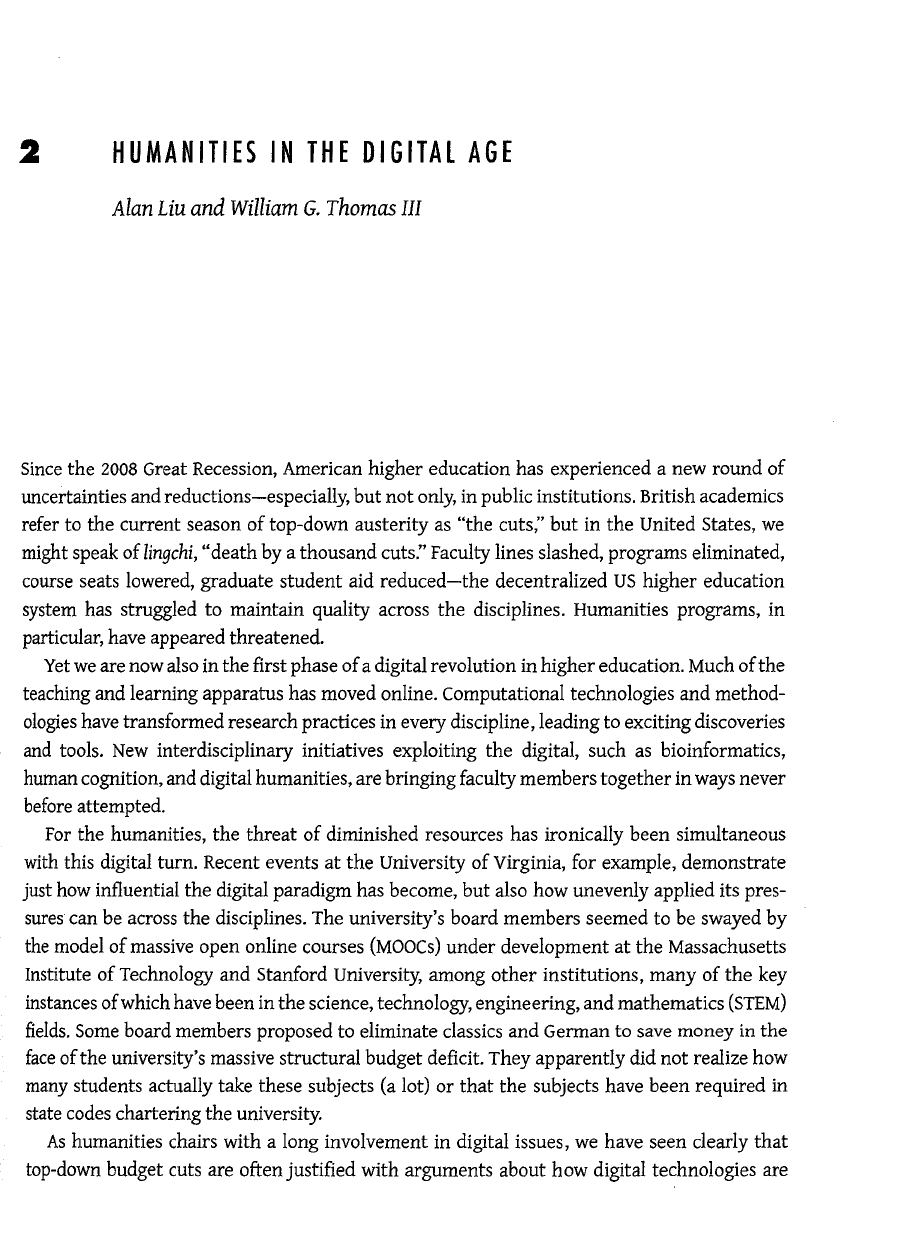
"The Humanities in the Digital Age"

First page

Citation: Liu, Alan, and William G. Thomas III. “Humanities in the Digital Age.” Between Humanities and the Digital. Ed. Patrik Svensson and David Theo Goldberg. Cambridge, MA: MIT Press, 2015: 45-40.

[Go to Course Site] This course works on two parallel tracks:
          On one track, students are introduced to methods and tools of the digital humanities–text encoding, data-mining and text analysis (including the cutting-edge approach known as “topic modeling”), social network analysis, mapping, and visualization. These provide extra leverage when reading individual texts or small collections of texts, and really come into their own when reading materials that literary interpretation previously had no way to handle–e.g., “big data” collections of texts or hybrid collections of texts (e.g., novels and newspapers of the nineteenth century). Each class in the early weeks of the course will introduce students to concepts, methods, and tools in the digital humanities, and require “practicums” in which students experiment with the tools in exploratory ways.
          On a second track, the course is an experiment in collaborative project-making. With the help and supervision of the instructor, we’re going to use the new digital methods to make a class project demonstrating the digital reading of literature…. [more]

“Key Research Trends in Digital Humanities — How the Digital Humanities Challenge the Idea of the Humanities.” Center for Information Technology lecture series, UC Santa Barbara. 30 April 2015.


“Key Trends in Digital Humanities — How the Digital Humanities Challenge the Idea of the Humanities.” Bucknell University. 27 April 2015.

  • Abstract: How do such key methods in the digital humanities as data mining, mapping, visualization, social network analysis, and topic modeling make an essential difference in the idea of the humanities, and vice versa? Using examples of digital humanities research, Alan Liu speculates on the large questions that confront the humanities in the face of computational media–most importantly, questions about the nature and function of interpretive “meaning.”


“The 4Humanities Initiative.” Bucknell University. 27 April 2015.

“Against the Cultural Singularity: Toward a Critical Digital Humanities.” Texas Digital Humanities Consortium conference, University of Texas at Arlington. 11 April 2015.

  • Abstract: Following up on the question he asked in the title of his 2012 essay “Where is Cultural Criticism in the Digital Humanities?”, Alan Liu will present early drafts from a book he is writing that imagines a mode of cultural criticism appropriate and native to the digital humanities. His talk focuses on the role of technology in, and between, neoliberalism’s major “knowledge work” institutions (including higher education) as the context in which digital-humanities research and development can be redirected from being primarily instruments of institution work to becoming also ways to act on institutions and their wider social impact. What methodological framework can assist the digital humanities in exploring that context? What kinds of scholarship, projects, and tool-building might constitute a critical digital humanities?
  • Storify of Twitter live-coverage of the talk by Adeline Koh (@adelinekoh).
  • Storify of Twitter posts from the #TXCHC conference by Jody Bailey (@reffervescent)


“Against the Cultural Singularity: Toward a Critical Digital Humanities.” History and Theory of New Media lecture series, Berkeley Center for New Media, University of California, Berkeley. 5 March 2015.

  • Abstract: Following up on the question asked in the title of his 2012 essay “Where is Cultural Criticism in the Digital Humanities?”, Alan Liu will present early drafts from a book that imagines modes of cultural criticism appropriate and native to the digital humanities. His talk focuses on the role of technology in (and between) neoliberalism’s major “knowledge work” institutions (including higher education). Can digital-humanities research and development be redirected from being primarily instruments of institution work to becoming also ways to act on institutions and their wider social impact? What methodological framework can assist the making of a revisionary “enterprise technology”? What kinds of scholarship, projects, and tool-building might constitute a critical digital humanities?


“Against the Cultural Singularity: Toward a Critical Digital Humanities.” Mellon Research Initiative in Digital Cultures, University of California, Davis. 3 March 2015.

  • Abstract: Following up on the question asked in the title of his 2012 essay “Where is Cultural Criticism in the Digital Humanities?”, Alan Liu will present early drafts from a book that imagines modes of cultural criticism appropriate and native to the digital humanities. His talk focuses on the role of technology in (and between) neoliberalism’s major “knowledge work” institutions (including higher education). Can digital-humanities research and development be redirected from being primarily instruments of institution work to becoming also ways to act on institutions and their wider social impact? What methodological framework can assist the making of a revisionary “enterprise technology”? What kinds of scholarship, projects, and tool-building might constitute a critical digital humanities?
  • Jenae Cohn, “A Recap of Alan Liu’s Talk, ‘Against the Cultural Singularity: Toward a Critical Digital Humanities.'” (HASTAC blog post reporting on the talk, 12 March 2015)


“Key Trends in Digital Humanities — How the Digital Humanities Challenge the Idea of the Humanities.” Digital Humanities at Claremont Colleges (DH@CC) Spring Symposium, Claremont Colleges. 18 February 2015.

  • Abstract: How do such key methods in the digital humanities as data mining, mapping, visualization, social network analysis, and topic modeling make an essential difference in the idea of the humanities, and vice versa? Using examples of digital humanities research, Alan Liu speculates on the large questions that confront the humanities in the face of computational media–most importantly, questions about the nature and function of interpretive “meaning.”
  • Storify of the talk and symposium.
  • Video Video of talk (videography by AJ Strout) (1 hr., 18 min.)


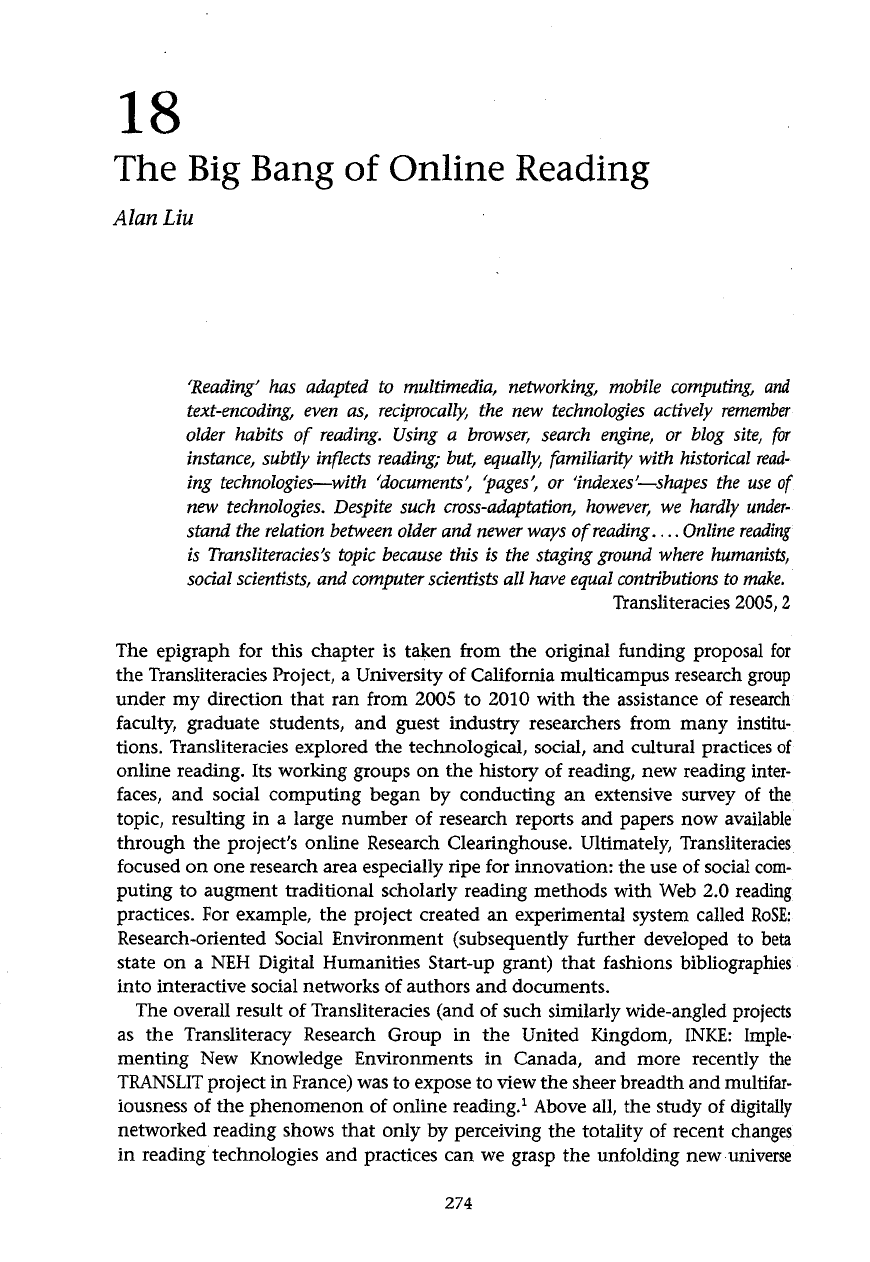
"The Big Bang of Online Reading"

First page

Citation:”The Big Bang of Online Reading.” Advancing Digital Humanities: Research, Methods, Theories. Ed. Paul Longley Arthur and Katherine Bode. Palgrave Macmillan, 2014: 274-90.

  • DOI of book: 10.1057/9781137337016
  • Full text (open-access author’s pre-copy-edited final version in institutional repository, PDF)


Citation: Peter de Bolla, “Digital Knowledge: Format, Scale, and the Information-knowledge Parallax at the Total Knowledge Horizon — A Reply to Alan Liu.” 15 November 2014. https://liu.english.ucsb.edu/peter-de-bolla-reply-to-alan-lius-theses-on-the-epistemology-of-the-digital/

The following was written by Peter de Bolla of Cambridge University in reply to Alan Liu’s “Theses on the Epistemology of the Digital,” a solicited follow-up to Liu’s participation in the second planning consultation session of the Cambridge University Centre for Digital Knowledge (CDK). Held on 7 May 2014 at the Cambridge Centre for Research in the Arts, Social Sciences and Humanities (CRASSH), the consultation session focused on “digital epistemology,” one of the two intended thematic strands of the Centre for Digital Knowledge. A previous planning consultation at CRASSH focused on the other intended strand of “digital society.”

At the consultation session that prompted Liu’s “Theses,” de Bolla initiated proceedings by reading a not-yet-published paper on the epistemology of the digital that served as a provocation for the proceedings.

(November 2015; posted here 15 November 2015)

It is clear, as Alan Liu points out in his “Theses on the Epistemology of the Digital,” that knowledge is not the first thing that comes to mind when we turn our attention to the digital. As he notes, we more commonly think of the digital as having considerable impact on the social, economic, political and cultural. This, it seems to me, is because our primary engagement with the digital is at the level of its effects and affordances with respect to communication, information storage and retrieval, statistical inference and manipulation. And the overwhelming majority of us use the digital as if it were analogue: the interfaces we are comfortable with simulate analogue forms. This is why the question of knowledge is so far back, so buried in our encounter with the format of the digital.

It is true that programmers take a different route but even in this case the question of knowledge is not particularly to the fore as programmers attend to system more than episteme. They are most concerned to get the ontology of their programmes to function efficiently. Perhaps this focus on “ontology” rather than “episteme” reveals a truth: the ontology of computation (where “ontology” is now being used in its philosophical sense) is order and sequence. In contrast to this sense “ontology” is used in programming to mean “a hierarchically organized classification system associated with a controlled, structured vocabulary that is designed to serve the retrieval and integration of data” [Ceusters and Smith, Switching Codes].

The Cambridge University Centre for Digital Knowledge (CDK) proposes to put the question of knowledge to the fore in our attempts to understand the difference that is made by the move from the analogue to the digital. This project is, at least initially, focussed on the difference in format. Seen from this perspective the alterations in the social, political, economic and cultural that arise when digital technologies become ubiquitous are epiphenomenal: these changes, important as they surely are, tend to obscure the alteration in episteme that occurs when analogue materials are migrated into digital format. This alteration is, I think, indicated in Liu’s observation that the “unique quality, or quantum, that is digital knowledge” involves “rebalancing the values of quality and quantity.” Put another way, data is knowledge in computational environments. The problem for us humans is that at the quantum level of data we are unable to perceive that knowledge. It is only at higher orders of data configuration that we are able to transform information into larger bits that we identify as knowledge. But to the computer this transformation is not one of type or category–a changing epistemology–it is merely one of scale. So, in concert with Liu’s remark that the CDK will need to “let go of too fixed an adherence to established modern ideas of knowledge,” we mean to push hard at the gates which sort information from knowledge.

It is manifestly clear that, as Liu points out, the landscape within which knowledge is produced and disseminated has changed significantly in recent times. There are new “systems, forms, and standards of knowledge” which pit “algorithmic” against “philosophical” knowledge, or “multimedia instead of print-codex knowledge.” The question for the CDK, however, is once again: are these changes epiphenomenal? Or, to put that more carefully, has our attention to these alterations so far been less directed to how epistemic shifts are at play than to the effects of these shifts. Liu’s attention to the flatness of knowledge in the realm of big or crowd data (in contrast to my “vertical axiology”) is, I think, directed at one of these effects. The distribution of information, its access and pliability all fall within a flat terrain where the “flatness” is the price of entry to the information. That is to say there is no–or very little–cost. But is that the same thing as a “flat epistemology”? As Liu puts it: “the wisdom of the crowd challenges the very notion of an epistemology.” Once more this seems to be a question of scale: is it the case that at this level of quanta one cannot see a theory of knowledge? Or, perhaps as important, at this level one does not need a theory of knowledge since the mass circulation of and access to information works as if it were knowledge.

I am not sure that this account is fully satisfying or convincing. Perhaps we need a more complex topography in order to see what is going on. If we were to plot the terms “information,” “knowledge,” “opinion” within a multidimensional space–a vector space–it might be possible to begin to see how these slightly different epistemic identifications overlap and connect, disconnect and repel. Here are some thought experiments. If one way of seeing knowledge is this: “knowledge is information which, when it is physically embodied in a suitable environment, tends to cause itself to remain so” (David Deutsch), and one way of seeing the wisdom of the crowd is “mass circulation opinion” then one of the vectors we would need in order to plot the topology would be time or persistence. Mass circulation opinion has, for example, a very distinctive temporality that might be represented as a wave form that corresponds to the volume of traffic at time t. Knowledge, in the Deutsch formulation, tends towards stability and might be represented as a flat line . The temporality of information might be represented as a set of discontinuities as older information becomes updated and replaced by more recent ?. A vector space model would seek to plot these data points within a planar matrix one of whose axes would be temporality. Another might be quantity. This would seek to plot the topology within which expert knowledge, the knowledge of the few, is distributed against mass circulation opinion, the knowledge of many. What measures would be helpful here? Would this help one to identify the range of measure x within which opinion tends towards knowledge? This, I think, might be close to Liu’s observation that knowledge “may not be either truth or story but just a probability distribution.”


If one were now to return the initiation question for the CDK–the issue of digital format–a similar observation might be made. The topology I have begun to sketch could equally be applied to the scalar issue. If one were to plot quanta of data in a vector space alongside persistence of accepted knowledge it might be possible to see more clearly how information at the very basic level of computational format (zero-one) contains within it knowledge, but knowledge that can only be seen at very high levels of data compression. Put this way knowledge decomposes into information at the quantum level. This seems to me to speak to Liu’s observation that “the humanistic and quantum universes of uncertainty are doppelgängers of each other.” It is a matter of scale. From the massive scale of knowledge in the humanities uncertainty appears as ambiguity; from the minuscule scale of data in the quantum world ambiguity appears as uncertainty.

This brings me to the question of the distinctiveness of the humanities. From whichever way I look at this issue it seems to me that we obscure too much when we maintain disciplinary coherence. The humanities are wedded to verification just as the non-humanities are. The humanities give considerable weight to accuracy just as the non-humanities. But in saying this we should not seek to make all knowledge wear the same overcoat. There are distributions within one kind of knowledge (call it humanistic) that are distinct from other kinds. But I am less convinced than some that these distributions are fixed. Still less am I convinced that they ought to stay fixed. By and large what we identify as humanities scholarship contains a mix–a distribution–of opinion, information and knowledge. Up until now the accreditation for this distribution of epistemic entities has been underwritten by a set of practices that give considerable cultural capital to individuals (so called experts) and institutions. What we might call single researcher accreditation protocols underwrite the opinions of literary critics. Outside the humanities the blend of opinion, information and knowledge is not quite the same. The hard sciences, for example, use the rhetoric of observer independent protocols for verifying information. Accreditation for opinions here stems from the repeatability of observational verification protocols. Single person cultural capital also applies, but it is tempered by mass and repeated observation. As long as the information persists and supports the opinion, knowledge is said to be gained.

It seems to me that what Liu identifies as the explosion of knowledge in the digital domain–“from crowds, people outside expert institutions, people outside formal organisations entirely”–consists in a remix of the distributions in a vector space that plots opinion, information and knowledge. This remix is not distinctively humanistic. In some ways it is “trans-humanistic.” Indeed we may be witnessing the decomposition of the humanities as knowledge decomposes into data or information. Put the other way around, we may be witnessing the recomposition of information as knowledge in the digital domain. And that applies to all types or kinds of knowledge, it is not unique to what heretofore we have called the humanities.

So let’s try and fit this around Liu’s sketch of a future humanities scholarship–one that has shed the protective skin of the “discourse model.” In place of the “one” reading and writing a book–the lone humanist–we will find collective and collaborative enterprise distributed in expansive networks of communication and experimentation. This, to my mind, will not be humanities 2.0 (or some such) but digital knowledge work. In this domain interpretation and critique are no longer centre stage (though there will be no necessary reason to jettison them entirely), occupying the foreground will be information, its gathering and manipulation so as to reveal what knowledge lies within the quantum level of information as data. Pattern recognition as much as pattern building will be the primary tasks for the agent who seeks to reveal this knowledge, and the machine (computer) will certainly have equal agential responsibilities in these tasks. There will doubtless be those who see such a sketch as irredeemably anti-humanist but the clear direction in which the contemporary is travelling seeks to make the division between the human and non-human far less monolithic. Things, animals and machines are more useful and friendly to humans when we begin to investigate the ways in which they may have or obtain agency or quasi-agency. The more we understand the quantum universe of biology the clearer it becomes that at the lowest level of life the domain of operation is digital. Pattern recognition and pattern building is what we, humans, do and are made of. To that extent the most humanistic enquiry is, therefore, digital. Once we accept this it becomes possible to see how much we have to learn from opening out to inspection digital knowledge, that is information held in a format that creates knowing from bits that are sub-opinion or only recognisable as knowledge at very high densities. It is not that we stand to gain an enormous revolution in what we know–that by definition will be impossible–but in how it comes to be known.

I agree with Liu that one of the ways this can be implemented is to build digital objects–hardware, software, algorithms and so forth–since this is a very testing methodology for exploring how the computer thinks. In this case there is a kind of “craft knowledge” that is only really accessible to those who make. But we should take care to insist that this is but one way. Others include embracing the techniques and technologies of advanced and advancing computer science–not the off the peg packages designed to fit problems already identified but the future horizon thinking that pushes at the boundaries of computation or the digital. What if we seek to produce a “total knowledge horizon” in which dynamic contextualisation operates at the largest scale of data repository and inspection? In a domain in which everything is potentially capable of finding relation with everything the task will be to sort out the noise from the significant signal. Although this may well involve building in the first sense above, it is as likely to involve building in the sense of conceptualising what digital knowledge might be at the “total knowledge horizon.” That’s the thing I hope we might aspire to build together.

Peter de Bolla has been Professor of Cultural History and Aesthetics at King’s College, Cambridge University, since 2009. He has been a visiting Professor at Siegen, Vanderbilt, New York University. He is Director of the Cambridge Concept Lab which is housed in the Cambridge Centre for Digital Knowledge at CRASSH (the Centre for Research in the Arts, Social Sciences, and Humanities at Cambridge University).


Works Cited

  • Ceusters, Werner, and Barry Smith. “Switching Partners: Dancing Witlogy in the Humanities and the Arts. Switching Codes: Thinking Through Digital Technology in the Humanities and the Arts. Ed. Thomas Bartscherer and Roderick Coover. Chicago: University of Chicago Press, 2011: 103. [Link to quotation in Google Books copy of book]
  • Deutsch, David. The Beginning of Infinity: Explanations That Transform the World. 2011; rpt. London: Penguin, 2012. E-book. Kindle Edition. Page 130. [Link to quotation in Google Books unpaginated copy of e-book]


“Practice and Theory of ‘Distant Reading’: An Introductory Workshop on Digital Humanities Methods.” Experimental Humanities program, Bard College. 7 November 2014.

  • Web site for workshop with detailed agenda and resources.
  • Abstract: In this hands-on workshop and discussion, Alan Liu will introduce some commonly used analytical tools in the digital humanities—e.g.,
    • Google Books Ngram viewer & the Bookworm tool for exploring Hathi Trust texts;
    • Voyeur Tools, AntConc, and similar text-analysis tools;
    • Topic modeling tools;
    • Social network analysis tools;
    • Visualization tools.

    Participants will then try their hand at one or more tools, aiming not for mastery or even competence but just to capture an interesting “souvenir,” e.g., a screenshot. (For the purposes of the workshop, even failed attempts can produce an interesting souvenir.)

    Alan Liu will then lead a broader discussion based on the souvenirs about the opportunities and limitations of digital humanities methods. The largest question that the workshop will open to view is: how do digital humanities methods signal today’s changing ideas about the human world?

“Rediscovering the Humanities: Humanities Advocacy in the Digital Age.” Experimental Humanities program, Bard College. 6 November 2014.

  • Abstract: How can liberal arts colleges, teachers, and students make the case for the value of the humanities to the public today? Starting with the example of the 4Humanities.org advocacy initiative that he co-founded, Alan Liu will discuss strategies of communicating the values of the humanities in today’s society. A special emphasis of the talk is the promise of new digital technologies for public engagement in the humanities.


[Go to Course Site] Digital technologies and methods have recently become important in the humanities as scholars use the new tools not only to help read and write about literary, historical, and artistic materials in traditional ways but in new ways influenced–not just communicated by–the new media forms. Literature+ is a course that draws on the new fields of “digital humanities” and “new media studies” to ask students to think about, and experiment with, how new digital methods enhance the study of literature.
          Students choose a literary work and use digital methods to model, map, visualize, text-analyze, social-network-analyze, blog, or otherwise interpret it using new tools and media. How can such methods augment or change our understanding of literature by comparison with other methods of literary interpretation? What is the relation, for example, between “close reading” of literary texts and “distant reading” methods that identify trends in language or themes across thousands of texts?… [more]

[Go to Course Site]

“Advice for Chairs (Based on English Department Practice at UCSB).” New Chair Orientation Meeting, College of Letters & Science, UC Santa Barbara. 29 September 2014.


« Previous PageNext Page »