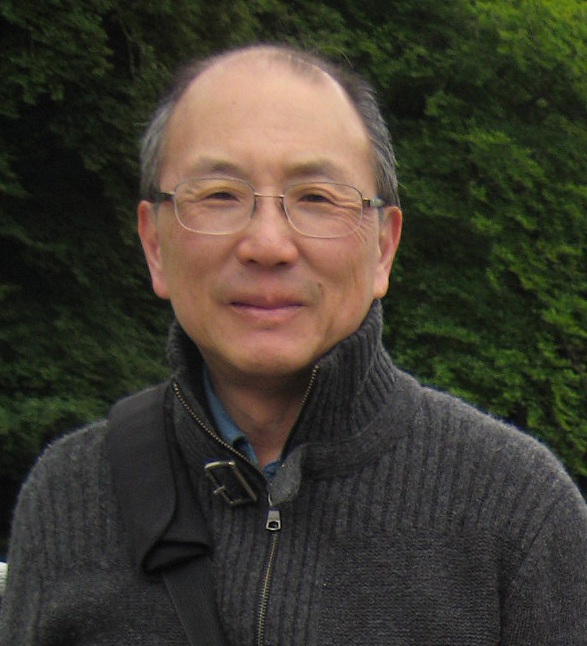
This is the professional home page of Alan Liu, Professor of English, University of California, Santa Barbara (UCSB). The English Department at UCSB also maintains a less complete bio page for Alan Liu.

See also Nothing Transcendental: Alan Liu’s Ad Hoc Site for Ordinary Business: “Here, the ordinary and routine business of professional life finds shelter from the pressure to be any more than it simply is.”

Recent:

I am Distinguished Professor Emeritus in the English Department at the University of California, Santa Barbara, where I taught from 1987 to 2025. I was also an affiliated faculty member of UCSB’s Media Arts & Technology graduate program. At the beginning of my career (1979-1986), I was Assistant Professor and then Associate Professor in Yale University’s English Department and British Studies Program.

I began my research in the field of British romantic literature and art. My first book, Wordsworth: The Sense of History (Stanford Univ. Press, 1989), explored the relation between the imaginative experiences of literature and history. In a series of theoretical essays in the 1990s, I explored cultural criticism, the “new historicism,” and postmodernism in contemporary literary studies.

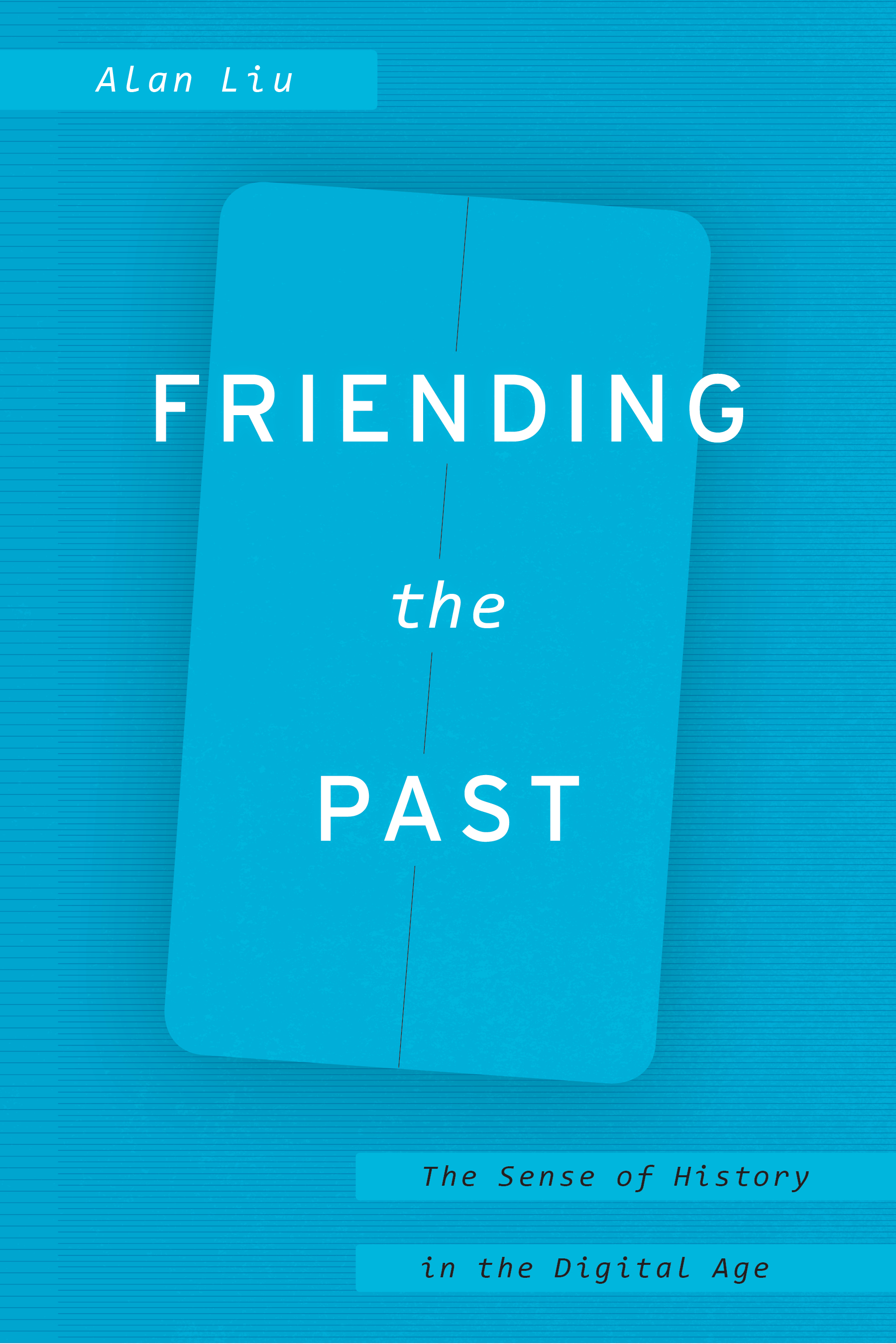
Subsequently, I was an early and now continuing voice in the “digital humanities” field. This started in 1994, when I created my Voice of the Shuttle Web site for humanities research. That was the era when I began to study information culture as a way to close the circuit between the literary or historical imagination and the technological imagination. In 2004, I published my The Laws of Cool: Knowledge Work and the Culture of Information (Univ. of Chicago Press). In 2008, I also published from Univ. of Chicago Press my Local Transcendence: Essays on Postmodern Historicism and the Database. A new book is appeared from the same press in 2018: Friending the Past: The Sense of History in the Digital Age.

In the late 1990’s, I founded the NEH-funded Teaching with Technology project at UC Santa Barbara called Transcriptions: Literature and the Culture of Information, and my English Dept’s undergraduate specialization on Literature and the Culture of Information. During 2002-2007 I was a member of the Board of Directors of the Electronic Literature Organization (ELO) and chair of the Technology/Software Committee of the ELO’s PAD Initiative (Preservation / Archiving / Dissemination of Electronic Literature). Digital initiatives I then led in the 2000s include Transliteracies: Research in the Technological, Social, and Cultural Practices of Online Reading, a University of California multi-campus, collaborative research group (2005-10); and RoSE (Research-oriented Social Environment), a software project funded by a NEH Digital Humanities Start-up grant (2011-12) that is the culmination of Transliteracies.

I founded and am co-leader of the international 4Humanities advocacy initiative in 2010. During 2017-2021, I was Principal Investigator of the 4Humanities WhatEvery1Says (WE1S) research project, which was supported by a $1.1 million grant from the Andrew W. Mellon Foundation. WE1S digital methods to study a big-data corpus of public discourse about the humanities, and created resources and toolkits for speaking up for the values of the humanities in today’s society. In 2022-2023, I chaired the Modern Language Association’s Committee on Information Technology. Currently I am focusing on co-founding and serving as co-president of the Center for Humanities Communication.

“Overview of Transliteracies Project.” Maryland Institute for Technology in the Humanities. University of Maryland, College Park. 27 April 2006.


“Preserving the Future: The Idea of the Electronic Literature Organization’s Preservation / Archiving / Dissemination (PAD) Initiative.” Maryland Institute for Technology in the Humanities. University of Maryland, College Park. 27 April 2006.


Course Wiki (co-produced with students): https://liu.english.ucsb.edu/wiki1/index.php/Main_Page

English 194 WikiCourse Description: This is a UCSB undergraduate research workshop or practicum (limited to 15 students) in which participants break into teams to pursue research related to literature and the culture of information. (The course may be counted for the English Department’s Literature and Culture of Information specialization.) The theme of this instance of the course is the relation between “creative” and “collaborative” models of authorship. Students will publish research into these topics on a collective, online research Web site produced through a “wiki” publishing and editing environment that enacts the process of creative collaboration. (Indeed, the collaborative wiki publishing environment will itself be one of the topics of the course.) Readings will include primary and secondary texts spanning from the era of Romanticism to recent theories and practices of “authorship,” “creativity,” “collaboration,” “innovation,” “peer-to-peer,” “intellectual property,” “open source,” “blogs,” etc.


“‘A Forming Hand’: Creativity and Destruction from Romanticism to Emergence Theory.” Center for Cultural Analysis. Rutgers University, New Brunswick. 2 March 2006.

[Expanded version of paper.]


Interview by Geert Lovink. “‘I work here, but I am cool’: Interview with Alan Liu.” Nettime-l list. 23 February 2006. <http://www.nettime.org/Lists-Archives/nettime-l-0602/msg00075.html>

“‘A Forming Hand’: Creativity and Destruction from Romanticism to Emergence Theory.” Holmes Lecture. Pomona College. 9 February 2006.


Citation: “The Humanities: A Technical Profession.” Teaching, Technology, Textuality: Approaches to New Media. Ed. Michael Hanrahan and Deborah Madsen. Basingstoke [England]: Palgrave Macmillan, 2005. 11-26.

/ excerpt » /

“‘A Forming Hand’: Creativity and Destruction from Romanticism to Emergence Theory.” University of Oregon. 13 October 2005.


Citation: “The New Historicism and the Work of Mourning.” The Wordsworthian Enlightenment: Romantic Poetry and the Ecology of Reading. Ed. Helen Regueiro Elam and Frances Ferguson. Baltimore: Johns Hopkins University Press, 2005. 149-57.

[Reprint of “The New Historicism and the Work of Mourning,” Studies in Romanticism 35 (1996): 553-62.]


“‘A Forming Hand’: Creativity and Destruction from Romanticism to Emergence Theory.” Workshop on “Development, Creativity, and Agency: New Approaches (A Conversation Between Thomas Pfau and Alan Liu).” North American Association for the Study of Romanticism (NASSR) conference. Montreal. 16 August 2005.


Transliteracies home page URL: https://transliteracies.english.ucsb.edu
Role: Principal Investigator.
Funded as a University of California Multicampus Research Group for 2005-2010, Transliteracies studies and plans for innovations in online reading from the perspectives of the computer sciences, social sciences, humanities (including the history of the book field), and new media art. Project participants include faculty from seven University of California campuses and several other universities. Current deliverables include: Transliteracies Research Clearinghouse.
Suggested Citation: Transliteracies Project (Research in the Technological, Social, and Cultural Practices of Online Reading). Home page. University of California. Retrieved [Date of access, e.g., 27 September 2006]. <https://transliteracies.english.ucsb.edu/>


URL: https://agrippa.english.ucsb.edu
Role: Project Leader and General Editor.
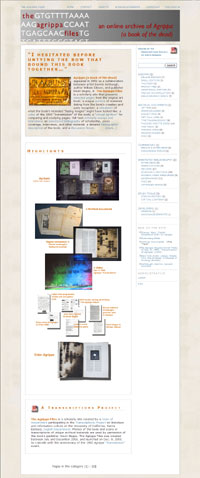
Collaborators: Paxton Hehmeyer, James J. Hodge, Kimberly Knight, David Roh, Elizabeth Swanstrom.Agrippa (a book of the dead) appeared in 1992 as a collaboration between artist Dennis Ashbaugh, author William Gibson, and publisher Kevin Begos, Jr. The Agrippa Files is a scholarly site that presents selected pages from the original art book; a unique archive of materials dating from the book’s creation and early reception; a simulation of what the book’s intended “fading images” might have looked like; a video of the 1992 “transmission” of the work; a “virtual lightbox” for comparing and studying pages; full-text scholarly essays and interviews; an annotated bibliography of scholarship, press coverage, interviews, and other material; a detailed bibliographic description of the book; and a discussion forum.The Agrippa Files was created in 2005 (and launched publicly on Dec. 9, 2005) by Alan Liu and a volunteer team of graduate students with the assistance of the book’s publisher, Kevin Begos.
Agrippa Files home page
Suggested Citation: The Agrippa Files. Home page. Ed. Alan Liu, et al. 2005. University of California, Santa Barbara. Retrieved [Date of access, e.g., 27 September 2006]. <https://agrippa.english.ucsb.edu/>


“Transcriptions Project & Other Digital Initiatives in the UCSB English Department.” Plenary session on “Centers of Innovation: The English Department’s Transcriptions Project, Early Modern Center, and American Cultures and Global Contexts Center at UCSB.” 2005 ADE Summer Seminar West. University of California, Santa Barbara. 21 June 2005.


“The Humanities: A Technical Profession.” Video-conference appearance at the Cyber-Disciplinarity Conference. Fannie and Alan Leslie Center for the Humanities. Dartmouth College. 14 May 2005.


“Thinking Destruction: Creativity, Rational Choice, and Destruction Theory.” Rational Choice Theory and the Humanities Conference. Stanford University. 29 April 2005.


“The Rout of Creativity: Destructive Art, New Media Art, and the Aesthetics of the New.” University of California, Irvine. 18 February 2005.


“The Laws of Cool.” Consortium for Literature, Theory, and Culture. University of California, Santa Barbara. 1 December 2004.


Citation: “Transcendental Data: Toward A Cultural History and Aesthetics of the New Encoded Discourse.” Critical Inquiry 31 (2004): 49-84.

  • DOI: 10.1086/427302
  • Full text (post-embargo published version in institutional repository, PDF)
  • Full text (paywalled, Jstor)
  • Full text (paywalled, Univ. of Chicago Press Journals)

/ excerpt » /

“The Rout of Creativity: Destructive Art, New Media Art, and the Aesthetics of the New.” Duke University. 18 November 2004.


“Humanities Computing: New Directions.” Guest presentation in course on “Computational Requirements: Scientific, Scholarly, and Commercial Perspectives” (Computer Science 595N / Environmental Studies & Management 595K). University of California, Santa Barbara. 3 November 2004.


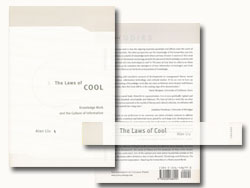
Citation: The Laws of Cool: Knowledge Work and the Culture of Information. Chicago: University of Chicago Press, 2004.


[552 pages, ISBN-10: 0226486990, ISBN-13: 978-0226486994]

book spine back cover back cover front cover

/ excerpt » /

“Escaping History: The New Historicism, Databases, and Contingency.” “Digital Retroaction” conference. University of California Digital Cultures Project. University of California, Santa Barbara. 17 September 2004.


“Escaping History: The New Historicism, Databases, and Contingency.” Conference on “Romanticism, History, Historicism.” University of Wales, Aberystwyth. 18 June 2004.


“Transcendental Data: Toward a Cultural History and Aesthetics of the New Encoded Discourse.” Conference on “The Arts of Transmission.” Franke Institute for the Humanities. University of Chicago. 21 May 2004.

  • Response by Mark Hansen
  • Rejoinder by Alan Liu


“The Humanities: A Technical Profession.” Public Session of the annual meeting of the ACLS. Washington, D.C. 8 May 2004.

  • This talk was subsequently published with minor revisions as “The Humanities: A Technical Profession.” 2007. In Andrew Delbanco, Ronald G. Ehrenberg, Alan Liu, and Catharine R. Stimpson, with an Introduction by Rebecca Chopp. The Idea and Ideals of the University (ACLS Occasional Paper No. 63) [full text in .pdf format]. [See Note for the relation between this 2007 published version and the original publication of the paper as an essay in 2005 in Teaching, Technology, Textuality: Approaches to New Media, ed. Michael Hanrahan and Deborah Madsen (Basingstoke [England]: Palgrave Macmillan, 2005): 11-26.]


“Center and Project Oriented Humanities Departments.” Panel on “Disciplines and Departments of the Future.” Interdisciplinary Humanities Center. University of California, Santa Barbara. 24 February 2004.


“The Rout of Creativity: Destructive Art, New Media Art, and the Aesthetics of the New.” University of California, Santa Barbara. 11 February 2004.


“The Humanities: A Technical Profession.” Panel on “Information Technology and the Profession.” Modern Language Association Convention. San Diego. 28 December 2003.


Citation: “Sidney’s Technology: A Critique by Technology of Literary History.” Acts of Narrative. Ed. Carol Jacobs and Henry Sussman. Stanford: Stanford University Press, 2003. 174-94.

/ excerpt » /

“The One Life and the One Gun: Memory, Mechanism, and Destruction in William Gibson’s ‘Agrippa’ and William Wordsworth’s ‘Tintern Abbey.'” 19th Century and Beyond British Cultural Studies Working Group. University of California, Berkeley. 18 November 2003.


“The Rout of Creativity: Destructive Art, New Media Art, and the Aesthetics of the New.” Beckman Lectures. English Department. University of California, Berkeley. 28 October 2003.

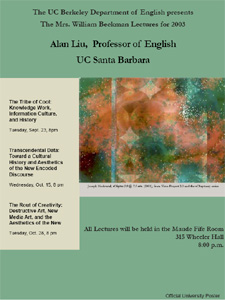
Beckman Lecture Series Poster


“Transcendental Data: Toward a Cultural History and Aesthetics of the New Encoded Discourse.” Beckman Lectures. English Department. University of California, Berkeley. 15 October 2003.


Citation: “Remembering the Spruce Goose: Historicism, Postmodernism, Romanticism.” South Atlantic Quarterly 102 (2003): 263-78.

/ excerpt » /

“The Tribe of Cool: Knowledge Work, Information Culture, and History.” Beckman Lectures. English Department. University of California, Berkeley. 23 September 2003.


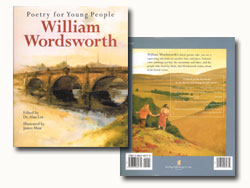
Citation: William Wordsworth. Ed. Alan Liu. Illustrator, James Muir. Poetry for Young People. New York: Sterling Publishing, 2003.

Jacket blurb: “William Wordsworth’s finest poems take you on a captivating adventure to another time and place. Fantastic color paintings portray the mountains and lakes, and the people who lived by them, that Wordsworth writes about in his lyrical verses.”

[48 pp., 35 illustrations;
ISBN-10: 0806982772,
ISBN-13: 978-0806982779]

William Wordsworth edition for children William Wordsworth edition for children (back)

/ excerpt » /

“The Tribe of Cool: Information Culture, Knowledge Work, and History.” California Institute of Technology. 23 April 2003.


“PAD Plan Overview: Issues and Approaches.” Introduction to panel on the Electronic Literature Organization’s Preservation/Archiving/Dissemination Initiative. e(X)Literature Conference. Electronic Literature Organization and the University of California Digital Cultures Project. University of California, Santa Barbara. 4 April 2003.


“The Art of the Data Pour: Toward a Cultural History and Aesthetics of XML and Database-Driven Web Sites.” Panel on “Digital Futures.” Modern Language Association Convention. New York City. 29 December 2002.


« Previous PageNext Page »