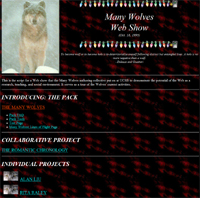
This was the digital version of a ham radio club I started on my campus in 1995 for faculty, graduate students, and undergraduates in several departments (including English and Art) who were early enthusiasts of Web authoring. Included our Web show, a tools page, a project proposal page, and inspiration from Deleuze and Guattari.

“1995 calling 2013: transmission begins. . . .”

Date of site: 18 October 1995. (Earliest Internet Archive capture: 21 November 1996)

Many Wolves Web Authoring Collective
  • Many Wolves site (archival version of site as captured in Internet Archive, 21 November 1996)

Response. Panel on “The Future of Teaching and Scholarship.” 50th Anniversary Celebration of University of California, Santa Barbara. University of California, Santa Barbara. 10 October 1995.

  • The summary of this response was later published in Teaching and Learning at the University of California, Santa Barbara: The Classroom and Beyond. Ed. Ronald W. Tobin. Occasional Paper, No. 1. Santa Barbara, CA: Office of Academic Programs, University of California, Santa Barbara, 1996. 15-16


This is one of the earliest “blog” essays I wrote–so early that it preceded the era of blogs.


Citation: “Should We Link to the Unabomber? An Essay on Practical Web Ethics.” English Department, UC Santa Barbara, 9 October 1995. http://oldsite.english.ucsb.edu/faculty/ayliu/research/whyuna.htm

Excerpt

Date: 9 October 1995

Background: The Emergence of the Unabomber Manifesto on the Net

Shortly after the publication of the Unabomber’s “Manifesto on Industrial Society and its Future” in the New York Times and Washington Post on Sept. 19, 1995, Time-Warner mounted the Manifesto on its Web server and made it available as a subpage (titled “Unabomber: Tightening the Net”) from its Pathfinder home page. The link to the full text of the Manifesto is accompanied on the “Tightening the Net” page by links to a variety of mainstream media stories and commentary as well as by updates on the FBI’s manhunt. Copies of the Manifesto have subsequently also appeared on other servers on the net.

The Issue: To Link or Not to Link From a Scholarly Research Page

The Manifesto, its context, and its reception are events of major interest to scholars in such fields as science-technology-and-culture, sociology, journalism, etc. This is all the more so because the distinctly academic style of argumentation and language in the Manifesto (which comes complete with the bomber’s endnotes) establishes an intense feedback loop or “reverb” with the academic institutions whose faculty and staff have been among the bomber’s favorite targets–and casualties.

Given the nature of the Manifesto’s original publication history, however (i.e., violently coerced), the ethics of participating to any degree in the further dissemination of the document is problematic. This is certainly the case if one were considering mounting a duplicate of the whole document on one’s server. But it is also the case, however attenuated and primarily symbolic, if one is merely considering creating a link to the document as it exists on someone else’s server.

In the broadest perspective, the Unabomber incident is a uniquely compelling test of the ethics of pure research. . . .


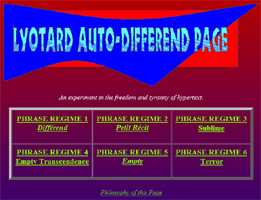
A “technical experiment and theoretical allegory” based on the work of Jean-François Lyotard. In this early attempt to explore the then-new dynamic capabilities of hypertext, I use now obsolete “client-pull” Web methods to create a series of automated tracks of Lyotard’s thought. The site includes a short theoretical essay on “philosophy of this page.”

Date: August 1995.

Lyotard Auto-Differend    Go to site

“The Voice of the Shuttle and the Laws of Cool.” Association for Computers and the Humanities & Association for Literary and Linguistic Computing (ACH-ALLC) conference. University of California, Santa Barbara. 13 July 1995.


“The Voice of the Shuttle: Web Page for Humanities Research.” Davidson Library. University of California, Santa Barbara. 12 May 1995.


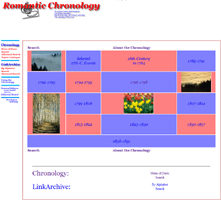
Co-edited with Laura Mandell, The Romantic Chronology was database-driven hypertext chronology of the Romantic period with a links-archive and other resources designed to provide a historically-organized introduction to online materials in the area. A “Philosophy of this Site” page includes theoretical essays by the editors as well as Rita Raley and Carl Stahmer (serving at that time as research assistants for the project).

The site started in 1995 as a series of large static HTML tables. Then, in 1999, the site became one of my first attempts to create a database-to-Web site (using Filemaker, though at this time I was also experimenting with other limited database programs such as Access before graduating to SQL Server and, later, to modern content management systems with LAMP architecture and MySQL databases).

By 2013, when Laura and I had long stopped developing or adding content to the site, the old Filemaker database (a problem for my English Department’s sysadmin to maintain) was retired. The site was “flattened” in static HTML form for archival purposes.

Date of site: 1995.

Romantic Chronology

“The Interdisciplinary War Machine (The Theory of Interdisciplinary Studies).” Harvard University. 1 December 1994.


“The Interdisciplinary War Machine: Saluting French Revolution Studies” (plus “Afterthoughts”). 2nd Annual Conference of the North American Society for the Study of Romanticism (NASSR). Duke University. 12 November 1994.


“The Interdisciplinary War Machine (The Theory of Interdisciplinary Studies).” Harvard University. 1 December 1994.

My primer for colleagues learning about the Internet. 124 pp.; “published” in bound form in 1994 and sold for $11 through my campus bookstore.

Date: 5 October 1994

  • Ultrabasic Guide to the Internet (full text as .pdf) (ported from a page-making program into PDF with some loss of elegance in formatting; bookmarks added to chapters)
  • Image I create for the guide illustrating the Internet as it appears through the “windshield” while driving on the information superhighway.
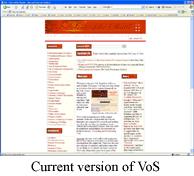
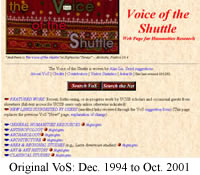
Original VoS       Current version of VoS

URL: http://vos.ucsb.edu
Role: Creator and editor (“weaver”).
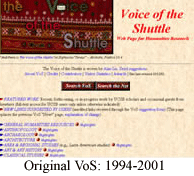
One of the earliest humanities research portals. VoS began in 1994 as a 70+ Web-page directory of humanities research resources organized by field, historical period, author, etc. Its original mission was to seduce other humanities scholars onto the Web by showing them available online humanities materials. Vos was reimplemented in 2001 as a database-to-Web system allowing for dynamic views of the data (general to specific) and user contributions.

Suggested Citation: Voice of the Shuttle: Web Page for Humanities Research. Ed. Alan Liu. [Date of page when accessed, e.g., 27 September 2006]. University of California, Santa Barbara. Retrieved [Date of access, e.g., 27 September 2006]. <http://vos.ucsb.edu/>


Original, static HTML version of my Voice of the Shuttle: Web Page for Humanities Research. I started VoS in late 1994 as a Web site restricted to my campus (U. California, Santa Barbara), then made it world-accessible on 21 March 1995 as the root site of UCSB’s first humanities server (named humanitas.ucsb.edu at that time). Original VoS Home PageLinks were collected primarily using the text-only Lynx browser (for speed over a 2400 baud modem) even though the Mosaic graphical browser had recently appeared. My colleague Victoria Vesna in Art scanned and Photoshopped the logo for me, using a bolt of fabric loaned by my colleague in English Shirley Lim.

From its origin to October, 1999, VoS stayed at the same address on the Humanitas server. It grew in that period to over 70 pages of links to humanities and humanities-related resources on the Internet. Its mission was to provide a structured and briefly annotated guide to online resources that at once respects the established humanities disciplines in their professional organization and points toward the transformation of those disciplines as they interact with the sciences and social sciences and with new digital media. An essay I published in 1998 narrates the origin and mission of VoS (“Globalizing the Humanities: ‘The Voice of the Shuttle: Web Page for Humanities Research.’” [pdf]).

In October 2001, after a year of development work by Jeremy Douglass and Robert Adlington, VoS was rebuilt as a database-to-Web site. A SQL-injection hacker attack on the site a few years later led to extensive further work by Douglass to harden the site.

Most of link collection, description, and maintenance was done solo (though for a brief period I had some funding and assistance from graduate students). I gradually slowed in collecting and fixing links for VoS over the years as portals and search engines became more generally used. Work on the site effectively stopped after c. 2009.

Date: December 1994

“The New Historicism and the Work of Mourning.” Modern Language Association convention. Toronto. 29 December 1993.


“Installing Romanticism in Postmodernism (Notes on the Spruce Goose).” Modern Language Association convention. New York City. 28 December 1992.


“The New Literary History: Poststructuralism, Postmodernism, and Multiculturalism (A Patchwork Talk).” Sociology Colloquium. University of California, Santa Barbara. 5 February 1992.


“Flat Literary History.” University of California, Riverside. 22 May 1991.


“Flat Literary History.” Conference on “Discourses of Localism.” University of Texas at Austin. 25 March 1991.


“Flat Literary History.” Conference on “What is the History of Literature?” Doreen B. Townsend Center for the Humanities. University of California, Berkeley. 2 March 1991.


“The Interdisciplinary War Machine.” Keynote address, graduate student conference on “Babel or Genesis?: Toward A Definition of the Interdisciplinary.” Lehigh University. 15 February 1991.


“The Resistance to Practice.” Modern Language Association convention. Chicago. 29 December 1990.


“Local Transcendence: Cultural Criticism, Postmodernism, and the Romanticism of Detail.” University of Southern California. 7 November 1990.


“Local Transcendence: Cultural Criticism, Postmodernism, and the Romanticism of Detail.” University of California, Santa Barbara. 18 October 1990.


“History and Surprise.” Introduction to panel discussion of Wordsworth: The Sense of History. Wordsworth Summer Conference. Grasmere, UK. 5 August 1990.

(Other discussants on panel: Geoffrey Hartman, Nicholas Roe, J. Drummond Bone, Jonathan Wordsworth.)


“Local Transcendence: Cultural Criticism and Postmodernism (Part I: The Romanticism of Detail).” Conference on “Revolutionary Romanticism, 1790-1990.” Society for the Humanities. Cornell University. 9 April 1990.


“Local Transcendence: Cultural Criticism and Postmodernism (Part I: The Romanticism of Detail).” Conference on “Revolutionary Romanticism, 1790-1990.” Bucknell University. 8 April 1990.


“Local Transcendence: Cultural Criticism and Postmodernism.” Modern Language Association convention. Washington, D.C. 28 December 1989.


“Local Transcendence: Cultural Criticism and Postmodernism.” Johns Hopkins University. 10 November 1989.


“Local Transcendence: Cultural Criticism and Postmodernism.” Harvard University. 9 November 1989.


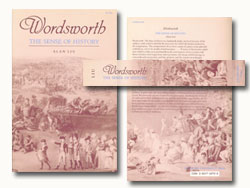
front cover back cover book spine back cover
Citation: Wordsworth: The Sense of History. Stanford: Stanford University Press, 1989.


[726 pp., ISBN-10: 0804718938, ISBN-13: 978-0804718936]

/ excerpt » /

Citation: “The Power of Formalism: The New Historicism.” ELH 56 (1989): 721-71.

  • DOI: 10.2307/2873158
  • Open access (published version in institutional repository, viewable online and downloadable as PDF)
  • Paywalled (published version, PDF)
  • Translations of essay:
    • “El Poder del Formalismo: El Nuevo Historicismo.” Nuevo Historicismo. Ed. Antonio Penedo y Gonzalo Pontón. Madrid: Arco/Libros, 1998. 193-261.
    • “Die Macht des Formalismus: Der New Historicism.” New Historicism. Literaturgeschichte als Poetik der Kultur. Ed. Moritz Baßler. Frankfurt am M.: Fischer Taschenbuch Verlag, 1995. 94-163.
    • “Il potere del formalismo:il nuovo storicismo.” Trans. Angela Tranfo. L’Asino d’oro 4.8 (November 1993; special issue on “Il nuovo storicismo“): 78-122.


/ excerpt » /

“Indiscipline, Interdiscipline, and Liberty: The Revolutionary Paradigm.” Conference on “Revolution ’89: Interdisciplinary Perspectives on the French Revolution.” University of California, Santa Barbara. 12 May 1989.


“Toward a Theory of the Prerequisite: Curing the Canon at Yale.” California Institute of Technology. 12 May 1988.


Respondent to Paul Hernadi, “Doing, Making, Meaning: Toward a Theory of Verbal Practice.” Interpretive Studies Colloquium. University of California, Santa Barbara. 11 March 1988.


“Wordsworth and Subversion, 1793-1804.” Modern Language Association convention. San Francisco. 28 December 1987.


“The Value of Romanticism.” Introduction the Wordsworth-Coleridge Association sessions on “The Value of Romanticism, I & II.” Modern Language Association convention. San Francisco. 28 December 1987.


“Wordsworth and Subversion, 1793-1804.” UCLA Romantics Study Group. Westwood, Los Angeles, CA. 3 December 1987.


“Wordsworth and Subversion, 1793-1804.” Conference on “Wordsworth and the Borders of Romanticism.” Yale University. 15 November 1987.


“The Economy of Lyric: Wordsworth’s Ruined Cottage.” University of California, Santa Barbara. March 1987.


“The Value of New Historicism: A Self-Critique.” Northwestern University. 5 December 1986.


« Previous PageNext Page »