“Quality E-Learning: MOOCs, Blended Learning, & Project-Based Methods.”  Talk and workshop at the Hertie School of Governance, Berlin.  4 August 2014.

  • Abstract: What methods and features of e-learning can be used to position graduate-level and executive-training higher-education programs as providers of “quality” e-learning? In this workshop, Alan Liu reviews the current state of e-learning in California and draws on his experience in digital humanities programs and projects at the University of California, Santa Barbara, to suggest several qualities of e-learning that can be the building blocks of a “quality” e-learning program.
                Publications that Liu has written relevant to this workshop include: “Literature+” (Currents in Electronic Literacy, Spring 2008), “Digital Humanities and Academic Change” (English Language Notes 47 [2009]) (open-access version, PDF), and “Teaching Literature+ — Digital Humanities Hybrid Courses in the Era of MOOCs” (forthcoming in Teaching Literature: Text and Dialogue in the English Classroom, ed. Ben Knights, Palgrave Macmillan). Recent graduate courses he has taught related to e-learning include “Digital Humanities: Introduction to the Field.”

  • Presentation Site with lecture notes and links to resources.


Digital Projects Collage[Go to Course Site] In recent years, the digital humanities field (“DH”) has reached a critical mass of participants, publications, conferences, institutional programs, job calls, critical discourse, and general visibility.  This course provides a graduate-level introduction to the field.  The course introduces major types of digital humanities work and central topics and controversies.  It asks students to develop project ideas and public visibility in their intended professional field in its relation to the digital humanities.  Major topics include: the emergence of the digital humanities and the relation of DH to the humanities in general; the logic of text encoding (with some attention to relational databases); methods of text analysis (including quantitative analysis, topic modeling, and social network analysis); deep space and time in the digital humanities (visualization, mapping, archival theory, and media archaeology); “algorithmic criticism” and “deformance” theory; and “critical digital humanities” (including controversies about the field’s relation to “theory” and “cultural criticism”).


A key aspect of the course is the balance it seeks between ideas and technology.  Far-reaching ideas from both the human past and present are reexamined from a technological perspective, and–just as important–vice versa.  The focal question for the first class, for example, is “What kind of ‘human’ subject do the digital humanities speak from, to, for?”  And the focal question for one of the last classes is “How can the digital humanities contribute to the humanities in helping human beings understand other ways of ‘understanding’ and of being ‘human’?”


Assignments in the course are designed to train graduate students in the digital humanities (Practicums); immerse them in the digital-humanities research community (Follow DH Community on Twitter); develop their professional profile in their intended research field (Blog Posts on Your Field in its Relation to Digital Humanities); and incubate a detailed “mock project prospectus” for a digital-humanities project (Mock Project Prospectus).  (Due to the constraints of a 10-week quarter, the project need not be implemented but could provide the basis for the student’s future research and professional development.)

“This is Not a Book: Long Forms of Attention in the Digital Age.” Material Cultures of the Book Working Group, University of California, Riverside. 3 June 2014.

  • Abstract: This talk argues that in the digital age, the “book”–whether physical, digital, or in some other media—is only a metaphor for “long forms of shared attention.” The book dissolves into, but also persists in, slowly-changing networks of discourse that are “transliteracies” because they span across media, across networks, and across time. The talk concludes with examples of recent digital projects—including the RoSE (Research-oriented Social Environment) at University of California, Santa Barbara–that attempt to represent such long forms of shared digital attention.
  • Full text of original talk (with thumbnails of selected slides.


“The Big Bang of Online Reading.”  Friends of English Southland graduate conference on “Reading Matters,” UCLA.  30 May 2014.


“From ‘Search’ to Digital Humanities.”  Dean’s Forum on “The Co-Evolution of the Humanities and New Technologies,” UCLA.  28 May 2014.


“Mickey Mouse Creativity: New Media Arts After the Ideology of Creativity.” Lahey Lecture, Concordia University. 3 April 2014.


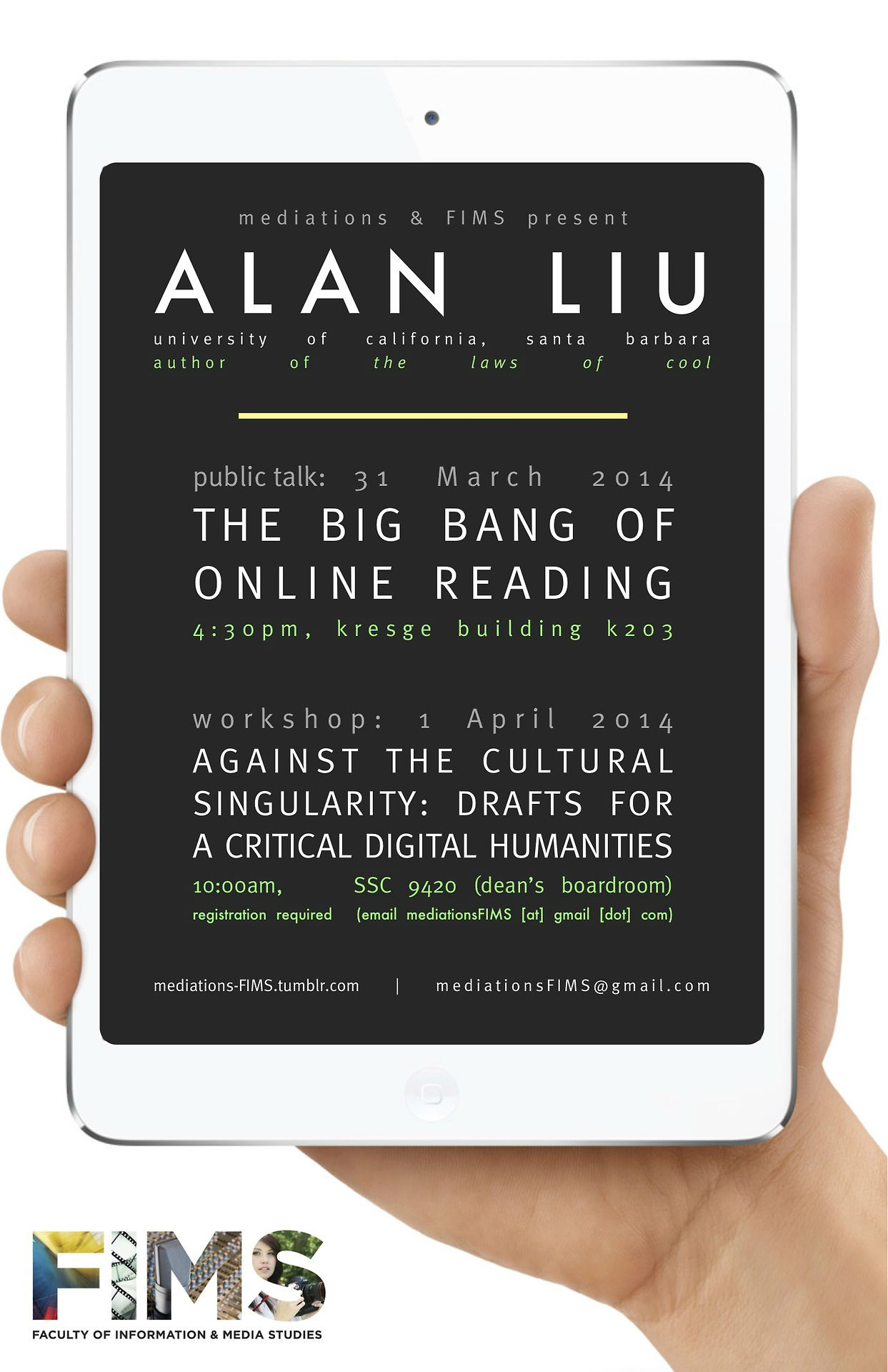
“Against the Cultural Singularity: Drafts For a Critical Digital Humanities — A Workshop.” mediations speaker series, Faculty of Information and Media Studies, University of Western Ontario, 1 April 2014.


“The Big Bang of Online Reading.” mediations speaker series, Faculty of Information and Media Studies, University of Western Ontario, 31 March 2014.


“A story and statement about the importance of the humanities in today’s world by Alan Liu, an English professor who started out a chemistry major. Video created in connection with the DHMakerBus and 4Humanities “The Humanities Bus Tour” project, 2014.”


“Digital Humanities: An Introduction.” Panel on IT Research Methods, Center for Information Technology and Society, University of California, Santa Barbara, 11 March 2014.

/ excerpt » /

5 March 2014

Helen Tartar

My friend and first editor, Helen Tarter — Editorial Director of Fordham University Press and formerly editor at Stanford University Press — died in a car accident on March 4th, 2014. (Fordham UP announcement) Helen was a formative influence on my writing and career who took a gamble on my sprawling first book Wordsworth: The Sense of History (Stanford UP, 1989) and nurtured it into print. I will always remember her support, the discipline she inspired rather than required, and the fluid, sparkling stream of her conversation (carried out in a voice so soft that I hear it in my mind whenever I reread Wordsworth’s “Nutting” and come to the line on “the murmur, and the murmuring sound”).

The following is excerpted from the beginning of the Acknowledgments in my second book (my first book “after Helen”):

/ excerpt » /

“Learning and Using Enough Digital Humanities to be Viable for Jobs With a DH or New Media Component: A Guide for Non-Specialists.” University of California, Santa Barbara. 19 February 2014.

/ excerpt » /

The Heart of the Matter: A Workshop Discussion.” 4Humanities@NY6 Public forum on “Defining and Framing the Humanities Today.” Union College, NY. 10 February 2014.

  • Workshop agenda (with links to The Heart of the Matter report, a version of the report annotated by Alan Liu, and other materials.


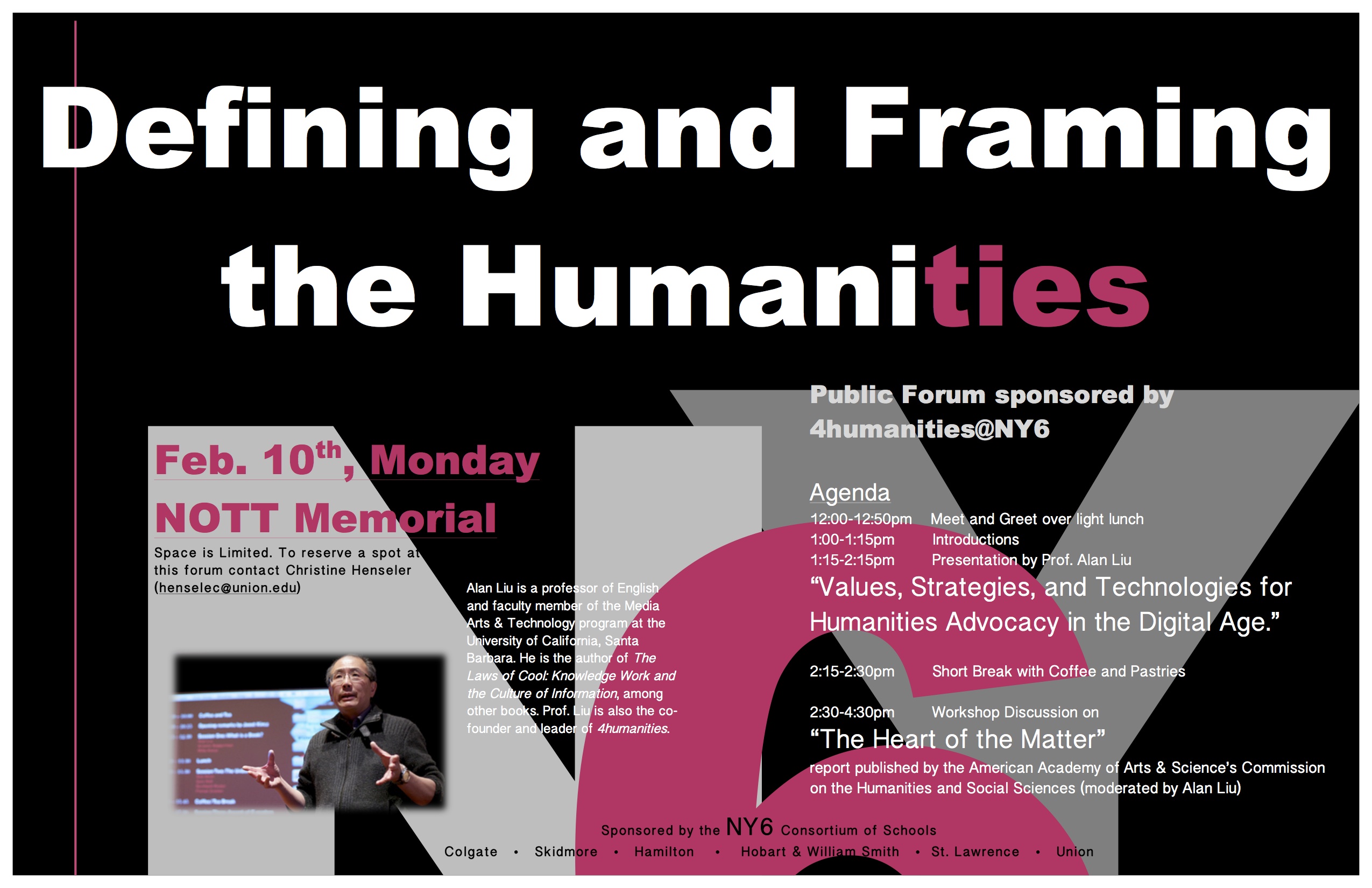
Event Poster“Values, Strategies, and Technologies for Humanities Advocacy in the Digital Age.” 4Humanities@NY6 Public forum on “Defining and Framing the Humanities Today.” Union College, NY. 10 February 2014.


[Go to Course Site] In recent years, digital methods of text analysis, data mining, mapping, visualization, social network analysis, and media studies have set up a collision between two broad approaches to the study of literature. One is “close reading” as it emerged in the 20th century from such methods as the American New Criticism and Russian Formalism. The other is “distant reading” as it is now emerging in the 21st century through “digital humanities” methods. This course immerses students in the ideas and practices of the original New Critics, the theory and practices of the digital humanities, and the broader debate in literary studies today about the nature of interpretive reading (including “surface reading” and “slow reading”). Our aim is bring to view and discuss the underlying literary, aesthetic, philosophical, and social issues at stake in the debate between close reading and distant reading.
          Students are asked to do some small-scale, hands-on digital practicums; but no advanced digital-technology experience is required…. [more]

[Go to Course Site] An introduction to modern literary theory focusing on important intellectual movements from the early 20th century to the present. Readings in American New Criticism, Russian Formalism, structuralism, deconstruction, poststructuralist feminist theory, cultural criticism, and digital humanities…. [more]

“Mickey Mouse Creativity: New Media Arts After the Ideology of Creativity.” Data Drive Research Programme, University of Amsterdam. 15 November 2013.


“Advocating for the Humanities Today: 4Humanities.org and 4Humanities@UCLA.” UCLA. 24 October 2013.

Abstract: 4Humanities is an initiative that advocates for the humanities by drawing on the technologies, new-media expertise, and ideas of the international digital humanities community and also on research and projects from local chapters at various universities. Alan Liu will give an overview of the initiative’s goals and projects and then participate with UCLA faculty, staff, and students in planning for a possible 4Humanities@UCLA local group. What research activities and project-building could a group that taps into UCLA’s pool of talent and expertise engage in? How might a UCLA local group collaborate with other 4Humanities local research groups—e.g., the ones at UC Santa Barbara and CSU Northridge?


“This is Not a Book: Long Forms of Attention in the Digital Age.” Print Culture Speaker Series, Simon Fraser University. 18 October 2013.


“Remembering Networks: Agrippa, RoSE, and Network Archaeology.” Print Culture Speaker Series, Simon Fraser University. 18 October 2013.


[Go to course site] Digital technologies and methods have recently become important in the humanities as scholars use the new tools not only to help read and write about literary, historical, and artistic materials in traditional ways but in new ways influenced–not just communicated by–the new media forms. Literature+ is a course that draws on the new fields of “digital humanities” and “new media studies” to ask students to think about, and experiment with, how new digital methods enhance the study of literature.

Students choose a literary work and use digital methods to model, map, visualize, text-analyze, social-network-analyze, blog, or otherwise interpret it using new tools and media. How can such methods augment or change our understanding of literature by comparison with other methods of literary interpretation? What is the relation, for example, between “close reading” of literary texts and “distant reading” methods that identify trends in language or themes across thousands of texts?

The course begins with discussion of selected readings and demos of digital tools to set the stage. Readings include: Franco Moretti’s Graphs, Maps, Trees, Ryan Heuser and Long Le-Khac’s “A Quantitative Literary History of 2,958 Nineteenth-Century British Novels,” Lisa Samuels and Jerome McGann’s “Deformance and Interpretation,” and Stephen Ramsay’s “Toward an Algorithmic Criticism.” Demos include online or downloadable tools from a Digital Humanities Resources for Student Project-Building site made available to the class (most can be used by non-programmers to create interesting projects).

After the initial unit of the course, students break into teams, choose a literary work, and collaborate in workshop/lab mode to produce a proof-of-concept digital project. Collaboration will occur both face-to-face and virtually in the class wiki. Individual students also create an annotated bibliography, research reports, and a final essay reflecting on their project.

This course counts for the English Department’s Literature and Culture specialization and also welcomes students from the College of Creative Studies and other majors.

Citation: Scott Pound and Alan Liu, “The Amoderns: Reengaging the Humanities — A Feature Interview with Alan Liu.” aModern, 2 (2013). https://amodern.net/article/the-amoderns-reengaging-the-humanities/


Citation: “‘Why I’m In It’ x 2 — Antiphonal Response to Stephan Ramsay on Digital Humanities and Cultural Criticism.” Alan Liu, 13 September 2013. https://liu.english.ucsb.edu/why-im-in-it-x-2-antiphonal-response-to-stephan-ramsay-on-digital-humanities-and-cultural-criticism/

Excerpt

i. Prelude

On January 7, 2011, Stephen Ramsay and I both participated in the memorable panel at the Modern Language Association convention in Los Angeles entitled “The History and Future of the Digital Humanities.” We both launched on that day controversial theses about the digital humanities by asking leading questions. Steve asked, “Do you have to know how to code [build, make]?”, and I asked, “Where is cultural criticism in the digital humanities?”

Now, two and a half years on, we have (virtually) converged again at the intersection between questions about the nature of the digital humanities field and questions about its relation to cultural criticism.  . . .


“Mickey Mouse Creativity: New Media Arts After the Ideology of Creativity.” University of Sydney. 30 July 2013.


“This is Not a Book: Long Forms of Attention in the Digital Age.” Humanities Research Centre Seminar Series, Australian National University. 23 July 2013.


“‘Literature+ ‘: A Project-Based Digital Pedagogy Model.” School of Cultural Inquiry seminar series, Australian National University. 22 July 2013.

Abstract: In this seminar, Alan Liu will discuss the paradigm of the “Literature+” courses he has evolved at both the undergraduate and graduate levels. Designed to introduce students to the use of digital methods in humanities scholarship, the courses provide a rapid orientation in key topics of the “digital humanities” before then focusing on team-based project building. Liu will use the example of the course structure and of some of the student projects that have been produced to discuss larger issues of digital humanities pedagogy—including the way such pedagogy can position the humanities as both similar to and different from the “building” versus “interpreting,” collaboration, and other trends of contemporary “knowledge work” societies.

“Humanities Centers and the Digital Humanities.” Panel on The Digital Humanities and Virtual Research Environments. Australasian Consortium of Humanities Research Centres 2013 Annual Meeting. University of Western Australia, 8 July 2013.


“Values, Strategies, and Technologies for Humanities Advocacy in the Digital Age.” Australasian Consortium of Humanities Research Centres 2013 Annual Meeting. University of Western Australia, 8 July 2013.


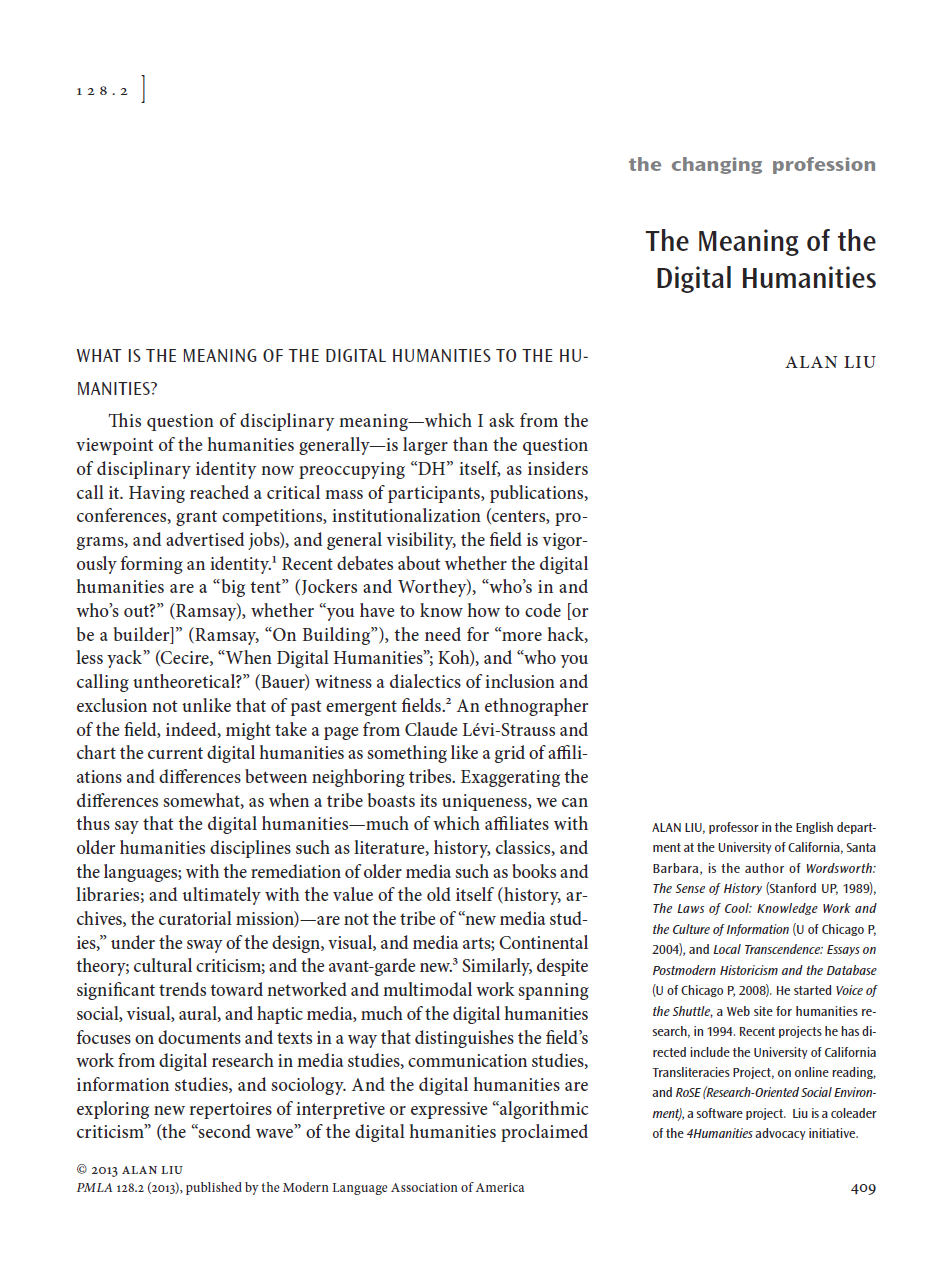
"The Meaning of the Digital Humanities"

First page

Citation: “The Meaning of the Digital Humanities.” PMLA 128 (2013): 409-23.


/ excerpt » /

N. Katherine Hayles, “Interview with Alan Liu.” Online addendum to Hayles, How We Think for How We Think: Digital Media and Contemporary Technogenesis (Chicago: University of Chicago Press, 2012). Interview posted May 2013.


Citation: “The Digital Humanities and Identity Issues.” Alan Liu, 11 May 2013. https://liu.english.ucsb.edu/the-digital-humanities-and-identity-issues/

Excerpt

I think that the distinctive identity issue to address in considering “the intermingling of race, class, gender, sexuality and disability and the digital humanities” is the political economy of digital-human identity today. Such identity consists in a relational set of overlaps and differences between at least two [groups] of the digital human: those who stand in the position of producers or managers of the technologies and media that shape life in the information age, and those whose “power of identity” (to use Manuel Castells’s term from his trilogy about network society) is shaped by or against those technologies and media without having direct access to producing or managing them.  . . .


“The Meaning of Digital Humanities.” Stony Brook University, SUNY. 6 May 2013.


“4Humanities — Planning Next Generation Digital Humanities Tools for Public Engagement.” Digital Humanities Initiative, New York University. 2 May 2013.


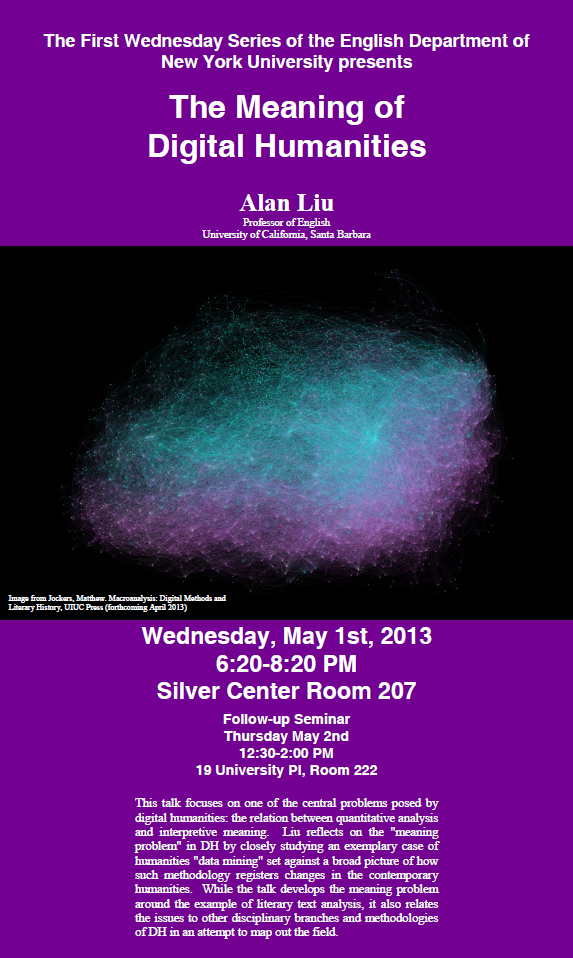
Publicity poster“The Meaning of the Digital Humanities.” Goldstone Lecture. New York University. 1 May 2013.

  • Video Video of talk (1 hr. 47 min.) [Talk presents a fuller version of the paper subsequently published in PMLA.]


“4Humanities: Values, Strategies, Technologies for Humanities Advocacy in the Digital Age.” University of Virginia. 17 April 2013.

Co-presented with Rama Hoetzlein. “History of Thought as a Networked Community: The RoSE Prototype.” University of Virginia. 16 April 2013.

  • Abstract: What if bibliographies of past authors and works could be modeled as a dynamic, evolving society linked to today’s scholars and students? What if scholars and students could add data about biographical, historical, and intellectual relationships to the bibliographical entries, thus using present-day crowdsourcing to make more socially meaningful the crowds of history? And what if visualizations could help us actively “storyboard” intellectual movements and not just spectate them? Alan Liu and Rama Hoetzlein present the conceptual framework and some of the discoveries and challenges of the RoSE Research-oriented Social Environment (in beta at the conclusion of a NEH Digital Humanities Start-up grant).
  • Sound file Podcast of talk. (1 hr, 7 min.)


Co-presented with Rama Hoetzlein. “The RoSE Prototype.” SNAC Advisory Board Meeting, University of Virginia. 16 April 2013.


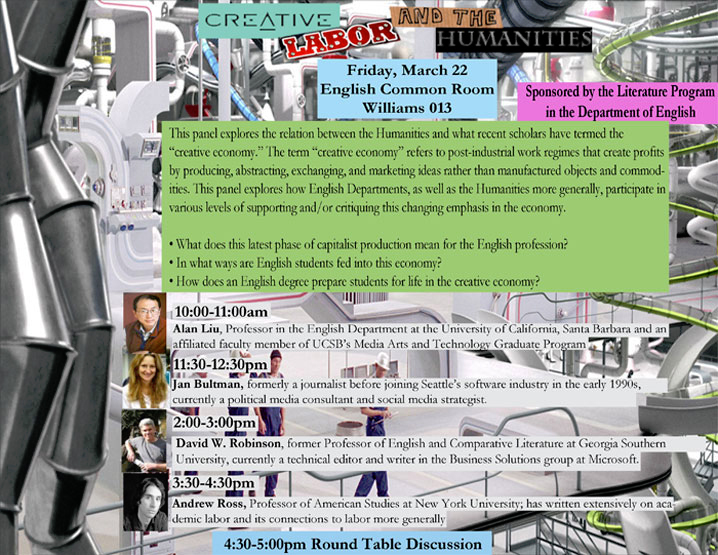
Publicity poster “Micky Mouse Creativity: New Media Arts after the Ideology of Creativity.” Conference on “Creative Labor and the Humanities,” Florida State University, Tallahassee. 22 March 2013.


Citation: “Is Digital Humanities a Field? — An Answer From the Point of View of Language.” Alan Liu, 6 March 2013. https://liu.english.ucsb.edu/is-digital-humanities-a-field-an-answer-from-the-point-of-view-of-language/

Excerpt

Over the past few years, I have wrestled with a low-level set of usage and style problems when publishing essays related to digital-humanities issues. These may be put in the form of the two questions: is “digital humanities” singular or plural? and should we crown the phrase with the definite article (“the digital humanities”)?

Of course, these are prosaic questions. But the issues they represent have the unsettling habit of showing up in the most prominent places, such as in the title of an essay I have forthcoming in The Changing Profession section of PMLA. Where my manuscript originally read, “The Meaning of Digital Humanities,” my copy editor has revised to,”The Meaning of the Digital Humanities.” Nor is it just in prominent places that the issues appear. Usage problems of this sort are pervasive to the point that my manuscripts on [the] digital humanities tend to be sprinkled throughout with innumerable tiny problems at the low level of articles and subject-verb agreements. . . .


“The Meaning of Digital Humanities.” Oklahoma University. 25 February 2013.

« Previous PageNext Page »