“Academic Expertise and Networked Public Knowledge.” Oklahoma University. 25 February 2013.

“This is Not a Book.” Oklahoma University. 25 February 2013.

“Digital Pedagogy: Literature+.” Oklahoma University. 25 February 2013.

“Advocating the Humanities: Values and Strategies for the Digital Age.” Webinar. 11 February 2013. Webinar Series on “The Global Crisis and Promise of Higher Ed,” co-sponsored by Kean U. and 4Humanities.

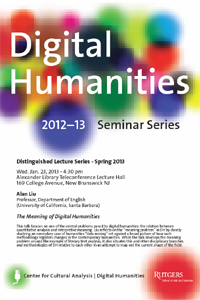
Publicity poster“The Meaning of Digital Humanities.” Rutgers University. 23-24 January 2013.


Citation: Alan Liu (lead author), Rama Hoetzlein, Rita Raley, Ivana Anjelkovic, Salman Bakht, Joshua Dickinson, Michael Hetrick, Andrew Kalaidjian, Eric Nebeker, Dana Solomon, and Lindsay Thomas. “Friending the Humanities Knowledge Base: Exploring Bibliography as Social Network in RoSE.” White Paper for the NEH Office of Digital Humanities: Rose Digital Humanities Start-up Grant (Level 2) HD-51433-11 (9/1/2011 TO 9/30/2012).

Citation: “From Reading to Social Computing.” Literary Studies in the Digital Age: An Evolving Anthology. Ed. Kenneth M. Price and Ray Siemens. MLA Commons. Modern Language Association of America. 2013. Web. <https://dlsanthology.mla.hcommons.org/from-reading-to-social-computing/>

“Close, Distant, and Unexpected Reading: Modern Literary Analysis and Digital Humanities.” University of Pennsylvania. 13 November 2012.


“3 Key Digital Humanities Trends: How Digital Humanities Register Changes in the Humanities Today.” Digital Humanities Forum Workshop. University of Pennsylvania. 12 November 2012.


“This is Not a Book: Transliteracies and Long Forms of Digital Attention.” Translittératies Conference, École normale supérieure de Cachan, Paris. 7 November 2012.

  • Abstract: This talk argues that in the digital age, the “book”–whether physical, digital, or in some other media—is only a metaphor for “long forms of shared attention.” The book dissolves into, but also persists in, slowly-changing networks of discourse that are “transliteracies” because they span across media, across networks, and across time. The talk concludes with examples of recent digital projects—including the RoSE (Research-oriented Social Environment) at University of California, Santa Barbara–that attempt to represent such long forms of shared digital attention.
  • Slides from talk
  • Video Video of Alan’s talk
  • Video Videos of other keynote talks


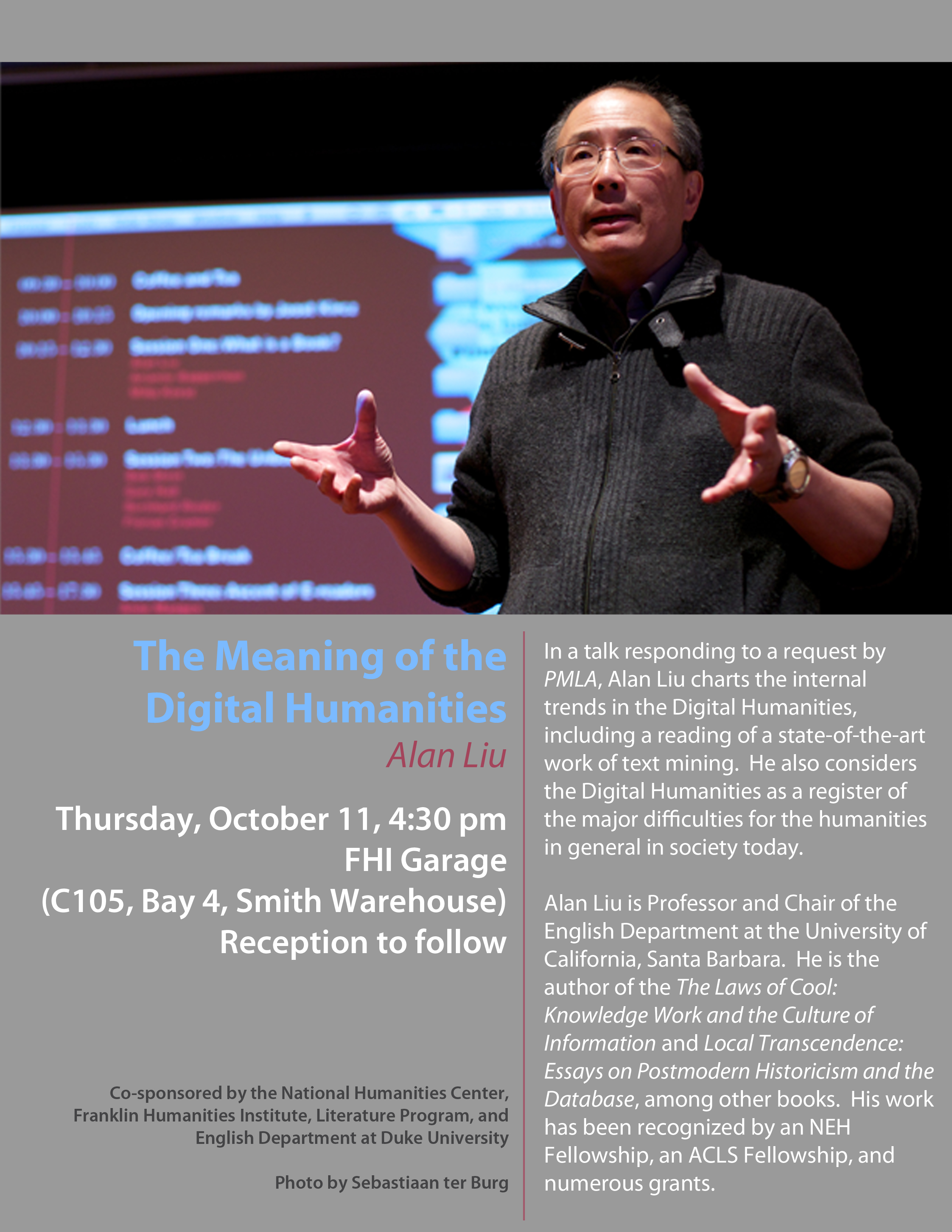
Alan Liu“The Meaning of the Digital Humanities.” Duke University. 11 October 2012.


“Creating a Humanities Advocacy Media Plan in the Digital Age.” Meeting of the Faculty Steering Committee for the Carolina Digital Humanities Initiative. University of North Carolina. 9 October 2012.


“3 key Digital Humanities Trends: How Digital Humanities Registers Changes in the Humanities Today.” National Humanities Center. 5 October 2012.

Presentation Materials:


“When Was Linearity? — Linear Thought, Graphics, and Freedom in the Age of Knowledge Work.” North Carolina State University. 3 October 2012.


“Digital Humanities, Pedagogy, and Tomorrow’s Humanities — An Informal Presentation.” North Carolina State University, 3 October 2012.

Seed materials for Discussion:


Citation: Alan Liu and William G. Thomas III, “Humanities in the Digital Age.” Inside Higher Ed — Views, 1 October 2012. http://www.insidehighered.com/views/2012/10/01/essay-opportunities-humanities-programs-digital-era/

Excerpt

Good strategy requires picking some point on the line to apply leverage. The leverage point in the policies now shaping the future university is the digital, and we feel that it is crucial that the humanities try for well-conceived, humanities-friendly models of digital work that are institutionally cohesive enough to influence policy.


“The Meaning of the Digital Humanities — A Paper in Progress.” King’s College, London. 19 September 2012.


“Creating a Humanities Advocacy Media Plan” Show the Arts and Humanities Matter conference, University College London. 18 September 2012.

This was written for the 4Humanities.org “Humanities, Plain & Simple” initiative.

Citation: “The Humanities and Tomorrow’s Discoveries.” 4Humanities, 25 July 2012. http://4humanities.org/2012/07/alan-liu-the-humanities-and-tomorrows-discoveries/

Excerpt

I think that the distinctive identity issue to address in Today, we use words like invention, innovation, and breakthrough to describe the most hopeful visions for the future of humanity. We pin our hopes on technological and other breakthroughs that might switch on whole new levels of economic, social, and personal well-being—or, just as important, help ward off threats to well-being. We even have a name for the greatest human challenges whose breakthrough solutions—not yet in sight—will require sustained innovation by large numbers of researchers across many fields. We call these “grand challenges.” As identified by the U.S. President’s Office, the Grand Challenges in Global Health initiative, the Bill and Melinda Gates Foundation, the U.S. National Academy of Engineering, and other public and private agencies, the grand challenges for the 21st century will be global in scale and require collaborative, interdisciplinary solutions on multiple fronts: scientific, engineering, biomedical, agricultural, social, economic, cultural, ethical, and educational. World energy, world climate, world hunger and thirst, world disease, world security. These are some of the grand challenges of the 21st century.

Yet not one of the words invention, innovation, and breakthrough are as powerful as the word that encompasses them all and gives them their full human meaning. That word is discovery, for which a society’s preparedness in the humanities is as vital as in any other field. Discovery is what happens when an invention, innovation, or breakthrough occurs in a fully human horizon of understanding that radically multiplies its value, discovering connections to whole worlds of human meaning and possibility.  . . .


Collage

Literature+

New Media & Literary Interpretation:
Close, Distant, and Other Reading


Graduate Course – Winter 2012

Instructor: Alan Liu

UC Santa Barbara

Thur 2:00 – 4:30 pm, South Hall 2509


Digital methods shared with other disciplines have recently introduced new methods of literary “reading” that destabilize older methods and extend the interdisciplinary experiments of previous decades. This course uses the theoretical and practical tools of the digital humanities and new media studies to study the relaton between “close reading” and such methods as “distant reading,” “cultural analytics,” and “social reading” (with their component methods of text analysis, social network analysis, visualization, mapping, etc.).

The course is designed to be a hybrid discussion seminar and project-building workshop. We begin with discussion of selected theoretical readings and digital methods. Then students break into teams, choose a literary work, and collaborate in workshop/lab mode to produce a final project that uses digital methods to complement established modes of literary interpretation with some other kind of “reading.”  (Alternatively, students may work individually on projects designed to support or complement their dissertation topics.)  Students, for example, can choose a story or poem to data-mine, text-analyze, model, simulate, map, visualize, sonify, encode, remix, blog, social-network, or redesign as a database, game, app, database, hypertext, mobile or locative installation, or virtual world.  Individual students also undertake the following tasks: discover new online tools, prepare an annotated bibliography, write a brief research report, and write a final essay reflecting on the project. (Auditors participate in team projects and the minor assignments.)


“This is Not a Book: Long Forms of Shared Attention in the Digital Age.” INKE Conference on Research Foundations for Understanding Books and Reading in the Digital Age: E/Merging Reading, Writing, and Research Practices, Havana. 12 December 2012.


“This is Not a Book: Long Forms of Shared Attention in the Digital Age.” Humanities Center, DePaul University. 11 April 2013.


“Close, Distant, and Unexpected Reading: The Modern Paradigm of Literary Analysis.” Ropes Lecture Series, University of Cincinnati. 10 May 2012.


“Transliteracies: The Big Bang of Online Reading.” Walter J. Ong Memorial Lecture, Saint Loius University. 23 April 2012.


Network Archaeology conference“Remembering Networks: Agrippa, RoSE, and Network Archaeology.” Network Archaeology conference, Miami University, Ohio. 21 April 2012.


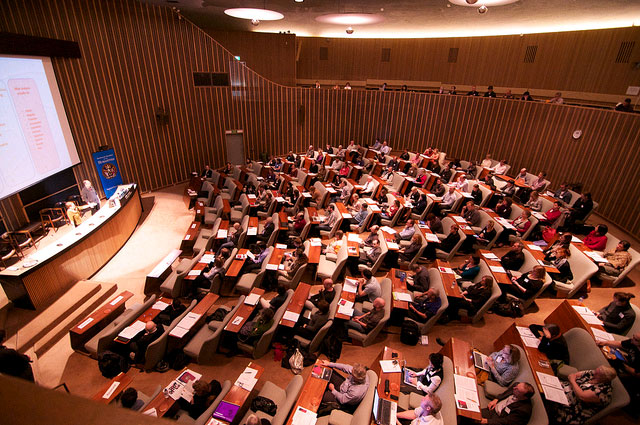
Liu Keynote Talk“Close, Distant, and Unexpected Reading: The Modern Paradigm of Literary Analysis.” Digital Humanities Australasia 2012 (inaugural conference of Australasian Association for Digital Humanities), Australian National University, Canberra. 28 March 2012.

VideoVideos of Keynote Presentations

    (3 hrs. 46 mins.)

    1. Julia Flanders, “Rethinking Collections” (0:0:0 to 0:47:00 | Q&A 0:47:01 to 1:14:39)
    2. Alan Liu, “Close, Distant, and Unexpected Reading” (1:14:40 to 2:12:00 | Q&A 2:12:01 to 2:29:35)
    3. Peter Robinson, Harold Short, John Unsworth – Panel on “Big Digital Humanities” (2:29:36 to 3:29:10 | Q&A 3:29:11 to 3:46:02)
  • Conference Program
  • Conference Photos


“Remembering Networks: Agrippa, RoSE, and Network Archaeology.” University of Western Australia, Perth. 23 March 2012.


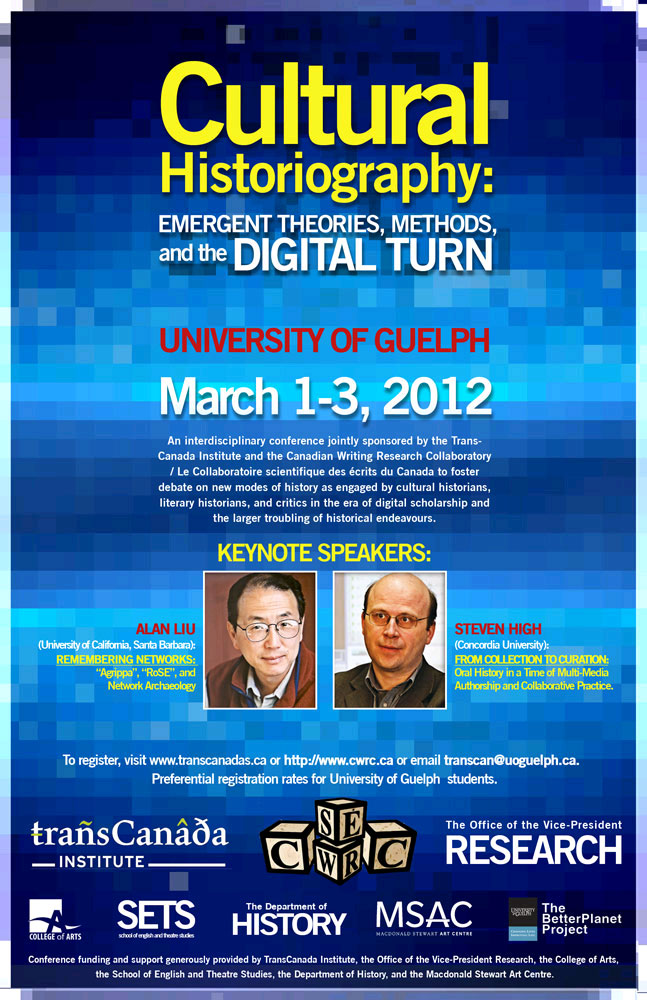
cultural Historiography Conference Poster“Remembering Networks: Agrippa, RoSE, and Network Archaeology.” Cultural Historiography conference, University of Guelph. 1 March 2012.


“UCSB English Professor Receives NEH Grant for Humanities Bibliographical Social Network” (press release on RoSE). 11 January 2012. UCSB Office of Public Affairs Press.


Citation: “Where is Cultural Criticism in the Digital Humanities?” Ed. Matthew K. Gold. Debates in the Digital Humanities. Minneapolis: University of Minnesota Press, 2012: 490-509.


Citation: “Translitteraties: le big bang de la lecture en ligne.” Trans. Françoise Bouillot. E-Dossiers de l’audiovisuel, January 2012. INA Expert (Inathèque of France). Web.

  • Full text (open access published version in institutional repository, PDF)
  • Full text (open access publisher’s version, HTML)


Citation: “The State of the Digital Humanities: A Report and a Critique.” Arts and Humanities in Higher Education, 11.1-2 (2012): 8-41. DOI: 10.1177/1474022211427364.

  • Open access (author’s pre-publication final version in institutional repository, viewable online and downloadable as PDF)
  • Paywalled (published version, PDF)


Citation: “Friending the Past: The Sense of History and Social Computing.” New Literary History, 42.1 (2011): 1-30. DOI: 10.1353/nlh.2011.0004

  • Open access (published article in institutional repository, viewable online and downloadable as PDF)
  • Paywalled (published version, PDF)
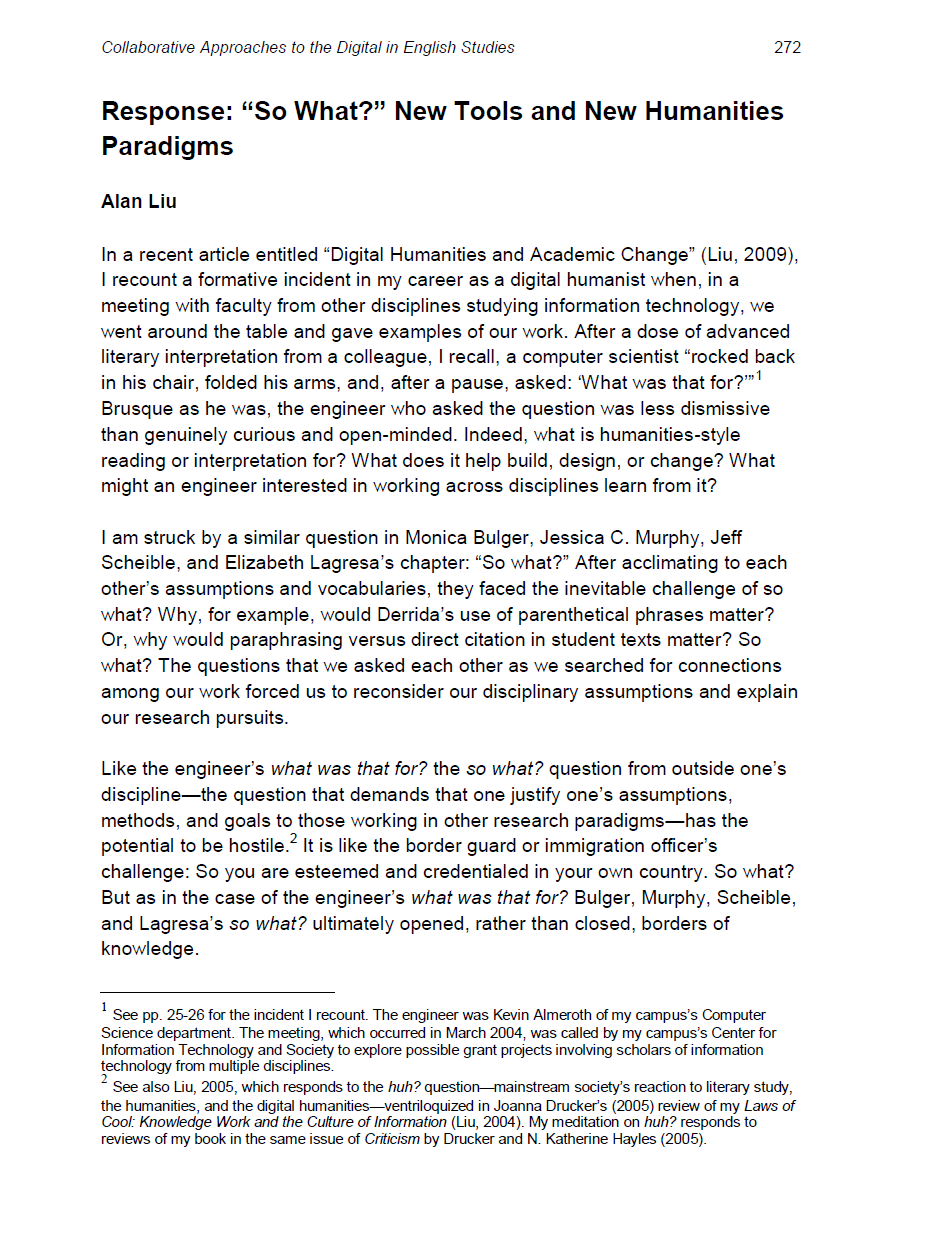
"So What?: New Tools and New Humanities Paradigms"

First page

Citation: “‘So What?’: New Tools and New Humanities Paradigms.” Response to Monica Bulger, Jessica Murphy, Jeff Scheible, and Elizabeth Lagresa, “Interdisciplinary Knowledge Work: Digital Textual Analysis Tools and Their Collaboration Affordances.” Collaborative Approaches to the Digital in English Studies. Ed. Laura McGrath. Logan, UT: Computers and Composition Digital Press / Utah State University Press, 2011. 272-75. (Available online.)


“Remembering Networks: Agrippa, RoSE, and Network Archaeology.” 1991@2011: Media in Motion Conference, Department of Media Studies, University of Amsterdam. 21 October 2011.


“Remembering Networks: Agrippa, RoSE, and Network Archaeology.” Digital Arts and Humanities Lecture Series, Brown University. 3 October 2011.


“RoSE (Research-oriented Social Environment).” Compatible Data Initiative meeting, New York City. 24 September 2011. (Talk presented via Skype.)


“Where Is Cultural Criticism in the Digital Humanities?” (50-minute version). University of Nottingham. 5 July 2011.


“Where Is Cultural Criticism in the Digital Humanities?” (30-minute version). Digital Literacies panel. The Future University conference. Centre for Research in the Arts, Social Sciences, and Humanities (CRASSH), Cambridge University. 2 July 2011.


“4Humanities: The Digital Humanities Community & Humanities Advocacy.” Luncheon address at centerNet General Business Meeting, Digital Humanities 2011 conference, Stanford, 22 June 2011.

« Previous PageNext Page »